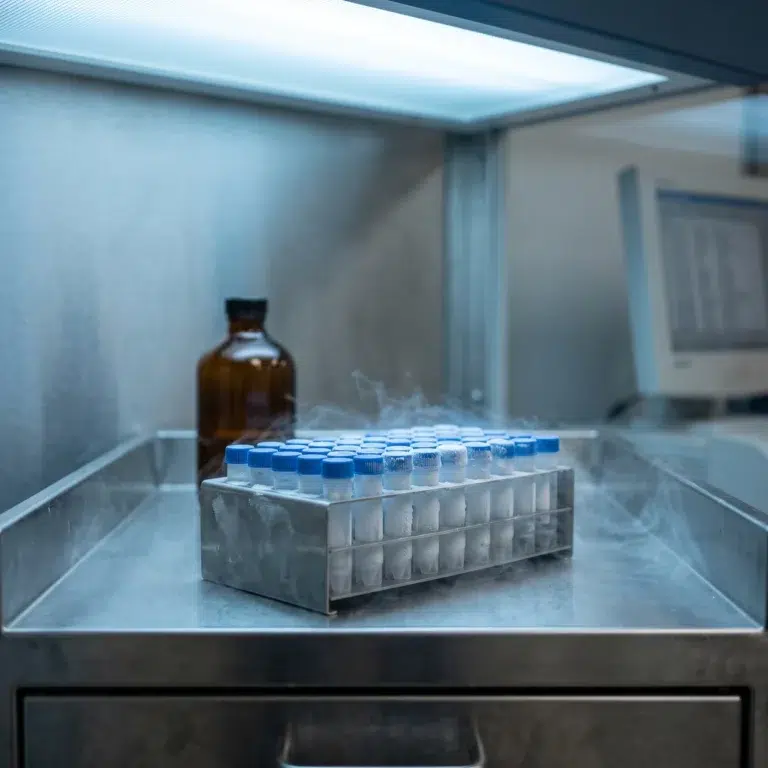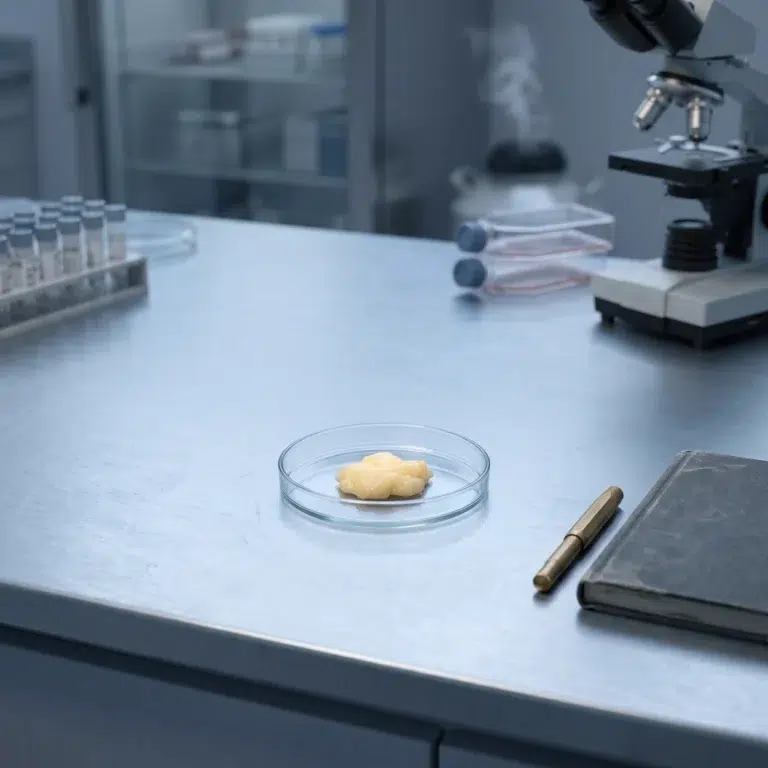
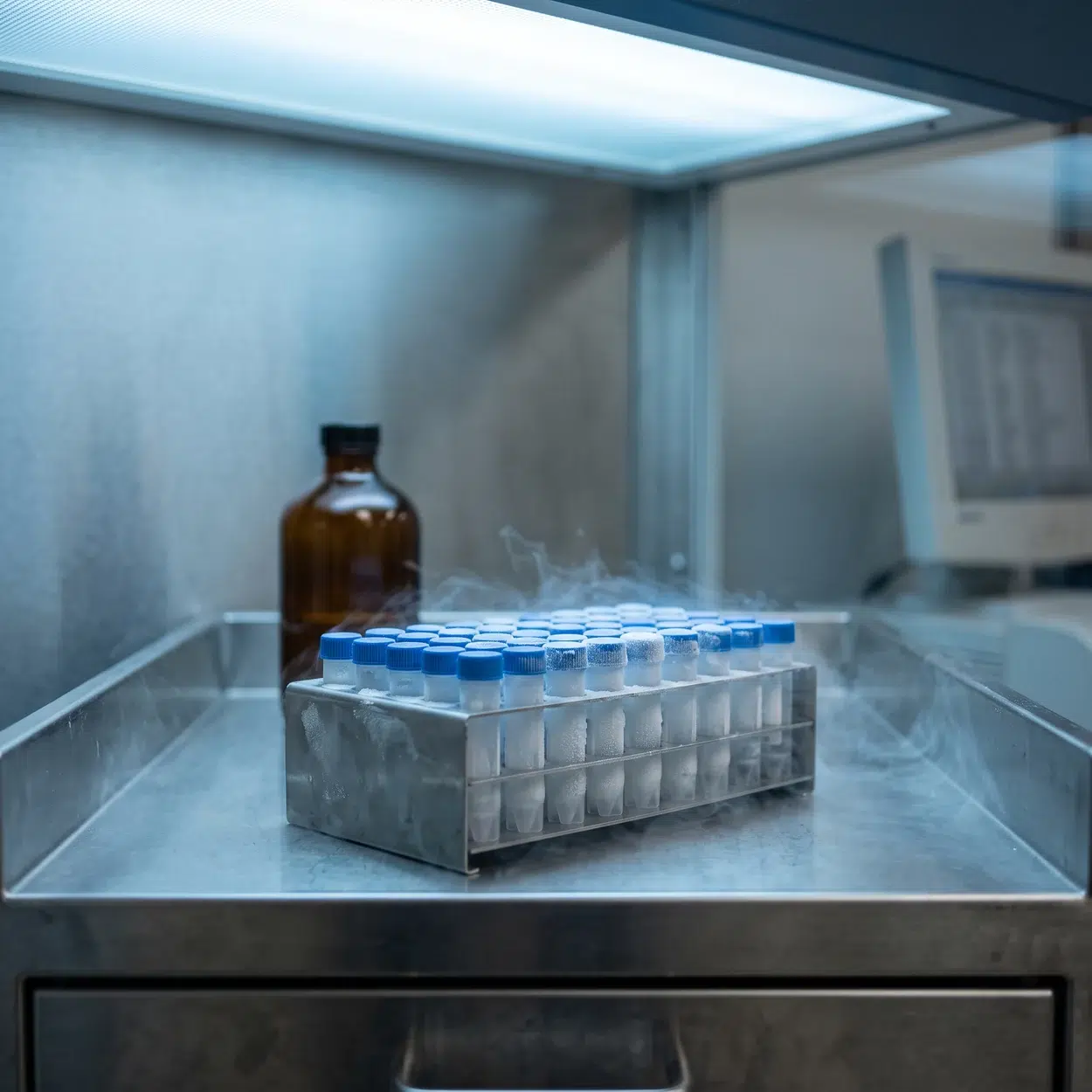
For decades, most cells frozen for later use have been protected by a chemical called dimethyl sulfoxide, or DMSO. Papers from 2024 to 2026 now test DMSO-free cryopreservation, using sugars, glycerol, amino acids, and polymers in its place. This guide explains what DMSO does, why researchers want alternatives, what the studies show, and what to ask a tissue bank.
TLDR DMSO is the most commonly used cryoprotectant, typically at 5 to 10 percent. Recent laboratory studies show DMSO-free solutions can preserve cultured cells and whole fat with results close to DMSO, but none reports a patient outcome, and some authors have ties to the companies making the reagents. Banking adipose tissue does not guarantee any future use. Ask a bank which cryoprotectant it uses and how it validated the process.
Important Disclaimer: Save My Fat does not provide FDA-approved treatments or cures for any disease. Banking adipose tissue today does not guarantee eligibility, access, or clinical benefit from any future therapy, clinical trial, or medical program. No cryopreservation method, with or without DMSO, has been shown to make banked adipose tissue useful for any condition. All content is for educational purposes only and does not constitute medical advice. Patients must consult their own licensed healthcare professionals regarding all medical decisions.
If you have banked adipose tissue, your fat will sit in a freezer for years, and something has to protect the cells from ice while they are there. In most laboratories that something is DMSO. It also has a reputation, earned in a very different clinical setting, for causing reactions when it reaches a patient’s bloodstream.
That reputation is why researchers now test freezing solutions that leave DMSO out. Plain definitions of the science are what readers most often come to this site looking for, so this guide starts with the basics.
What DMSO Does in Cryopreservation
DMSO is a small molecule that enters cells and limits the ice damage that would otherwise kill them during freezing. A 2014 review describes it as the most commonly used cryoprotective agent, typically at 5 to 10 percent (Shu 2014). That review covers hematopoietic grafts, the blood forming cells used in transplants, not adipose tissue.
Penetrating agents such as DMSO and glycerol pass through the cell membrane, while sugars stay outside the cell. A 2026 review lists the traditional protocol as 5 to 10 percent DMSO with fetal bovine serum (Wang 2026). Our earlier guide explains how cryopreservation works .
Why Researchers Want Alternatives to DMSO
Researchers want alternatives because DMSO that is not washed out travels into the patient with the cells, and in hematopoietic transplant it has been linked to infusion reactions. That review reports that infusing cryopreserved cell products has been associated with adverse reactions “ranging from relatively mild symptoms to much more serious, life-threatening complications” (the same review). Its table of transplant studies lists incidences from 8 percent to 67.36 percent.
Every figure comes from intravenous infusion of blood forming grafts into transplant patients, a different product, route, and population from stored fat. The data also do not blame DMSO alone. A 2018 surveillance of 1125 hematopoietic stem cell transplants in Japan found grade 2 or higher adverse events most frequent in bone marrow transplants with no DMSO, at 37.7 percent, versus 20.9 percent for peripheral blood and 19.3 percent for cord blood (Ikeda 2018). The authors concluded that factors unrelated to DMSO contribute.
The Wang review states that penetrating cryoprotectants, “most notably DMSO,” raise concerns about infusion-related toxicity, and that clinical data for DMSO-free formulations are still limited (2026 narrative review). Nobody has shown that DMSO is unsafe for stored adipose tissue, and nobody has shown that DMSO-free cryopreservation is safer.
What DMSO-Free Cryopreservation Studies Found in 2024 and 2026
The recent studies found that DMSO-free solutions can keep cultured cells and whole fat alive through freezing at rates close to DMSO. None measured what happens in a patient. The table below summarizes the six most relevant papers, three of which used adipose cells or whole fat.
| Study | Year | Cells or tissue | Comparison | Main finding |
|---|---|---|---|---|
| Mamo (PACT and BEST), seven centers | 2024 | Cultured MSCs from bone marrow or adipose | Sucrose, glycerol and isoleucine (SGI) versus 5 to 10% DMSO | Viability fell 4.5% with DMSO and 11.4% with SGI from 94.3%; recovery 92.9% with SGI, 5.6% lower with DMSO; comparable markers and gene expression |
| Lam | 2026 | Human bone marrow MSCs, in vitro | XT-Thrive (DMSO-free) versus CryoStor CS10 (DMSO) | Above 90% of pre-freeze viability after a 24 hour room temperature hold versus about a 40% drop with CS10; post-thaw viability above 85% versus 60% to 70% |
| Wang, narrative review | 2026 | MSCs generally | Sugars, glycerol, amino acids, polymers, hydrogels | Clinical safety and efficacy data for DMSO-free formulations remain limited |
| Dovgan | 2017 | Human adipose-derived stem cells, in vitro | Trehalose by electroporation versus 10% DMSO | 83.8% post-thaw recovery versus about 91.5% with DMSO; growth and differentiation retained |
| Zhang | 2022 | Human liposuction fat, one month, in vitro plus nude mouse | Glycerol, trehalose, or DMSO plus serum | 70% glycerol matched fresh tissue on enzyme activity, 52.37% retention in mice, lower inflammation than DMSO or trehalose |
| Bonomi, systematic review of 59 studies | 2026 | Whole fat | All protocols to November 2024 | Most common: minus 80 degrees Celsius with a cryoprotectant, slow cooling, fast warming; results conflicting; ideal protocol “remains to be established” |
The DMSO-free solutions hold their own on viability and recovery in the laboratory, but every result comes from a dish or a mouse. Mamo carries the most weight because it ran the same comparison in seven centers (Mamo 2024), yet post-thaw function was not tested and one author founded a company commercializing SGI. Lam used only bone marrow cells, and three authors were employed by the reagent’s maker (Lam 2026).
The adipose specific work is smaller: cultured adipose cells with trehalose (Dovgan 2017), whole liposuction fat in mice (Zhang 2022), and a systematic review that concluded the ideal protocol for autologous fat “remains to be established” (Bonomi 2026). Our guide to cryopreservation viability explains these measures.
What None of This Research Shows
None of these studies shows that a DMSO-free method produces a better result in a person, or that any freezing method makes banked adipose tissue useful for any condition. Mamo and Lam used bone marrow cells for some or all of their work, and bone marrow findings cannot be presented as adipose evidence.
No paper here reports a clinical outcome from any cryopreserved adipose product. This research is preliminary and early stage, no reagent is FDA approved as a way to make banked fat useful, and anyone weighing these findings should discuss them with a licensed provider. No source states which cryoprotectant any particular bank uses, so this article says nothing about how any bank freezes tissue. Our overview of cryopreservation safety covers the freezer itself.
What a Patient Can Ask a Bank About Cryopreservation
A patient can ask four things: which cryoprotectant the bank uses and at what concentration, how the freezing process was validated, what checks are run after thawing, and how storage temperatures are recorded. Part 1271 addresses communicable disease, not whether stored tissue will ever be useful. If the answer to the first question is a brand name, ask what is in it.
On validation, 21 CFR 1271.230 requires that a process that cannot be fully verified by later testing be validated and documented, and 1271.225 requires that any change be verified or validated and approved before use (21 CFR 1271.230). Ask when the freezing protocol was last validated and whether the bank has changed cryoprotectants since.
On records, under 21 CFR 1271.260 an establishment must set acceptable storage temperature limits, record storage temperatures, assign an expiration date where appropriate based on factors that include the method of preservation, and document corrective action when conditions are not met (21 CFR 1271.260). Ask what the bank measures after a thaw and how to see the temperature record for your own tissue. Our guide to the science of freezing explains those records.
Frequently Asked Questions
Is DMSO-free cryopreservation better than DMSO?
Not on current evidence. Laboratory results are close to DMSO on viability and recovery, the 2026 Wang review calls clinical data for DMSO-free formulations limited, and no published study shows that DMSO harms stored adipose tissue.
Does the freezing method change what banked tissue can be used for?
No. Any future use of banked adipose tissue depends on FDA regulatory status, physician guidance, and available approved or investigational pathways at that time, not on the cryoprotectant.
Which cryoprotectant does a given tissue bank use?
This article does not say, because no published source describes any particular bank’s method. Ask the bank directly, using the questions above.
Key Takeaways
DMSO remains the most commonly used cryoprotectant, typically at 5 to 10 percent, and its infusion reaction record comes from hematopoietic transplant, a different product and setting. Studies from 2017 to 2026 show DMSO-free solutions can come close to DMSO on laboratory viability and recovery, but none reports a patient outcome, some authors have ties to reagent makers, and the 2026 systematic review found no established ideal protocol. Banking adipose tissue does not guarantee any future use. Ask a bank which agent it uses, how it validated the process under 21 CFR 1271.230, and what it checks after thawing.
Save My Fat connects patients and providers with a U.S.-based tissue bank. It is not a tissue bank, a laboratory, a medical practice, or a treatment provider. Stem cell and regenerative medicine regulations vary by state, including specific informed-consent and disclosure requirements in Florida, Utah, California, Georgia, and Tennessee governing tissue and stem cell services. Banking adipose tissue does not connect patients to any treatment pathway, and any future use depends on FDA regulatory status, physician guidance, and the availability of approved or investigational pathways at that time.
Readers weighing adipose tissue banking for potential future use can review current pricing or ask about the freezing process through the contact page.
Save My Fat works with a U.S.-based tissue bank for laboratory processing and storage.
This article is for educational purposes only and does not constitute medical or legal advice. Please consult your own licensed healthcare provider before making any decisions about treatment or research participation.
About the author: Oscar Tellez is the founder and CEO of Save My Fat. He holds a Bachelor of Science in Exercise Science and Health Promotion from Florida Atlantic University. He has spent a decade in the regenerative medicine industry across product distribution, laboratory and vendor relationships, and provider training. He is not a licensed clinician, and this article is educational, not medical advice.
Related guide: the stem cell science glossary.