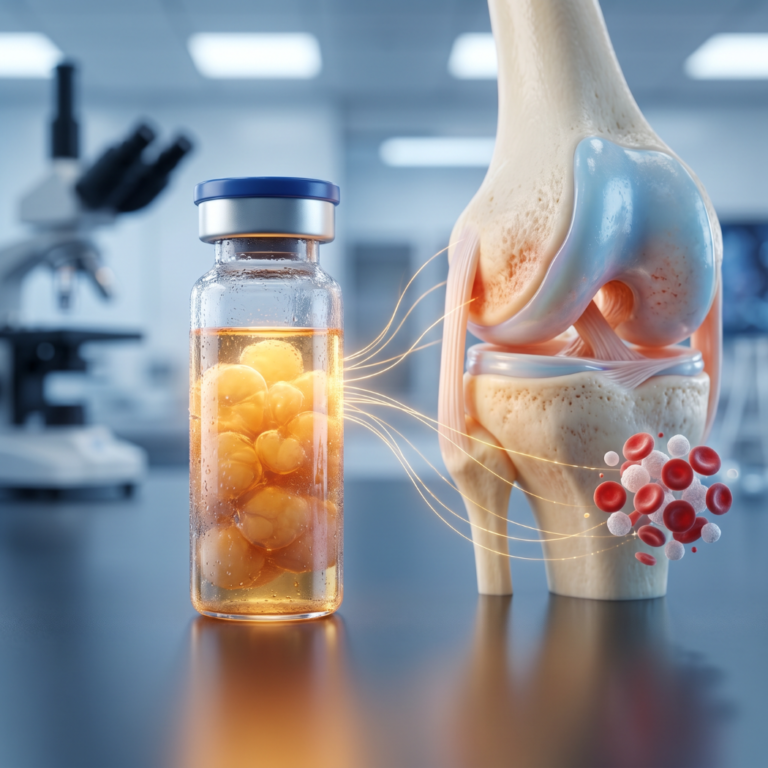

Endocrinologists and metabolic medicine specialists understand adipose tissue better than most, which makes the banking conversation in this setting both more informed and more nuanced. This guide covers what the metabolic adipose-derived research pipeline actually contains, how obesity affects cell quality and what that means for banking timing, and how patient selection works in a metabolic practice.
TLDR: Adipose tissue is an active endocrine and immune organ, a fact metabolic physicians already work with, and adipose-derived stem cells are under early study in metabolic and endocrine research. Obesity and metabolic dysfunction are associated with changes in adipose tissue and its cells, so cell quality is a legitimate consideration when discussing banking timing, though individual outcomes cannot be predicted. No adipose-derived product holds FDA approval for any metabolic condition. Banking preserves a patient’s own tissue under 21 CFR Part 1271; it is not a treatment for diabetes or metabolic disease, and it does not guarantee eligibility, access, or clinical benefit.
Important Disclaimer: Save My Fat does not provide FDA-approved treatments or cures for any disease, including diabetes or metabolic conditions. No adipose-derived stem cell product currently has FDA approval for any metabolic indication. Banking adipose tissue today does not guarantee eligibility, access, or clinical benefit from any future therapy, clinical trial, or medical program. All content is for educational purposes only and does not constitute medical advice. Patients must consult their own licensed healthcare professionals regarding all medical decisions.
For metabolic physicians, the useful framing separates what is well established about adipose biology from what remains investigational about adipose-derived cells, and keeps banking positioned as preservation. The sections below address the science, the obesity question, and the operational realities.
Adipose Tissue as an Endocrine Organ: What Metabolic Physicians Already Know
Metabolic physicians already treat adipose tissue as an active endocrine and immune organ rather than inert storage. It secretes adipokines such as leptin and adiponectin, participates in inflammatory signaling, and is central to metabolic regulation. A scientific review of adipokines in inflammation and metabolic disease describes how these secreted factors link adipose tissue to systemic metabolism and immune function.
This existing knowledge is the reason adipose-derived cells draw interest in metabolic research, and it is also the reason a metabolic physician is well placed to communicate accurately about them. The overview of adipose as an endocrine organ connects this familiar biology to where adipose-derived stem cells fit. The established endocrine role of adipose tissue does not, however, translate into any approved adipose-derived therapy.
The Metabolic ADSC Research Pipeline: Active Studies
The metabolic and endocrine adipose-derived research pipeline is early and exploratory. Interest stems from the studied influence of these cells on inflammatory and metabolic signaling, but the work consists of investigational questions rather than established therapy, and a metabolic physician should read it that way.
An honest characterization avoids overstatement. The evidence base specific to adipose-derived cells in metabolic disease is limited, and no adipose-derived product holds FDA approval for any metabolic indication. For the underlying science, the overview of metabolic and endocrine research summarizes how adipose-derived cells are being studied, and a physician can point patients there for context rather than to marketing claims. The distinction worth holding is between adipose tissue biology, which is well characterized, and adipose-derived cell therapy, which is not yet established. A metabolic physician understands the former in depth, but that understanding should not be allowed to imply that the latter is proven. Patients sometimes infer that because adipose tissue is metabolically important, adipose-derived cells must be therapeutically useful, and that inference does not hold.
How Obesity Affects ADSC Quality and What That Means for Banking Timing
This is the question metabolic physicians are best equipped to engage, and it deserves an honest answer. Research suggests that obesity and metabolic dysfunction are associated with changes in adipose tissue and the cells within it, including alterations in cellular function and the inflammatory environment. In practical terms, the metabolic state of the patient is part of the biological context of any tissue collected.
Two honest qualifications follow. First, population-level associations between obesity and adipose tissue changes do not predict what any individual patient’s banked cells will do, because individual biology and group patterns are not interchangeable. Second, banking records a patient’s tissue as it is at the time of collection, and the value of that record does not depend on any promised future use. A metabolic physician can reasonably discuss timing in light of a patient’s metabolic status while avoiding any implication that banking treats the underlying condition. This is precisely the kind of nuance a metabolic physician is positioned to convey well, because it requires distinguishing population data from individual prediction, a distinction central to metabolic practice.
Patient Selection in a Metabolic Practice
Patient selection in a metabolic practice benefits from the physician’s understanding of each patient’s metabolic status and goals. The overview of ideal banking candidates describes general considerations, which a metabolic physician can apply with the added context of a patient’s diabetes management, weight trajectory, and overall health.
The central boundary is that banking is preservation, not treatment. A patient with diabetes or metabolic syndrome who chooses to bank is making a preservation decision, not pursuing a therapy for their condition, and the conversation should make that explicit. Selection is therefore about whether banking fits a patient’s informed preferences, not about any therapeutic indication, because none exists.
Harvest Logistics for a Metabolic Medicine Practice
Many metabolic medicine practices do not perform fat harvesting, so a banking collection is typically coordinated through an appropriate procedural workflow rather than added to a routine visit. The harvest for banking is a collection step whose purpose is preservation, handled under proper conditions and documented carefully.
The provider-facing overview of the harvest procedure outlines collection, handling, and transfer. The practical requirements are arranging the collection in a suitable setting, maintaining sterile technique, and transferring the tissue to the processing and storage partner under documented chain-of-custody. The service operates under 21 CFR Part 1271, and the overview of why physicians add banking describes how the service fits a practice.
Physician Action Checklist
A condensed action list for a metabolic medicine practice:
- Communicate that adipose tissue’s endocrine role does not imply any approved adipose-derived therapy, and that no adipose-derived product is FDA-approved for metabolic conditions.
- Discuss obesity and cell quality honestly, noting that population associations do not predict individual outcomes.
- Frame banking as preservation, never as a treatment for diabetes or metabolic disease.
- Coordinate any harvest through an appropriate procedural workflow with documented chain-of-custody.
- Confirm the banking partner operates under 21 CFR Part 1271 and retain documentation of its regulatory status.
Frequently Asked Questions
Does banking adipose tissue treat diabetes or metabolic disease?
No. Banking preserves a patient’s own tissue for potential future use. It is not a treatment for diabetes or any metabolic condition, and no adipose-derived product holds FDA approval for these indications.
Does obesity affect the quality of banked cells?
Research suggests obesity and metabolic dysfunction are associated with changes in adipose tissue and its cells. However, population-level associations do not predict what any individual patient’s banked cells will do, and banking records the tissue as it is at collection.
Is there an FDA-approved adipose stem cell therapy for metabolic conditions?
No. Adipose-derived cells are under early study in metabolic and endocrine research, but no adipose-derived product is FDA-approved for any metabolic indication.
How does adipose tissue’s endocrine role relate to banking?
The endocrine role explains why adipose-derived cells draw research interest, but it does not establish any approved therapy. Banking remains a preservation service regardless of the biology, and it makes no therapeutic claim.
How is adipose tissue banking regulated?
Banked adipose tissue is handled under 21 CFR Part 1271, the federal framework governing screening, processing, and storage of human cells and tissues.
Key Takeaways
For metabolic physicians, the banking conversation pairs well-established adipose biology with an honestly preliminary cell-therapy pipeline. Adipose tissue is an active endocrine and immune organ, which is why adipose-derived cells draw research interest, but that role does not establish any approved therapy, and no adipose-derived product holds FDA approval for metabolic conditions. Obesity and metabolic dysfunction are associated with changes in adipose tissue and its cells, making cell quality a legitimate discussion point for banking timing, though individual outcomes cannot be predicted from population patterns. Patient selection is about informed preference rather than any therapeutic indication, and any harvest requires separate banking consent, documented chain-of-custody, and a partner operating under 21 CFR Part 1271. Above all, banking adipose tissue is a preservation service for potential future use; it is not a treatment for diabetes or metabolic disease, and it does not guarantee eligibility, access, or clinical benefit.
Save My Fat operates as a tissue preservation service, not a medical practice or treatment provider. Stem cell and regenerative medicine regulations vary by state, including specific informed-consent and disclosure requirements in Florida, Utah, and Nevada governing tissue and stem cell services. Banking adipose tissue does not connect patients to any treatment pathway, and any future use depends on FDA regulatory status, physician guidance, and the availability of approved or investigational pathways at that time.
Metabolic medicine practices evaluating whether to add a preservation service can review the service model and contact the team to discuss integration and documentation requirements.
Save My Fat partners with L2 Bio for laboratory processing and storage.
This article is for educational purposes only and does not constitute medical or legal advice. Legal and medical review including endocrinology input is required before publication. Please consult your endocrinologist before making any decisions about treatment or research participation.
Related guide: the adipose stem cell clinical trials directory.