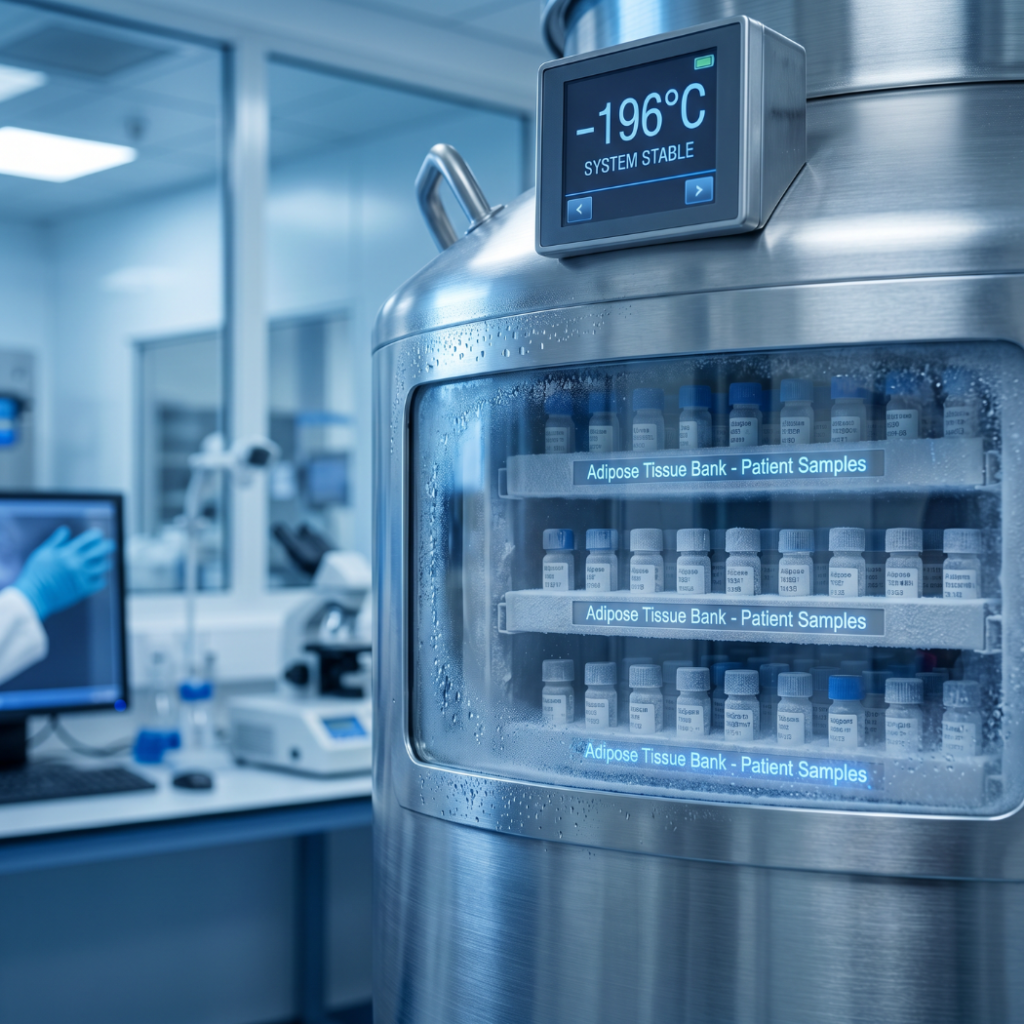
This page answers the 50 questions patients, physicians, and families most commonly ask about adipose tissue banking, the MFAT procedure, expanded access programs, and the ADSC clinical pipeline, organized by topic so you can go directly to what matters most. Each answer is concise and links to the full post on that topic where you need more depth. If your question is not here, use the site search or contact Save My Fat directly.
TLDR: 50 questions answered across eight categories: what banking is, the science, the procedure, the cost, the pipeline, regulatory compliance, the provider network, and post-banking management. Use the section headers to navigate directly to your area of interest.
Important Disclaimer: All answers below are for educational purposes only and do not constitute medical, legal, or financial advice. Banking does not treat, cure, or prevent any disease. Individual patient circumstances vary. Consult a physician before making any medical decision.
Section 1: What Banking Is
Q1. What is adipose tissue banking?
Adipose tissue banking is the process of harvesting a small volume of fat tissue, processing it to isolate adipose-derived stem cells, and cryopreserving those cells in liquid nitrogen for potential future use. Banking is tissue preservation. It is not a treatment and makes no therapeutic claims. Full explanation at Save My Fat’s complete guide to banking.
Q2. What is Save My Fat?
Save My Fat is a Section 361 HCT/P-compliant adipose tissue banking program that works with a network of trained partner physicians to perform the harvest and with L2 Bio, an FDA-registered laboratory, to process and store cells. The program gives patients the option to preserve their adipose-derived stem cells at their current biological quality for potential future use in FDA-regulated pathways as they develop.
Q3. What is the MFAT procedure?
MFAT stands for micro-fragmented adipose tissue, and the term refers to a method of processing harvested fat tissue into a micro-fragmented form. In the context of Save My Fat, the term describes the small-bore cannula harvest technique used to collect adipose tissue for banking. The procedure is a thirty-minute outpatient harvest under local anesthesia rather than a therapeutic injection. The foundational Zuk 2002 paper established the scientific basis for this adipose tissue collection approach.
Q4. What are MFAT injections?
“MFAT injections” refers to the therapeutic use of micro-fragmented adipose tissue, meaning injecting processed fat into joints or other tissue targets as a treatment. This is a distinct service from banking. Save My Fat is a banking service that preserves cells for future use under 21 CFR Part 1271. Any service offering MFAT injections as a current therapy is operating under a different and distinct regulatory category, and Save My Fat’s comparison of banking vs. stem cell treatment clinics covers the distinction in more depth.
Q5. What is “my fat” or “myfat”?
“My fat” and “myfat” are informal terms patients use when searching for Save My Fat or for information about their own fat tissue banking. Save My Fat is the formal program name. If you are looking for the Save My Fat patient portal or provider directory, start at savemyfat.com.
Q6. How is banking different from a stem cell treatment clinic?
Banking preserves your cells. A stem cell treatment clinic claims to treat a condition using stem cells. These are different services with different regulatory statuses. Banking under 21 CFR Part 1271 is compliant tissue preservation. Unregulated stem cell injection for treatment purposes is an FDA enforcement target, as Save My Fat’s resource on fake stem cell clinic red flags covers in more depth. Knowing the difference protects you.
Q7. Why bank fat tissue instead of other tissue types?
Adipose tissue yields substantially more mesenchymal stem cells per gram than bone marrow, making it the most practical source for autologous banking in adults. The harvest is a minor outpatient procedure with a fast recovery. Fat tissue is abundant in most adults and accessible through a small-bore cannula procedure under local anesthesia, as the foundational Zuk 2002 paper first documented. Save My Fat’s patient-facing ADSC overview covers the tissue source comparison in more depth.
Section 2: The Science
Q8. What are adipose-derived stem cells?
Adipose-derived stem cells are a population of mesenchymal stem cells isolated from fat tissue. They are multipotent, capable of differentiating into bone, cartilage, fat, and muscle cell lineages, and have well-documented immunomodulatory paracrine activity, as the foundational Zuk 2002 paper established. Full explanation at Save My Fat’s patient-facing ADSC overview.
Q9. How do ADSCs compare to bone marrow stem cells?
ADSCs and bone marrow MSCs share the same core biological properties, meaning multipotent differentiation and immunomodulatory paracrine activity, as the 2019 MSC biology review documents. The primary differences are yield, where adipose tissue yields substantially more MSCs per gram than bone marrow, and collection method, where fat harvest is a minor outpatient procedure while bone marrow harvest is more intensive. Save My Fat’s comparison of mesenchymal stem cells across sources covers the detailed comparison.
Q10. Does cell quality really decline with age?
Yes. Published research documents that ADSC proliferative capacity, differentiation potential, and paracrine activity all decrease with donor age and with conditions like obesity, diabetes, and chronic inflammation. The 2018 MSC clinical review covers the effects of disease state on MSC quality. Banking earlier preserves higher-quality cells.
Q11. How long can banked cells survive in cryostorage?
Published cryopreservation research has demonstrated viable cell recovery with maintained differentiation potential after twenty to thirty years of liquid nitrogen storage at approximately negative 196 degrees Celsius. Cells do not age in cryostorage, because biological aging requires metabolic activity, which is fully arrested at cryogenic temperatures. Save My Fat’s overview of long-term storage duration covers the evidence base in more depth.
Q12. What is the viability certificate and what does it tell me?
The viability certificate is the document from L2 Bio confirming your banking result. It records total cell yield, post-processing viability percentage, number of cryopreserved vials, and storage confirmation. It is your permanent record of what was banked and its quality at the time of cryopreservation. File it with your health records. Save My Fat’s overview of cryopreservation viability covers what each data point represents.
Q13. What is SVF and is it the same as ADSC banking?
Stromal vascular fraction is the heterogeneous cell population isolated from adipose tissue before further processing. ADSCs are a specific cell type within that broader population. SVF-based therapy approaches use the mixed cell population for immediate therapeutic injection, while ADSC banking preserves cells from adipose tissue for future use. Save My Fat is a banking program rather than a therapy service, and the two categories operate under different regulatory considerations.
Section 3: The Procedure
Q14. What happens during the banking harvest?
A small-bore cannula is inserted through a tiny entry point at the harvest site under local anesthesia, and a small volume of fat tissue is removed in approximately thirty minutes. The specimen is packaged and shipped to L2 Bio for processing and cryopreservation. You are awake throughout, as the foundational Zuk 2002 paper context describes and Save My Fat’s overview of how banking works covers in more depth.
Q15. Is the procedure painful?
The local anesthesia injection may sting briefly. Once the site is numb, most patients report pressure and movement sensation but not pain. Post-procedure soreness and mild bruising at the harvest site is typical for twenty-four to forty-eight hours and usually responds well to over-the-counter pain relief and rest.
Q16. How long does recovery take?
Most patients return to normal light activity the same day or the following day. Full activity typically resumes within forty-eight to seventy-two hours. The harvest is a minor outpatient procedure, so recovery is substantially shorter than most elective surgical procedures and does not typically require time off beyond the procedure day itself.
Q17. Do I need general anesthesia?
No. The harvest is performed under local anesthesia only. You are fully awake throughout the procedure. No sedation is required, no general anesthesia is involved, and no hospital admission is needed.
Q18. Where is the harvest site?
The harvest is typically performed at the lower abdomen or flank, chosen based on available tissue volume and patient comfort. Your provider will assess and mark the harvest site during the pre-procedure consultation, and you can discuss positioning preferences at that step.
Q19. How do I prepare for the procedure?
Avoid blood-thinning medications and supplements for the period your provider specifies, which is typically seven to ten days before the harvest. Wear loose comfortable clothing that accommodates the harvest site. Eat and hydrate normally. No fasting is required because the procedure is performed under local anesthesia rather than general anesthesia.
Q20. Can I bank more than once?
Yes. A second harvest is possible for patients who want to add to their vial count, though cells from the second harvest reflect the biological quality at the time of the second procedure, which will be lower than cells from an earlier harvest if meaningful time has passed. The published MSC biology literature supports the age-related quality decline that makes earlier harvesting biologically preferable.
Section 4: Cost and Value
Q21. How much does banking cost?
The initial banking package costs between $8,000 and $15,000, covering consultation through first-year storage. Annual storage fees apply every year thereafter. Current pricing is published at savemyfat.com/pricing.
Q22. Is banking covered by insurance?
No. Banking is a cash-pay service. It is not covered by health insurance. Plan the full cost, meaning initial package plus annual storage fees, as an out-of-pocket health investment rather than an insurance-reimbursable expense.
Q23. Is banking worth the cost?
It depends on three factors: whether the cost fits your discretionary health budget without financial strain, whether your health profile makes the ADSC pipeline specifically relevant, and whether you are comfortable investing in option value rather than expecting immediate benefit. Save My Fat’s resource on how to compare banking services covers the financial evaluation framework in more depth.
Q24. What is the ten-year cost of banking?
Add the initial package cost to annual storage fees multiplied by nine, covering years two through ten. Calculate this before banking and build annual storage into your ongoing health budget. The long-term storage commitment is real and should be evaluated honestly, because the ten-year total is the relevant number for a long-term preservation decision rather than the initial package alone. Current pricing is published at savemyfat.com/pricing.
Q25. How does banking cost compare to cord blood banking?
Cord blood banking costs $2,000 to $4,000 for the initial collection plus annual fees, which is a lower initial cost than ADSC banking. However, cord blood banking is done at birth with no patient choice in timing, and historical utilization rates for stored cord blood have been low. ADSC banking is done by adults at a chosen time, preserving a higher-quantity autologous cell population with a broader clinical trial pipeline covering orthopedic, autoimmune, neurological, and aesthetic applications.
Section 5: The Pipeline and Clinical Trials
Q26. What conditions is the ADSC pipeline researching?
The most active categories are orthopedic (knee osteoarthritis, cartilage repair, the most mature category), autoimmune (Crohn’s disease, multiple sclerosis, lupus, rheumatoid arthritis, active Phase 2 programs), neurological (ALS, Parkinson’s disease, Phase 1 to Phase 2), and aesthetic and reconstructive applications (clinically established and expanding). The active ADSC trial pipeline on ClinicalTrials.gov covers the current recruiting trials across all four categories.
Q27. What was the December 2024 FDA approval and why does it matter?
Ryoncil, generic name remestemcel-L, received FDA approval in December 2024 for steroid-refractory acute graft-versus-host disease in pediatric patients. It is a bone marrow MSC therapy rather than an adipose-derived therapy, but it established the regulatory precedent for FDA-approved MSC biologics that the ADSC pipeline is now building toward. The FDA approved cellular and gene therapy products database lists the approval and will list future MSC and ADSC approvals as they occur.
Q28. How do I find clinical trials relevant to my health profile?
Go to ClinicalTrials.gov and search for your condition plus “adipose stem cells” or “mesenchymal stem cells.” Filter by “Recruiting” status. Set up email alerts for new studies matching your search terms. The ADSC trial pipeline search is the reference query, and Save My Fat’s guide on finding legitimate clinical trials covers the evaluation framework in more depth.
Q29. What do Phase 1, Phase 2, and Phase 3 mean for trials I am evaluating?
Phase 1 tests safety in a small group. Phase 2 tests efficacy in a larger group at a range of doses. Phase 3 is a large-scale efficacy trial that, if successful, supports an FDA approval application. Phase 2 and Phase 3 trials are most relevant for patients evaluating enrollment because they involve the indications and doses closest to potential approval. Full explanation at Save My Fat’s guide to what ClinicalTrials.gov phases mean.
Q30. What is an expanded access program and how do I access one?
Expanded access allows patients with serious conditions to access investigational therapies outside of a clinical trial, under FDA oversight and with physician involvement. It requires a physician to initiate the request, FDA review, and manufacturer permission. The Reagan-Udall Expanded Access Navigator is the best starting resource, and Save My Fat’s overview of expanded access programs covers the framework in patient-facing depth.
Q31. What is the process for an expanded access program?
The standard process runs in four steps. First, a physician identifies an investigational therapy potentially relevant to their patient. Second, the physician submits an expanded access request to the FDA using Form FDA 3926 for single-patient requests. Third, the FDA reviews and responds, with emergency cases addressed within hours and non-emergency cases within thirty days. Fourth, if the FDA grants the request, the manufacturer must also agree to provide the therapy, which is often the most uncertain step. The Reagan-Udall Navigator walks physicians through each step, and the regulatory framework at 21 CFR Part 1271 covers the cellular therapy chain-of-custody elements that apply when the investigational therapy involves tissue-based products.
Q32. What is adipose-derived SVF therapy clinical trials enrollment?
Clinical trials testing stromal vascular fraction approaches enroll patients for specific conditions in an investigational setting. These are distinct from banking. SVF-based therapy trials use the full heterogeneous cell population for immediate injection under investigational protocols. Save My Fat is a banking program rather than a therapy enrollment service. Banking preserves cells that may be relevant to future trial or approved therapy access, but Save My Fat does not enroll patients in therapy trials directly. Search the active ADSC trial pipeline on ClinicalTrials.gov for currently recruiting studies by condition.
Q33. When will ADSC therapies be approved?
The orthopedic pipeline is closest to approval, with Phase 2 to Phase 3 programs active and the nearest-term approval candidates. Autoimmune applications are five to ten years out from first approvals in most indications. Neurological applications are ten to twenty years out, though the highest-unmet-need conditions like ALS could potentially move faster if safety and efficacy data support accelerated pathways. No specific approval date can be predicted in advance. Banking preserves access to the pipeline as it develops rather than betting on any specific approval timeline.
Section 6: Regulatory Compliance
Q34. Is Save My Fat FDA-regulated?
Yes. Banking operates under 21 CFR Part 1271, which is FDA Section 361 HCT/P regulation. L2 Bio is an FDA-registered tissue establishment. The banking service does not require an Investigational New Drug application because it is tissue preservation rather than an investigational new drug program. Save My Fat’s overview of FDA regulations for adipose tissue covers the regulatory structure in more depth.
Q35. What is 21 CFR Part 1271?
21 CFR Part 1271 is the FDA regulation governing Human Cells, Tissues, and Cellular and Tissue-Based Products. It establishes the registration, screening, testing, processing, storage, and labeling requirements for tissue banking services. Full explanation at Save My Fat’s overview of 21 CFR Part 1271, and the regulatory text itself is available at the ECFR for direct review.
Q36. Does banking require a doctor’s prescription?
Banking does not require a prescription in the way a drug does. It requires a physician to perform the harvest procedure and complete the informed consent process with the patient. The physician involvement is a regulatory requirement under 21 CFR Part 1271 rather than a prescription pathway, and any patient can initiate the process directly by contacting a Save My Fat partner provider.
Q37. What is informed consent for banking?
Informed consent for banking documents that the patient understands what the procedure involves, what banking provides and does not provide, the risks of the harvest procedure, and the chain-of-custody process for their specimen. It is a regulatory requirement under 21 CFR Part 1271 and a patient protection standard that any responsible provider will follow. Full explanation at Save My Fat’s overview of informed consent in regenerative medicine.
Q38. How do I verify that a banking service is FDA-compliant?
Ask for the name of their processing laboratory and verify it on the FDA’s tissue establishment registry directly. Ask whether they make treatment claims, because a compliant service does not. Ask for their 21 CFR Part 1271 compliance documentation. Each of these three checks can be verified independently rather than taken on faith from the service’s marketing materials.
Q39. What are the red flags of an unregulated stem cell clinic?
Three immediate disqualifiers. First, treatment claims, meaning any claim to treat or cure a specific disease with cellular therapy. Second, an unregistered laboratory that is not verifiable on the FDA tissue establishment registry. Third, bundled therapeutic injections that package banking with immediate stem cell injections that have no FDA approval. Full guide at Save My Fat’s resource on fake stem cell clinic red flags.
Section 7: The Provider Network
Q40. How do I find a Save My Fat provider near me?
The provider directory is available at Save My Fat’s provider program page, which is searchable by location. All listed providers are trained partner physicians operating in clinical settings under the Save My Fat protocol.
Q41. What types of physicians join the Save My Fat network?
The strongest-fit specialties are plastic surgeons, aesthetic physicians, functional and concierge medicine physicians, orthopedic surgeons, and rheumatologists or internists with autoimmune patient panels. All partner providers are licensed physicians trained in the Save My Fat harvest protocol, as the provider program overview covers in more depth.
Q42. What should I look for when choosing a provider?
Seven criteria apply. FDA-registered processing laboratory. No treatment claims. Trained and licensed harvest providers. Viability certification provided after processing. Transparent pricing. Clear storage and ownership terms in the patient agreement. Documented chain of custody from harvest through long-term storage. Each criterion can be verified through specific questions at consultation, and the framework applies equally to any banking service under evaluation, including Save My Fat. The regulatory framework at 21 CFR Part 1271 establishes the compliance foundation for the evaluation.
Q43. Can my current physician join the Save My Fat network?
Physicians interested in joining the partner network can begin the process at the Save My Fat partner sign-up page. The program is open to trained, licensed physicians across relevant specialties who can meet the training and compliance requirements.
Q44. What does provider training for Save My Fat involve?
Provider training covers the harvest protocol and technique, specimen handling and chain-of-custody requirements, informed consent documentation and patient communication, and the regulatory compliance framework. Training is designed to be completed without significant disruption to an existing practice schedule for physicians already comfortable with minor outpatient procedures.
Section 8: After Banking
Q45. What do I do with my viability certificate after banking?
File it with your permanent health records, share a copy with your primary care physician, and keep it retrievable without a search. It is your documentation of what was banked and at what quality, and you will reference it if you ever access your cells for a clinical trial or approved therapy. Save My Fat’s overview of cryopreservation viability covers what the certificate represents in more depth.
Q46. How do I stay connected to the pipeline after banking?
Set ClinicalTrials.gov email alerts for your health-relevant search terms. Monitor the FDA approved products page for MSC approvals. Stay current with Save My Fat communications by keeping your contact information updated. The active ADSC trial pipeline on ClinicalTrials.gov is the reference query for post-banking pipeline monitoring.
Q47. How do I access my cells if I need them?
The access process involves four steps. Identify the clinical pathway, meaning a trial, expanded access, or approved therapy. Confirm eligibility with your physician and the receiving facility. Arrange vial release and shipping through Save My Fat and L2 Bio under the 21 CFR Part 1271 chain-of-custody framework. Work with your physician at the receiving facility on the clinical application. Save My Fat’s overview of how banking works covers the access mechanism in more depth.
Q48. What happens if I move after banking?
Update your contact information with Save My Fat immediately. Your storage account communications, viability updates, and any pipeline developments will reach you only if your contact details are current. Your cells remain at L2 Bio regardless of where you live, because storage is tied to the account rather than to your geographic location.
Q49. Can my partner or family members also bank?
Yes. Each person banks their own cells, because banking is always individual and autologous. There is no cross-use of a partner’s or family member’s cells under the regulatory framework at 21 CFR Part 1271. Each person must complete their own harvest, consent, and banking process independently, even if appointments are coordinated as a family banking event.
Q50. What is the most important thing to know before deciding to bank?
Banking is tissue preservation, not treatment. It costs real money with an uncertain future return. The value depends on your health profile’s relevance to the pipeline, your financial flexibility, and your comfort with long-term option-value investing. The patients best served by banking are the ones who understand all of this clearly before they decide. Start with Save My Fat’s complete guide to banking.
Still Have Questions?
Before moving forward: adipose tissue banking is a preservation service for potential future use in FDA-regulated pathways, not a treatment or a guarantee of access to any specific clinical trial, therapy, or product. No adipose-derived product is FDA-approved for general disease treatment, and banking cannot be represented as a treatment for any condition. Consult your physician about whether banking is appropriate for your specific situation. Physicians considering partnership should independently verify applicable state licensing and informed-consent requirements, particularly in Florida, Utah, and Nevada, which have stem cell-specific statutes.
The resources below cover the topics in this FAQ in more depth. Save My Fat’s complete guide to banking is the primary reference document for anyone new to the service. The resource on questions to ask before banking covers the pre-consultation checklist patients should work through. The provider page connects patients with partner physicians across the network. Current pricing is published at savemyfat.com/pricing. Active clinical trials are searchable on ClinicalTrials.gov. The Reagan-Udall Expanded Access Navigator is the federal resource for patients and physicians evaluating expanded access.
Save My Fat provides adipose tissue banking services in partnership with L2 Bio for laboratory operations. Save My Fat does not provide medical treatments, clinical trial enrollment, or Expanded Access services.
This article is for educational purposes only and does not constitute medical or legal advice. Legal and medical review including neurology and neurosurgery input is required before publication. Please consult your neurologist or neurosurgeon before making any decisions about neurologic treatment or research participation.
Related guide: the stem cell science glossary.