
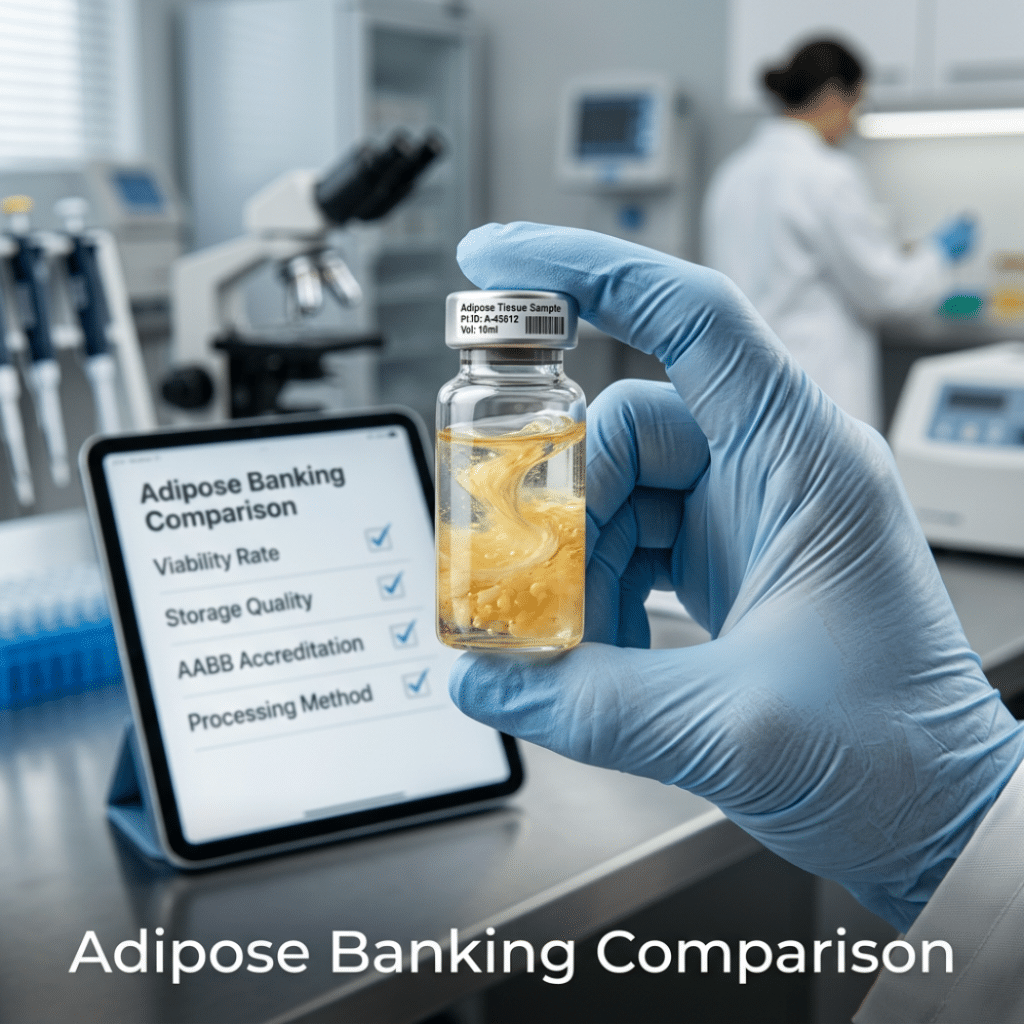
The adipose tissue banking market has grown substantially in recent years, and the services available today vary widely in their regulatory standing, scientific rigor, and honest communication with patients. This article provides a five-category evaluation framework that any patient can apply to any tissue banking service before committing, regardless of which service they are considering. The framework is designed to cut through marketing language and focus on verifiable facts. It applies equally to every service in this space, including Save My Fat.
TLDR: When comparing adipose tissue banking services, evaluate five categories in order: FDA registration and regulatory standing, processing transparency and regulatory pathway, cryopreservation science and quality standards, contract terms covering ownership and continuity, and marketing honesty. A service that passes all five deserves further consideration. A service that fails any of the first three should be avoided. The questions in this guide will tell you everything you need to know.
Important Disclaimer: Save My Fat does not provide FDA-approved treatments or cures for any disease or medical condition. Adipose tissue banking is a preservation service for potential future opportunities, not a therapeutic product. Banking adipose tissue today does not guarantee eligibility, access, or clinical benefit from any future therapy, clinical trial, or medical program. All content here is for educational and informational purposes only and does not constitute medical advice. Patients must consult their own licensed healthcare professionals regarding all medical decisions. Outcomes of any regenerative medicine research or future therapies are highly individual and cannot be predicted or guaranteed.
The regenerative medicine market now includes dozens of companies offering some form of tissue banking, stem cell preservation, or adipose storage. For a patient without a regulatory background, evaluating these services honestly is genuinely difficult. The marketing language across compliant and non-compliant services often sounds nearly identical: validated protocols, quality standards, state-of-the-art facilities. None of those phrases require any specific underlying reality.
The core problem is that many services use phrases like “FDA compliant” and “FDA registered” interchangeably, but these mean different things. A service can be registered with the FDA as a tissue banking facility without the FDA having endorsed, approved, or even reviewed anything that service does. A service can use terminology that sounds regulatory without actually operating under the correct pathway. Patients who do not understand these distinctions are vulnerable to making significant financial commitments to services that may not withstand regulatory scrutiny.
The solution is a framework that focuses on what is verifiable rather than what is marketable. Five categories, applied in order, answer the question: does this service deserve my trust and my biological material? By the end of this article, you will know what to look for in each category, what a strong response sounds like, and what responses should end the conversation.
Category One: Regulatory Standing and FDA Registration
Regulatory standing is the non-negotiable baseline. A service that cannot pass this category should not be evaluated further, regardless of how compelling its other messaging is.
FDA Establishment Registration
Any establishment that recovers, processes, stores, labels, or distributes human cells, tissues, or cellular and tissue-based products (HCTPs) in the United States must register with the FDA under 21 CFR Part 1271. This is federal law, not a voluntary certification, and it applies to every tissue banking service operating in this space. A compliant banking service should be able to provide its FDA establishment registration number immediately and should actively encourage you to verify it independently through the FDA’s HCTP establishment database. If a service will not provide a registration number, or claims registration does not apply to it, that is a disqualifying response.
Warning Letter History
The FDA publishes warning letters publicly and searchably. Before committing to any banking service, search the FDA warning letter database using the company’s legal entity name. Warning letters for unapproved marketing claims, CGTP violations, or processing violations are serious regulatory findings. A legitimate service will tell you exactly what legal entity name to search under and will encourage you to do so.
| What to Check | Passing Response | Should Raise Concern |
|---|---|---|
| FDA establishment registration number | Specific number provided; service encourages independent verification | Vague compliance claims; no number provided; claims registration is not required |
| Warning letter history | Clean public record; service names the exact legal entity for your search | Defensiveness; inability to name the legal entity; discouraging verification |
| Regulatory pathway | Clear explanation of whether service operates under Section 361 or Section 351 and why | Cannot explain the difference; no answer to “which pathway and why” |
Category Two: Processing Transparency
How tissue is processed after collection is the single most consequential regulatory variable in tissue banking. A service that is not transparent about this is not in a position to be trusted with your biological material.
The Section 361 vs. Section 351 Question
The FDA classifies tissue banking services based on how tissue is processed and what it is intended to be used for. Intact adipose tissue banking, meaning tissue is washed, centrifuged, and cryopreserved without enzymatic digestion, may qualify under the less restrictive Section 361 HCTP pathway if all four regulatory criteria are met. Enzymatic digestion to produce stromal vascular fraction (SVF) is considered by the FDA to be more than minimal manipulation under the November 2017 guidance on minimal manipulation and homologous use, which triggers the Section 351 biologics pathway. That pathway requires an Investigational New Drug application for any clinical investigation and a Biologics License Application before any product can be marketed for treating disease. Three federal circuit courts from 2014 to 2024 upheld FDA authority over enzymatically processed adipose products, and the Supreme Court declined to hear a challenge to the most recent ruling in 2025.
What Transparency Looks Like
A service that processes tissue compliantly should be able to name every step in the protocol: what happens to tissue after collection, what reagents or enzymes are or are not used, what the regulatory classification of the resulting product is, and what written documentation supports that classification. “We use the best protocols” or “we are FDA compliant” without specifics are not sufficient answers. The specific question to ask is: do you use enzymatic digestion at any stage, and what regulatory pathway governs the resulting product? A transparent service answers this clearly. A vague answer or an assertion that enzymatic SVF processing is equivalent to intact tissue banking because it uses the patient’s own cells misrepresents the regulatory framework.
For background on the biology of adipose-derived cells and why the cellular composition of banked tissue matters, the patient’s guide to adipose-derived stem cells provides a plain-language overview.
Category Three: Cryopreservation Science and Quality Standards
The science behind how tissue is preserved determines whether it will still be biologically useful when it is eventually needed. Any credible banking service should be able to answer questions in this category with specific numbers and specific citations, not generalities.
Cryoprotective Agent and Cooling Rate
Published research by Thirumala and colleagues in 2010 documented that DMSO concentrations of 5 to 10 percent show no significant differences in ADSC viability after cryopreservation, with post-thaw viability of 80 to 91 percent with standard protocols. The published optimal cooling rate for adipose-derived stem cells is 1 to 2 degrees Celsius per minute (Shu et al., 2015). A banking service should be able to name the specific cryoprotective agent used, its concentration, and how the cooling rate is controlled, whether through a programmable controlled-rate freezer or a validated passive cooling device.
Post-Thaw Viability and Sterility Standards
Quality banking facilities require post-thaw viability of 85 percent or higher as a release criterion, consistent with published quality benchmarks. Sterility testing under CGTP requirements (21 CFR Part 1271 Subpart D) is mandatory, with the standard being a 14-day culture per USP 71. Research by Tsekouras and colleagues in 2018 demonstrated no significant differences from fresh tissue after more than a decade of liquid nitrogen storage with proper protocol. Published research by Gonda and colleagues in 2019 documented an average 67 percent volume recovery from long-term biobanked intact lipoaspirate. A service should be able to provide a specific viability threshold, the testing method used (trypan blue exclusion or flow cytometry), and a clear policy on what happens when a sample does not meet that threshold.
Long-Term Storage Temperature
Long-term storage requires liquid nitrogen or vapor phase temperatures (-150 to -196 degrees Celsius) to halt all biological activity. Ultra-low freezers at -80 degrees Celsius are appropriate for short-term staging and sample transit, not for long-term banking. Continuous temperature monitoring with automated alarm systems and documented backup nitrogen supplies are the expected standard. Any service that equates -80 degree Celsius freezer storage with liquid nitrogen temperatures for long-term banking is misrepresenting the cryobiology.
| Standard | Published Benchmark | What to Ask the Service |
|---|---|---|
| Cryoprotective agent | DMSO 5 to 10 percent (Thirumala et al., 2010) | What CPA do you use and at what concentration? |
| Cooling rate | 1 to 2 degrees Celsius per minute (Shu et al., 2015) | What cooling rate and what equipment achieves it? |
| Post-thaw viability threshold | 85 percent or higher (published quality standard) | What viability threshold must samples meet, and what happens if they do not? |
| Storage temperature | Liquid nitrogen or vapor phase (-150 to -196 degrees C) | What temperature and what storage method for long-term banking? |
| Sterility testing | 14-day USP 71 culture (21 CFR Part 1271 CGTP) | What sterility testing is performed and when? |
Category Four: Contract Terms
Contract terms determine what you actually own, what access you retain, and what protection you have if circumstances change. The service agreement is where verbal assurances either get confirmed or quietly disappear.
Tissue Ownership and Retrieval
The service agreement should state clearly that tissue is the patient’s property throughout the banking relationship. The facility is a custodian, not an owner. Retrieval terms should specify the conditions under which release occurs, who authorizes it, and how quickly it can be executed. Ambiguous ownership language or retrieval conditions that are undefined in writing create legal vulnerability for the patient. These terms should be in the contract before you sign, not in a follow-up conversation.
Company Continuity Plan
A banking relationship may last decades. A documented continuity plan is a reasonable contractual expectation for any service asking for that kind of long-term commitment. The agreement should specify where samples would be transferred if the company closes, the timeline for patient notification, and what options patients would have. An absence of a written continuity plan is a material omission in a long-term custodial relationship.
Fee Transparency
Tissue banking is typically not covered by health insurance. The all-in cost includes the collection procedure, the initial banking and processing fee, and ongoing annual storage fees that accumulate over years or decades. A service should provide a complete itemized cost breakdown before you sign anything. Reluctance to provide that breakdown in writing before commitment is a red flag.
| Contract Term | What It Should Say |
|---|---|
| Tissue ownership | Patient retains full legal ownership; facility is custodian only |
| Retrieval terms | Specific conditions, timelines, and authorization process written into the agreement |
| Continuity plan | Named transfer facility and patient notification process documented in the agreement |
| Fee structure | Itemized all-in cost provided in writing before signing, with no hidden ongoing fees |
| Family use terms | If offered, eligible relationships and regulatory pathway stated in writing |
Category Five: Marketing and Communications Quality
How a service communicates with prospective patients reveals more about its regulatory posture than almost anything else. The marketing is where non-compliant services typically expose themselves.
Disease Claims Are Disqualifying
Any banking service that states, implies, or suggests that banking tissue, ADSCs, or stored cells will treat, cure, reverse, or prevent any disease or medical condition is violating FDA and FTC regulations. The FDA’s guidance on unapproved regenerative medicine products is published at the FDA consumer alert on regenerative medicine products including stem cells and exosomes. The FTC Health Products Compliance Guidance establishes what evidence is required before health claims can be made in marketing. A service making disease claims is either unaware of applicable regulations or is knowingly disregarding them. Either situation is disqualifying.
Honesty About Limitations
A credible service should disclose proactively that banking does not guarantee access to any treatment, trial, or clinical pathway. It should acknowledge that the future regulatory landscape is uncertain, that therapies investigational today may not reach FDA approval, and that eligibility for any future pathway depends on factors entirely outside the banking process. Services that avoid these disclosures or place them in fine print are not operating transparently.
Education Quality
The Reagan-Udall Foundation’s Expanded Access Navigator is a free, authoritative resource that helps patients and physicians navigate legitimate FDA access pathways. A banking service that references this resource, explains FDA pathways accurately with appropriate context and caveats, and positions banking within the real regulatory landscape rather than a speculative one is demonstrating the kind of transparency that distinguishes compliant services.
The Three Fastest Ways to Identify a Service Worth Avoiding
Not every patient has time to run a complete five-category evaluation before a sales conversation ends. These three questions each take under 60 seconds and collectively identify the most important compliance gaps.
1. Ask for the FDA establishment registration number.
A compliant facility provides it immediately and encourages independent verification. A service that cannot produce this number or that claims it is not required has failed the most basic regulatory threshold.
2. Look at the marketing for disease-treatment language.
Search the website for phrases like “fight arthritis,” “reverse aging,” “treat autoimmune conditions,” or any language that implies the banking process will help a specific condition. These are illegal marketing claims for unapproved products. If they appear on the site, regulatory compliance is not the priority.
3. Ask directly: do you use enzymatic digestion, and what regulatory pathway applies to your service?
A service that cannot answer this question clearly, or that claims enzymatic SVF processing and intact tissue banking are regulatory equivalents, does not have a credible compliance posture.
A legitimate service answers all three of these in under 60 seconds. A service that cannot answer them should not receive a deposit.
What This Framework Means for Save My Fat
Save My Fat welcomes every question in this framework. The purpose of publishing this evaluation guide is not to direct patients toward any single conclusion. It is to ensure that patients who are making a long-term decision about their own biological material have the tools to evaluate any service, including this one, on its actual merits.
Save My Fat banks intact adipose tissue without enzymatic digestion. The service’s regulatory positioning is designed to address the criteria for the Section 361 HCTP pathway under 21 CFR Part 1271: the banking process uses washing, centrifugation, and validated cryopreservation without breaking down the tissue’s cellular architecture. Understanding why that distinction matters is the reason articles on this site cover topics like minimal manipulation, SVF classification, and the three federal court rulings that have confirmed FDA authority in this space.
Save My Fat publishes educational content covering FDA regulatory pathways, the science of cryopreservation, and the critical differences between tissue banking and treatment because that education is how legitimate services build trust. Patients who understand the regulatory landscape are better protected from services that misrepresent their compliance posture. Patients who are fully informed make better decisions about where to bank and why.
Patients are encouraged to verify Save My Fat’s FDA registration, search the warning letter database under the company’s legal entity name, and apply every question in this article before signing. The Reagan-Udall Foundation’s Expanded Access Navigator is a useful independent resource for patients also exploring legitimate future access pathways for investigational therapies.
Frequently Asked Questions
Does FDA establishment registration mean a banking service is safe or approved?
No. Registration means the facility has submitted required paperwork and listed its HCTPs with the FDA under 21 CFR Part 1271. It does not mean the FDA has reviewed, approved, or validated anything the service does. It is a baseline administrative requirement, not a quality certification or endorsement. The appropriate follow-up question is: which regulatory pathway does your processing operate under, and can you document why?
What is the difference between the Section 361 and Section 351 pathways for adipose tissue banking?
Section 361 HCTP classification applies to tissue that meets four regulatory criteria simultaneously, including minimal manipulation and homologous use. Intact adipose tissue banking may qualify. Section 351 applies to products that do not meet those criteria, such as enzymatically digested SVF or culture-expanded cells, and requires an IND for clinical investigation and eventually a BLA for marketing. The FDA’s November 2017 guidance explains this distinction and specifically addresses adipose tissue classification.
What does “FDA compliant” actually mean when a banking service uses that phrase?
It typically means the service believes its operations comply with 21 CFR Part 1271 and related CGTP requirements. However, it does not mean the FDA has audited or verified that compliance. Patients should ask for specifics: What is your FDA establishment registration number? What regulatory pathway does your processing operate under? These are verifiable questions, and a compliant service provides specific, verifiable answers.
Can I verify a tissue banking service’s compliance independently?
Yes. FDA establishment registration is verifiable through the FDA’s HCTP establishment database. Warning letters are searchable by company name through the FDA’s public database. Clinical trial registrations are searchable at ClinicalTrials.gov. Independent verification is not only possible, it is the recommended baseline before committing to any service.
What is the Reagan-Udall Foundation and why is it relevant to tissue banking?
The Reagan-Udall Foundation’s Expanded Access Navigator at navigator.reaganudall.org is a free, authoritative resource that helps patients, physicians, and sponsors navigate the FDA’s Expanded Access program. It is relevant to tissue banking because legitimate banking services position stored tissue for potential future use in FDA-regulated pathways, including Expanded Access. A banking service that references and links to this resource is demonstrating alignment with regulated, legitimate patient access pathways rather than speculative or unapproved ones.
Key Takeaways
Not all tissue banking services are equally regulated. FDA establishment registration, processing method, and regulatory pathway vary significantly across services and cannot be assumed from marketing language alone.
FDA registration is verifiable and should be confirmed before committing. The FDA’s HCTP establishment database is publicly searchable, and a compliant service provides its registration number on request.
Processing method determines regulatory classification. Ask specifically whether enzymatic digestion is used. Intact tissue banking may qualify under Section 361. Enzymatically processed SVF triggers Section 351, which requires IND authorization for clinical research.
Cryopreservation quality is measurable against published benchmarks. Published research establishes specific standards for cooling rate (1 to 2 degrees Celsius per minute), post-thaw viability (85 percent or higher as a release criterion), and long-term storage temperature (liquid nitrogen vapor phase). Ask for those specifics before deciding.
Contract terms and marketing honesty are as important as science credentials. Ownership language, continuity plans, and absence of disease claims tell you how a service views its responsibilities to the patients it serves over the long term.
Ready to Evaluate Adipose Tissue Banking Options?
Evaluating any banking service before committing is not only reasonable, it is the appropriate standard of care for a decision involving your own biological material and a long-term financial relationship. The questions in this framework are designed specifically to make that evaluation straightforward, regardless of which service you are considering.
Save My Fat offers adipose tissue banking and cryopreservation services using validated protocols, operates under 21 CFR Part 1271 CGTP requirements, and publishes educational content about FDA regulatory pathways so that patients can understand exactly what banking is, what it is not, and why the difference matters. This service does not offer treatments for any disease, does not guarantee access to any clinical trial or future therapy, and positions banking honestly as a preservation decision made in the context of an uncertain but actively developing scientific and regulatory landscape.
To learn more about what the banking process involves at each stage, the complete guide to adipose tissue banking and the step-by-step overview of how the banking process works provide detailed, science-based explanations of each stage from collection through long-term storage. For information tailored to patients who are making this decision, the For Patients section is the starting point. For providers interested in offering tissue banking as a service, the For Providers section explains how the provider relationship works.
The standard for any legitimate banking service is transparency: about its regulatory standing, its science, its contracts, and the honest limits of what banking can and cannot provide. That transparency is what this framework is designed to evaluate, and it is the standard Save My Fat holds itself to.
Medical Disclaimer
Save My Fat does not provide FDA-approved treatments or cures for any disease or medical condition. Adipose tissue banking is a preservation service for potential future opportunities that may arise as regenerative medicine science and FDA regulations evolve. Banking does not guarantee eligibility, access, or clinical benefit from any future therapy, clinical trial, or medical program. All content in this article is for educational and informational purposes only and does not constitute medical advice. Patients must consult their own licensed healthcare professionals regarding all medical decisions.
This article is for educational purposes only and does not constitute medical or legal advice. Legal review is recommended before publication. Please consult your licensed healthcare provider regarding all relevant decisions.
Related guide: compliant marketing standards.
Last Updated: April 12, 2026