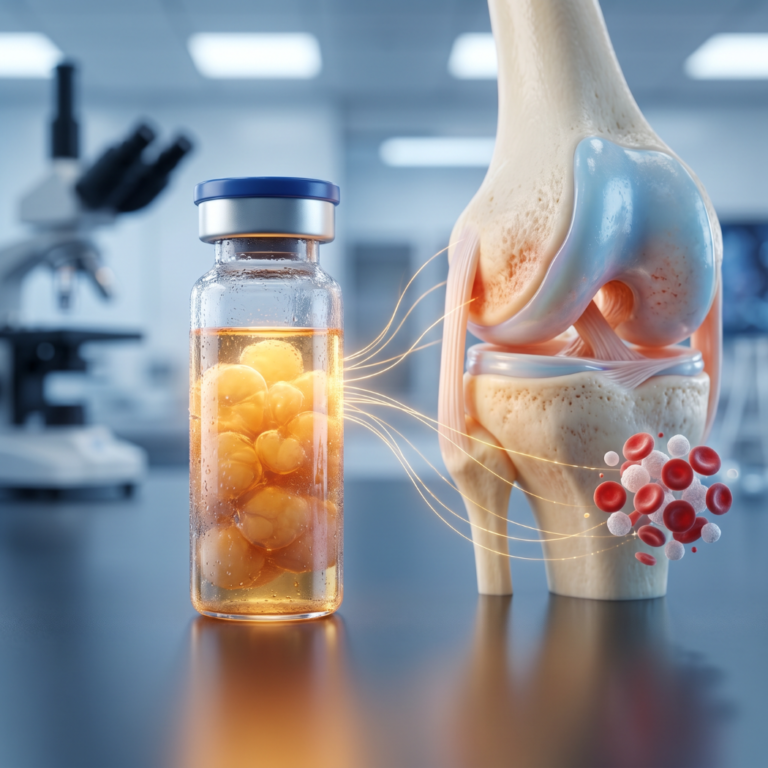

Patients with chronic kidney disease sometimes ask whether banking adipose tissue is relevant to their condition. The honest answer requires separating genuine but early research from any suggestion that banking treats kidney disease. This guide explains what the kidney-related adipose research is actually studying, how CKD stage factors into a banking decision, and why the conversation belongs with a nephrologist. For the basics of the service, the complete guide to adipose tissue banking explains what is preserved and why.
TLDR: Adipose-derived stem cell research relevant to kidney patients is early and narrow, and the active trials in this area focus on improving dialysis vascular access in advanced kidney disease rather than on restoring kidney function. No adipose-derived product is FDA-approved for chronic kidney disease. CKD stage, overall health, and treatment are part of the clinical context for any banking decision, which belongs with a nephrologist. Banking preserves a person’s own tissue for potential future use; it is not a treatment for kidney disease, it does not improve kidney function, and it does not guarantee eligibility, access, or clinical benefit.
Important Disclaimer: Save My Fat does not provide FDA-approved treatments or cures for any disease, including chronic kidney disease. No adipose-derived stem cell product currently has FDA approval for chronic kidney disease. Banking adipose tissue today does not guarantee eligibility, access, or clinical benefit from any future therapy, clinical trial, or medical program. All content is for educational purposes only and does not constitute medical advice. Patients must consult their own licensed healthcare professionals regarding all medical decisions.
For CKD patients, the useful framing distinguishes what the research is genuinely examining from what banking is. The sections below cover the research, the role of disease stage, the current evidence, and the questions to bring to a nephrologist.
What the Kidney ADSC Research Is Studying
Adipose-derived stem cell research relevant to kidney patients is at an early stage, and it is important to be precise about what it is and is not studying. Much of the most visible activity in renal patients is not aimed at restoring kidney function. Instead, it focuses on specific complications of advanced kidney disease, such as the vascular access used for dialysis. That is a meaningful distinction, because a patient could easily assume that adipose research in kidney patients means research on treating kidney disease itself, which is not the case here.
The interest in adipose-derived cells generally stems from their studied influence on inflammatory and cellular signaling, which is why they appear in research touching a range of conditions. For the broader science across organ systems, the overview of adipose cells across kidney, heart, and lung provides context. A CKD patient should read this as a developing research area rather than a set of available options. It is also worth noting that kidney disease is heterogeneous, with different causes and stages, so research findings in one renal context do not necessarily transfer to another, which is a further reason to rely on a nephrologist’s interpretation rather than general claims.
How CKD Stage Affects Banking Eligibility and Cell Quality
CKD stage and overall health are part of the clinical context for any banking decision, and a nephrologist is the right person to weigh them. Kidney disease, its complications, and the medications used to manage it all shape a patient’s overall medical picture, and that picture is relevant to whether any elective procedure is appropriate. A patient should not assume banking is advisable at any particular stage without the nephrology team’s input.
The honest framing is that banking records a person’s tissue as it is at the time of collection, and the value of that record does not depend on any promised future use. The overview of ideal banking candidates describes general considerations, which a nephrologist can apply to an individual patient’s situation. Banking is elective preservation, not a step in kidney care, so timing should follow clinical guidance.
Active Trials and the Current Evidence Status
An accurate read of the active trials keeps expectations grounded. The adipose-derived studies currently active in renal patients are early-phase and focused on dialysis vascular access rather than on kidney function. One study using a patient’s own adipose-derived cells, registered as NCT02808208, is examining their use in reducing hemodialysis arteriovenous fistula failure, and it is active but no longer recruiting. A related study, NCT04392206, is recruiting and is examining adipose-derived cells in the context of arteriovenous access. The broader set of active clinical trials shows where these sit.
Two points belong with these references. First, these trials concern vascular access complications in advanced kidney disease, not restoration of kidney function, and that distinction should not be blurred. Second, registration does not establish an approved therapy, and no adipose-derived product is FDA-approved for chronic kidney disease. The evidence base specific to kidney applications remains limited and early.
Questions to Bring to Your Nephrologist
A focused conversation with the nephrology team produces better decisions than online research alone. A patient can ask whether banking is appropriate given their CKD stage and overall health, how their kidney disease and medications factor into any elective procedure, and what the realistic state of kidney-related adipose research is. These are questions only the treating nephrologist can answer for an individual.
It also helps to ask the nephrologist to explain why the active kidney-related trials focus on dialysis vascular access rather than kidney function, so the distinction is clear. A trustworthy clinician will reinforce that banking preserves tissue for potential future use and offers no kidney benefit or guarantee.
Frequently Asked Questions
Does banking adipose tissue treat my kidney disease or improve kidney function?
No. Banking preserves a person’s own tissue for potential future use. It is not a treatment for kidney disease, it does not improve kidney function, and no adipose-derived product is FDA-approved for chronic kidney disease.
Are there active adipose stem cell trials for kidney disease?
The active adipose-derived trials in renal patients are early-phase and focused on dialysis vascular access, such as reducing arteriovenous fistula failure, rather than on restoring kidney function. No adipose-derived product is FDA-approved for chronic kidney disease.
Does my CKD stage affect whether I can bank?
CKD stage and overall health are part of the clinical context, and your nephrologist is the right person to assess whether an elective procedure is appropriate. Banking is elective preservation rather than a step in kidney care.
Should I bank before my kidney disease progresses?
That is a decision for your nephrologist. Banking records your tissue as it is at collection, but whether and when an elective procedure is appropriate depends on your individual medical situation and should follow clinical guidance.
How is adipose tissue banking regulated?
Banked adipose tissue is handled under 21 CFR Part 1271, the federal framework governing screening, processing, and storage of human cells and tissues.
Key Takeaways
For CKD patients, the banking decision should rest on an accurate read of early research and a nephrologist’s guidance. Adipose-derived research relevant to kidney patients is early and narrow, and the active trials, including NCT02808208 and NCT04392206, focus on improving dialysis vascular access rather than on restoring kidney function, with no adipose-derived product FDA-approved for chronic kidney disease. CKD stage, overall health, and treatment are part of the clinical context for any banking decision, which belongs with a nephrologist, and banking is elective preservation rather than a step in kidney care. Above all, banking adipose tissue is a preservation service for potential future use; it is not a treatment for kidney disease, it does not improve kidney function, and it does not guarantee eligibility, access, or clinical benefit.
Save My Fat operates as a tissue preservation service, not a medical practice or treatment provider. Stem cell and regenerative medicine regulations vary by state, including specific informed-consent and disclosure requirements in Florida, Utah, and Nevada governing tissue and stem cell services. Banking adipose tissue does not connect patients to any treatment pathway, and any future use depends on FDA regulatory status, physician guidance, and the availability of approved or investigational pathways at that time.
CKD patients who want to understand what banking does and does not offer can review the complete guide and contact the team after discussing the decision with their nephrologist.
Save My Fat partners with L2 Bio for laboratory processing and storage.
This article is for educational purposes only and does not constitute medical or legal advice. Legal and medical review including nephrology input is required before publication. Please consult your nephrologist before making any decisions about treatment or research participation.
Related guide: the adipose stem cell clinical trials directory.