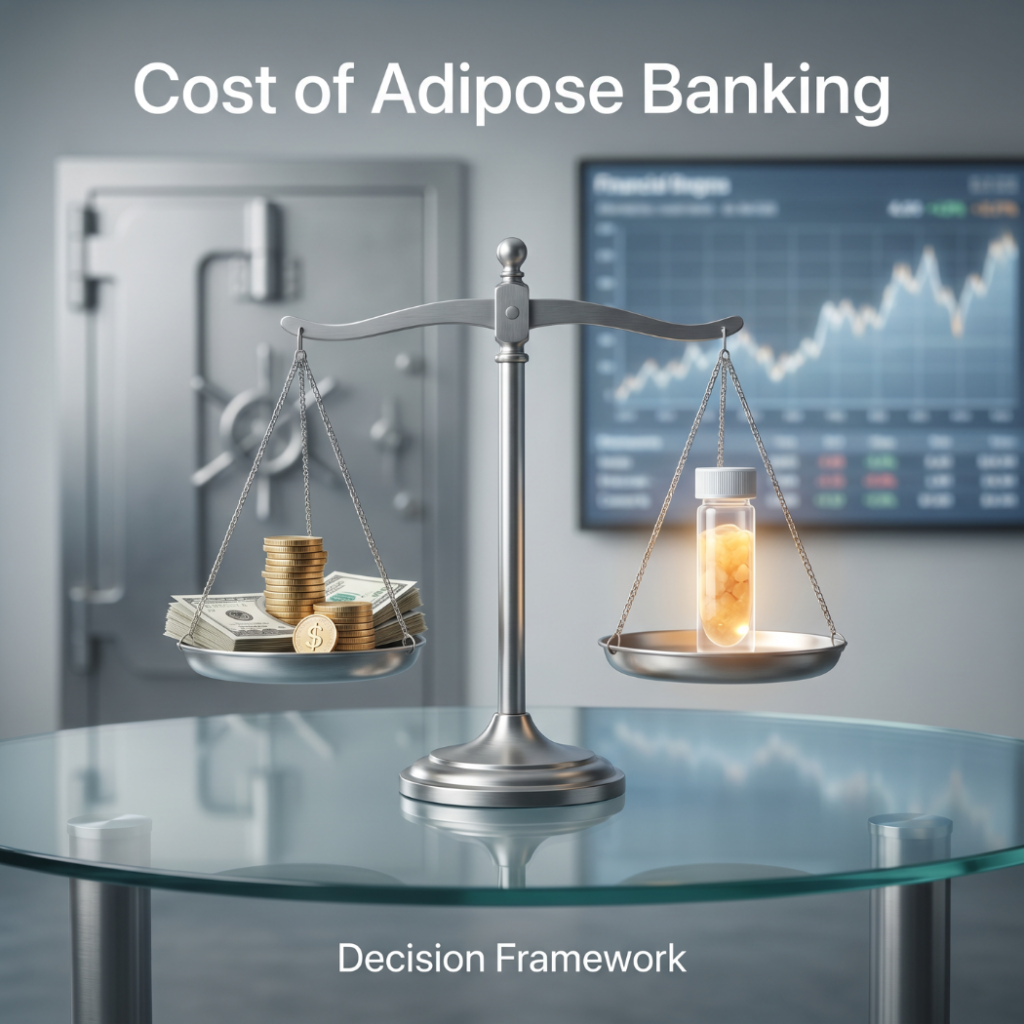
Adipose tissue banking is a cash-pay health service typically priced between $8,000 and $15,000 depending on the package, provider, and storage terms, which makes it a significant financial decision that deserves a clear-eyed evaluation framework rather than an impulse. The right way to think about banking cost is not as a medical procedure expense but as an option-value investment: you are paying to preserve a biological asset at its current quality against a pipeline of therapies that is growing and maturing. This post gives you the full cost picture, what is included, what ongoing costs look like, how banking compares to other health investments at similar price points, and how to evaluate whether the cost makes sense for your specific situation.
TLDR: Banking typically costs $8,000 to $15,000 for the initial procedure and first year, with annual storage fees ongoing. The cost covers harvest, processing, a documented vial inventory typically in the 200 to 400 range of cryopreserved cells, viability certification, and long-term liquid nitrogen storage. It is cash-pay, because insurance does not cover it. The financial case rests on option value, meaning the cost of banking now versus the cost of not having banked when the options it preserves become relevant.
Important Disclaimer: Save My Fat does not provide FDA-approved treatments or cures for any disease. Banking adipose tissue does not guarantee eligibility, access, or clinical benefit from any future therapy, clinical trial, or medical program. Pricing information in this post reflects general market ranges and Save My Fat’s published pricing. Confirm current pricing directly with Save My Fat and your provider before making any financial commitment. All content is for educational purposes only and does not constitute financial, tax, or medical advice.
Most health decisions are not really financial decisions. They are clinical ones that happen to have a price attached. Banking is different. It is a proactive, elective, cash-pay health investment with no insurance coverage, a real upfront cost, and a return measured in biological option value rather than immediate clinical outcome. Evaluating it requires a financial thinking frame, not just a medical one.
The people who bank tend to be the same people who already make financial health investments of similar scale. Full-body MRI screenings, comprehensive genetic testing with clinical interpretation, premium functional medicine programs, advanced diagnostic panels. For these patients, the cost of banking is not an unfamiliar magnitude. It is a familiar type of decision with a new subject matter. The question is whether the option value of banking is worth the cost in the same way those other investments are.
This post breaks down what banking costs, what you get for that cost, how to compare banking against other health investments at similar price points, and the one cost that most patients forget to factor in, which is the cost of waiting.
What Banking Costs and What Is Included
Initial Package Pricing
Adipose tissue banking is priced as an all-inclusive package covering the clinical and laboratory services involved. The typical range is $8,000 to $15,000 for the initial package, which includes the harvest procedure performed by a Save My Fat partner provider under local anesthesia, specimen packaging and shipping to L2 Bio, L2 Bio processing (cell isolation, viability testing, and controlled-rate cryopreservation), a documented vial inventory of cryopreserved adipose-derived stem cells typically in the 200 to 400 range, a viability certificate documenting cell yield and post-processing viability percentage, and the first year of liquid nitrogen storage at L2 Bio.
Actual pricing depends on the specific package selected and any provider-specific fees. Save My Fat publishes current package pricing directly on the Save My Fat website at the pricing page, and confirming current pricing with Save My Fat before making a financial commitment is the right final step in the evaluation process.
Annual Storage Fees
After the first year, ongoing annual storage fees apply for continued liquid nitrogen cryostorage of the patient’s vials. Annual storage fees for cryopreserved cell banking services are typically in the hundreds of dollars per year, comparable to annual fees for cord blood banking services, which are the closest analogous consumer product in the market.
When evaluating any banking service, ask specifically about the annual storage fee amount, the fee escalation terms over time, what happens to stored cells if annual fees are not paid, and whether a multi-year prepayment option is available. Save My Fat’s resource on questions to ask before banking covers the full due diligence checklist patients should work through before committing to any service.
What Is Not Included
Banking pricing does not include physician consultation fees, if the provider charges a separate consultation before the harvest, future vial release and shipping fees when cells are accessed for a clinical trial or approved therapy, or the cost of any future therapy or trial that uses the banked cells. Trial participation is typically at no cost to participants because the sponsor funds the trial, and expanded access costs vary by sponsor with some products provided at no charge and others charged at manufacturing cost. Save My Fat’s overview of how banking works covers the full patient-facing process from consultation through potential future access.
Insurance and FSA and HSA Considerations
Insurance Does Not Cover Banking
Adipose tissue banking is not covered by health insurance as of 2026. It is an elective, cash-pay health service. This is consistent with the regulatory framework: banking under Section 361 HCT/P at 21 CFR Part 1271 is tissue preservation rather than a medical treatment, and insurance coverage generally does not apply to preservation services of this type.
FSA and HSA Eligibility
Whether banking expenses are FSA or HSA eligible depends on individual plan terms and how the expense is characterized. Some patients have successfully used HSA funds for banking as a qualified medical expense. Consult your HSA or FSA plan administrator and a tax advisor before assuming eligibility for your specific plan. This is not tax advice, and the rules vary by plan document.
How Banking Compares to Other Health Investments
The most useful way to contextualize banking cost is to compare it to other cash-pay health investments the target patient typically makes. The table below uses publicly available pricing ranges for comparable longevity and preventive health services.
| Health Investment | Typical Cost | What It Preserves or Provides |
|---|---|---|
| Full-body MRI screening | $2,000 to $5,000 (one-time) | Baseline imaging for early detection |
| Comprehensive genetic testing with interpretation | $1,000 to $5,000 (one-time) | Genetic risk profile, fixed and cannot be changed |
| Annual functional medicine program | $3,000 to $10,000 per year | Biomarker monitoring and intervention guidance |
| Continuous glucose monitoring (annual) | $1,500 to $3,000 per year | Real-time metabolic data |
| Adipose tissue banking | $8,000 to $15,000 (initial) plus annual storage | Your stem cells at current biological quality, preserved long-term |
The distinguishing characteristic of banking in this comparison is that it is the only investment in the table that preserves a biological asset that cannot be replaced or recovered if the window closes. Every other item can be purchased later. Imaging can be done at sixty. Genetic testing can be done at any age. Your cells at their current quality can only be banked now, which is the structural feature the published MSC biology literature documents and which Save My Fat’s resource on how to compare banking services covers in more depth.
The Cost of Waiting
Cell Quality Declines and That Has a Cost
Every year of delay in banking is a year of measurable ADSC quality decline. Published research documents three specific changes: reduced proliferative capacity, reduced differentiation potential, and increased pro-inflammatory secretory profile. These are not theoretical risks. They are documented biological changes that affect what is available to bank and what those banked cells can do. The cryopreservation longevity literature demonstrates that once cells are cryopreserved the biological clock stops, but cells that have not yet been banked continue to age at the normal biological rate. Save My Fat’s overview of cryopreservation viability covers the preservation side of the argument in patient-facing depth.
Disease Changes the Calculation Further
If a condition develops before banking, whether joint disease, an autoimmune diagnosis, metabolic disease, or another systemic condition, the biological quality of available cells is reduced and the urgency of access increases. A patient who waits until they have a reason to need their cells is banking under worse biological conditions and with less time available to access the pipeline. The 2018 MSC clinical review from Galipeau and Sensebe covers the effects of disease state on MSC quality in depth. The financial cost of banking is approximately the same at fifty as at forty. The biological cost of waiting from forty to fifty is not zero. Save My Fat’s complete guide to banking covers the timing rationale in patient-facing detail.
The Pipeline Grows While You Wait
The ADSC clinical trial pipeline on ClinicalTrials.gov has more than four hundred active studies. The December 2024 FDA approval of Ryoncil established the regulatory precedent for MSC approval. Independent market research projects double-digit CAGR through the end of the decade. A patient who banks in 2026 is accessing the option before the pipeline matures. A patient who banks in 2031 is accessing the option after five more years of pipeline maturation, but with five fewer years of cell quality. The two costs run in opposite directions, and only one of them can be recovered once it is lost.
How to Evaluate Whether Banking Makes Sense for You
Four questions to answer honestly before deciding.
- Are you in good enough health for an outpatient harvest procedure? The harvest is a thirty-minute outpatient procedure under local anesthesia. Most healthy adults are candidates. If you have conditions that affect fat tissue availability or that make even minor outpatient procedures inadvisable, discuss with your physician first.
- Is the cost within your discretionary health budget without financial strain? Banking is a meaningful investment. It should not be made at the expense of essential financial obligations. If the cost requires financing or creates financial strain, that is a relevant consideration and an honest reason to defer until your discretionary health budget can absorb it comfortably.
- Do you have a specific condition or family history that makes the ADSC pipeline particularly relevant to you? Joint disease, autoimmune conditions, and neurological conditions in your personal or family health history increase the specific option value of banking. A patient with a family history of early-onset Parkinson’s or established rheumatoid arthritis has a higher baseline reason to bank than a patient with no relevant health history.
- Are you comfortable with the regulatory framework and the banking service provider? Banking under the Section 361 HCT/P framework at 21 CFR Part 1271 is compliant tissue preservation. Understanding what you are buying, and what it is not, is the foundation of a comfortable decision. Save My Fat’s overviews of FDA regulations for adipose tissue and questions to ask before banking are the two resources to read before committing.
Frequently Asked Questions
Is there a payment plan option for banking?
Contact Save My Fat directly to ask about payment options. Pricing and payment terms are confirmed at booking with the specific provider and Save My Fat’s patient services team, because terms can vary based on provider, package, and current program offerings.
Can I bank again later if I want more vials?
Yes. A second banking procedure is possible, and some patients elect to bank at multiple points in time. A second harvest preserves cells at the biological quality at the time of the second harvest, which by definition will be lower quality than the first harvest because of the aging documented in the published MSC biology literature. Banking earlier captures higher-quality cells. Banking again later adds volume at reduced quality, which may still be worthwhile for some patients but does not substitute for the timing advantage of the first bank.
What happens if the cost of banking comes down over time?
The cost of banking reflects the current cost of compliant laboratory processing, cryopreservation infrastructure, and long-term storage. Like other health technology services, costs may evolve over time. The biological argument for banking now rather than later is independent of future price changes. Cells banked today are preserved at today’s biological quality regardless of what banking costs in five years, as the long-term cryopreservation literature supports. A patient who waits for a lower price trades a biological gain for a potential financial gain, and the biological gain is the one that cannot be recovered if the calculation turns out wrong.
How does banking compare in cost to paying for a stem cell clinic treatment later?
Unregulated stem cell clinics often charge $10,000 to $100,000 for treatments with no regulatory approval and no published safety or efficacy data. Banking is not a treatment. It is compliant preservation. The comparison is not apples to apples. Banking under the Save My Fat framework preserves options for FDA-regulated future use. Unregulated clinic treatments carry significant financial, health, and legal risks, and Save My Fat’s comparison of banking vs. stem cell treatment clinics covers the distinction in more depth.
Key Takeaways
Banking typically costs $8,000 to $15,000 for the initial package, which covers the harvest, processing, a documented vial inventory typically in the 200 to 400 range of cryopreserved cells, viability certification, and first-year storage. Annual storage fees apply after year one and are comparable to annual fees for cord blood banking services, which is the closest analogous consumer product.
Banking is cash-pay. Insurance does not cover it. HSA and FSA eligibility depends on individual plan terms and how the expense is characterized, and consultation with the plan administrator and a tax advisor is the appropriate step before assuming eligibility for any specific plan.
The financial decision framework is straightforward. Compare banking to other longevity health investments at similar price points, factor in the cost of waiting, which is cell quality lost to age and disease that cannot be recovered, and weigh the option value of accessing the growing ADSC pipeline against the upfront cost. The pipeline banking preserves access to is real, growing, and FDA-precedent supported, and the option value of the preservation increases as the pipeline matures.
Four questions to answer honestly before deciding. Can you safely have the harvest procedure? Can you afford it without financial strain? Is the ADSC pipeline particularly relevant to your health history or family history? Are you comfortable with the regulatory framework and the banking service provider? A patient who can answer yes to all four questions has cleared the decision framework. A patient who cannot answer yes to one or more has a specific reason to defer or decline, and that reason deserves to be respected rather than overridden.
The cost of banking is approximately the same at fifty as at forty. The biological cost of waiting from forty to fifty is not zero. That asymmetry is the single most important fact to hold in mind while working through the financial decision, because it changes the calculation from “is this worth it now” to “what is the cost of not doing it now and doing it later.”
See Current Pricing and Ask Your Questions
Before moving forward: adipose tissue banking is a preservation service for potential future use in FDA-regulated pathways, not a treatment or a guarantee of access to any specific clinical trial, therapy, or product. No adipose-derived product is FDA-approved for general disease treatment, and banking cannot be represented to patients as a treatment for any condition. Confirm current pricing directly with Save My Fat before making any financial commitment, because pricing, package terms, and annual storage fee structures are subject to change. Physicians considering partnership should independently verify applicable state licensing and informed-consent requirements, particularly in Florida, Utah, and Nevada, which have stem cell-specific statutes.
To see the current banking package pricing, visit savemyfat.com/pricing. To prepare your questions before deciding, visit the Save My Fat resource on questions to ask before banking. To understand the full process from consultation through storage, visit the Save My Fat overview of how banking works.
Save My Fat provides adipose tissue banking services in partnership with L2 Bio for laboratory operations. Save My Fat does not provide medical treatments, clinical trial enrollment, or Expanded Access services.
This article is for educational purposes only and does not constitute medical or legal advice. Legal and medical review including neurology and neurosurgery input is required before publication. Please consult your neurologist or neurosurgeon before making any decisions about neurologic treatment or research participation.
Related guide: what adipose tissue banking costs.