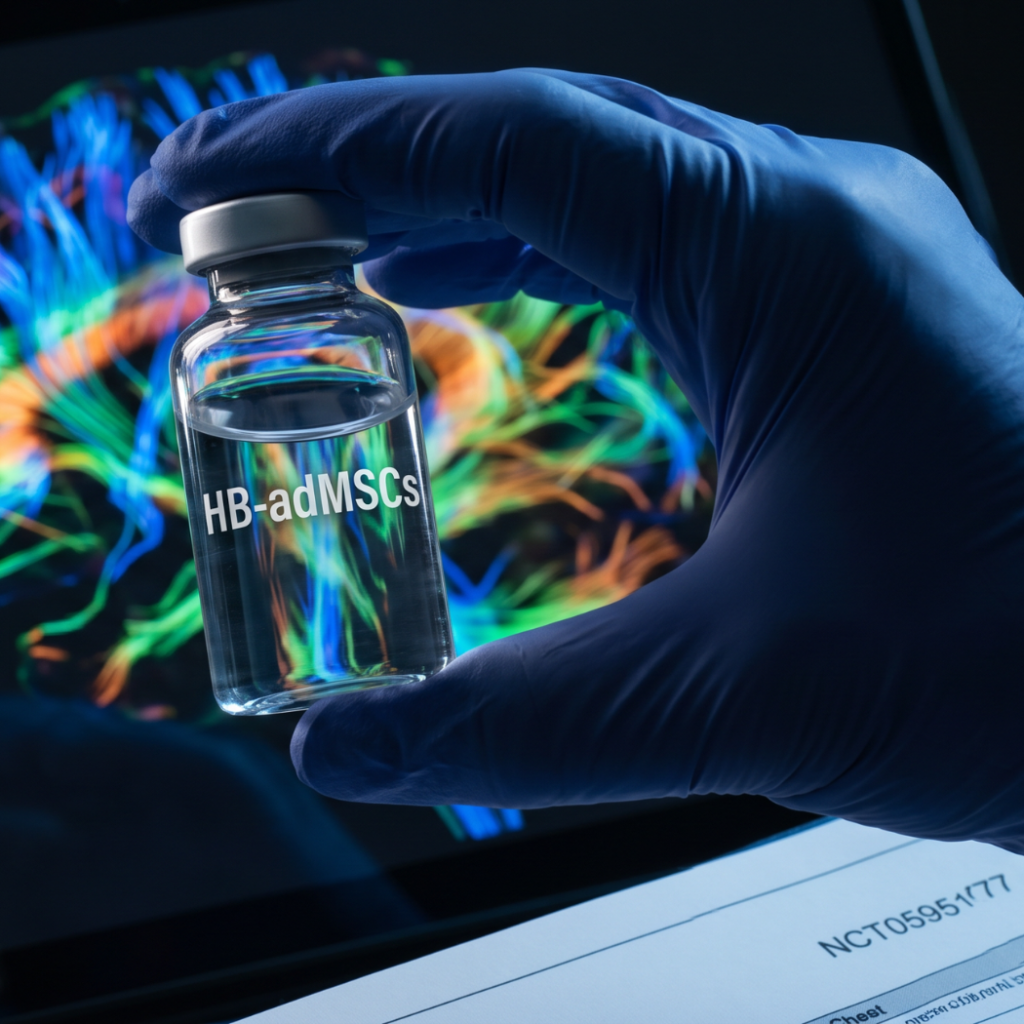
Chronic traumatic brain injury has no FDA-approved disease-modifying or regenerative therapy, leaving treatment largely supportive and rehabilitative. Hope Biosciences’ Phase 2 trial, NCT05951777, is studying the company’s autologous adipose-derived mesenchymal stem cells in chronic TBI against a saline placebo. The banking question this raises is different from the one in a rapidly progressive disease: many TBI patients are young and otherwise healthy, and the practical timing of a banking conversation tends to fall in the post-injury stabilization window. What follows is what treating physicians need to know about the trial as registered and how the timing consideration fits long-term care planning.
TLDR: NCT05951777 is a Hope Biosciences Phase 2 trial of autologous adipose-derived MSCs (HB-adMSCs) versus saline placebo in chronic traumatic brain injury, recruiting, with an estimated completion in December 2026. There is no FDA-approved regenerative therapy for chronic TBI, and Phase 2 status means preliminary efficacy and safety, not established benefit. Because TBI patients are often young with long horizons, the subacute-to-early-chronic phase is typically when a banking discussion is most timely. Each trial has its own manufacturing requirements, so third-party banked tissue does not automatically qualify. Banking adipose tissue does not enroll a patient in therapy and does not guarantee any future eligibility, access, or benefit.
Important Disclaimer: Save My Fat does not provide FDA-approved treatments or cures for any disease. Banking adipose tissue today does not guarantee eligibility, access, or clinical benefit from any future therapy, clinical trial, or medical program. No adipose-derived stem cell product currently holds FDA approval for traumatic brain injury or any condition discussed here. This therapy is investigational. All content is for educational purposes only and does not constitute medical advice. Patients must consult their own licensed healthcare professionals regarding all medical decisions.
The TBI timing argument is more comfortable than the one in a rapidly fatal disease, but it carries the same obligation: the banking conversation is about preserving an option during a window when it is practical to do so, not about offering a treatment for the injury. Physicians who treat TBI through rehabilitation are well placed to raise it as part of long-term planning, provided it stays framed that way.
The Chronic TBI Treatment Gap
Chronic TBI is generally defined as persistent neurological symptoms more than twelve months after a moderate-to-severe injury. Current options are primarily supportive and rehabilitative, and no disease-modifying or regenerative therapy is FDA-approved for the condition. The investigational rationale for MSC therapy rests on the neuroinflammatory and neurodegenerative mechanisms implicated in chronic TBI: MSCs are being studied for possible modulation of neuroinflammation and support of neural repair through paracrine signaling. TBI-related long-term disability affects a large US population, which is part of why the unmet need has drawn investigational cell-therapy interest. As with any early-to-mid-phase program, the mechanism is a hypothesis under test, not an established effect.
Hope Biosciences and the Trial: NCT05951777
Hope Biosciences is a clinical-stage company focused on autologous adipose-derived MSC therapies, and its model is directly relevant to the banking discussion because the autologous banking step is built into its trial approach. As registered on ClinicalTrials.gov, the trial studies autologous adipose-derived MSCs (designated HB-adMSCs) against a normal-saline placebo in chronic TBI. The lead sponsor is Hope Biosciences. The study began in April 2024, lists an estimated enrollment of 51, and has an estimated completion of December 2026. Its current status is recruiting.
| Field | Detail (as registered) |
|---|---|
| NCT number | NCT05951777 |
| Condition | Traumatic brain injury (chronic) |
| Phase | Phase 2 |
| Sponsor | Hope Biosciences |
| Cell type | Autologous adipose-derived MSC (HB-adMSCs) |
| Comparator | Normal saline placebo |
| Enrollment | 51 (estimated) |
| Status | Recruiting |
| Estimated completion | December 2026 |
Because the trial is recruiting, a physician with a potential candidate has a more actionable path than with a closed trial, but inclusion and exclusion criteria should be reviewed against the live record before any referral.
Why Autologous Matters Here
The Hope Biosciences model uses the patient’s own cells, which removes the allogeneic immune-response considerations that accompany donor-derived products and may bear on tolerability. From a banking standpoint, a patient whose tissue is already banked through a cGMP-compliant facility may be positioned to move more readily toward an autologous pathway than one who must undergo harvest as part of enrollment. That advantage has a hard limit worth stating plainly: each trial has its own cell-preparation and manufacturing requirements, so banked tissue from a third-party facility does not automatically qualify for use in a given trial. Patients and physicians should confirm any specific trial’s requirements with the sponsor rather than assume banked tissue is interchangeable.
The Post-Injury Banking-Timing Window
The practical timing of a banking conversation in TBI maps onto the recovery course. In the acute phase the patient is often medically unstable and the conversation is inappropriate. The subacute phase, roughly one to three months post-injury, is when the patient is stabilizing and forward-looking planning becomes reasonable. The early-chronic phase, roughly three to twelve months, is typically when the patient is functional enough for an outpatient harvest and the pipeline is most relevant to long-term planning. In the late-chronic phase, banking remains possible, but the connection to any near-term trial opportunity becomes more distant. The physician managing rehabilitation is usually best placed to introduce the topic, as part of long-term care planning rather than as a treatment recommendation.
| Post-injury phase | Banking-conversation timing | Notes |
|---|---|---|
| Acute (0 to 4 weeks) | Generally not appropriate | Patient medically unstable; focus on acute care |
| Subacute (1 to 3 months) | Introduce as part of long-term planning | Patient stabilizing; reasonable for a forward-looking discussion |
| Early chronic (3 to 12 months) | Typically the most timely window | Patient often functional enough for outpatient harvest |
| Late chronic (1+ years) | Still possible | Banking remains an option; trial relevance more distant |
How the Treating Physician Interacts with the Trial
Review the inclusion and exclusion criteria for any patient who may qualify, and contact Hope Biosciences clinical operations to discuss referral or enrollment while the trial is recruiting. For patients who do not qualify, expanded access is a separate route to consider, with the usual caveat that access is never assured and depends on the sponsor. Document the banking discussion and any referral consideration in the patient’s chart.
Frequently Asked Questions
Is this the same as a Phase 2a trial?
The registry lists it as Phase 2. Some descriptions use “Phase 2a,” but the registered phase is Phase 2, which is the designation a physician should rely on.
Does banked tissue qualify a patient for this trial automatically?
No. The autologous model may position a patient well, but each trial has its own manufacturing requirements, and third-party banked tissue does not automatically qualify. Confirm with the sponsor.
When is the right time to discuss banking with a TBI patient?
Generally the subacute to early-chronic window, once the patient is stabilized and able to tolerate an outpatient procedure. The acute phase is not appropriate.
Key Takeaways
NCT05951777 is a Hope Biosciences Phase 2 trial of autologous adipose-derived MSCs against a saline placebo in chronic TBI, recruiting, with estimated completion in December 2026. The evidence is investigational, no regenerative therapy is FDA-approved for chronic TBI, and Phase 2 tests preliminary efficacy and safety. The autologous model is what links the trial to the banking discussion, but the link is bounded: trial-specific manufacturing requirements mean third-party banked tissue does not automatically qualify, so the sponsor’s requirements govern. The timing of a banking conversation maps onto the recovery course, with the subacute-to-early-chronic window the most practical, and the rehabilitation physician usually best placed to raise it as part of long-term planning. Banking remains a preservation decision separate from therapy, with no guarantee of future benefit.
Save My Fat connects patients and providers with a U.S.-based tissue bank. It is not a tissue bank, a laboratory, a medical practice, or a treatment provider. Stem cell and regenerative medicine regulations vary by state, including specific informed-consent and disclosure requirements in Florida, Utah, California, Georgia, and Tennessee governing tissue and stem cell services. Banking adipose tissue does not connect patients to any treatment pathway, and any future use depends on FDA regulatory status, physician guidance, and the availability of approved or investigational pathways at that time.
Physicians planning long-term TBI care can contact Save My Fat to discuss the tissue-preservation side.
Save My Fat partners with a U.S.-based tissue bank for laboratory processing and storage.
This article is for educational purposes only and does not constitute medical or legal advice. Please consult your neurologist or neurosurgeon before making any decisions about neurologic treatment or research participation.
About the author: Oscar Tellez is the founder and CEO of Save My Fat. He holds a Bachelor of Science in Exercise Science and Health Promotion from Florida Atlantic University. He has spent a decade in the regenerative medicine industry across product distribution, laboratory and vendor relationships, and provider training. He is not a licensed clinician, and this article is educational, not medical advice.
Related guide: the adipose stem cell clinical trials directory.