Florida SB 1768 requires that before stem cells are used in a patient, the physician receive and review a post-thaw viability analysis report from the accredited facility. It is one of the most operationally specific obligations in the statute, and it is frequently misunderstood as a one-time formality rather than a per-use prerequisite. What follows is a physician-level account of what the report is, what it must contain, when it must be received and reviewed, what to do when viability falls below threshold, and how the report functions as the quality readout on the entire upstream banking process.
TLDR: Florida SB 1768 requires an accredited facility (AABB, NMDP, WMDA, or AATB) to provide a post-thaw viability analysis report that the physician must receive and review before each therapeutic use, not just the first. Viability is typically measured by trypan blue exclusion or flow cytometry, with a commonly cited acceptable threshold above roughly 70%, though the threshold varies by cell type and application and should be confirmed with the processing partner. If viability is below threshold, the physician should not proceed with that sample. The report is the quality certificate on the upstream banking process. Banking adipose tissue does not enroll a patient in therapy and does not guarantee any future eligibility, access, or benefit.
Important Disclaimer: Save My Fat does not provide FDA-approved treatments or cures for any disease. Banking adipose tissue today does not guarantee eligibility, access, or clinical benefit from any future therapy, clinical trial, or medical program. No adipose-derived stem cell product currently holds FDA approval for the conditions discussed in this article. All content is for educational purposes only and does not constitute medical or regulatory advice. Patients must consult their own licensed healthcare professionals regarding all medical decisions.
The viability report is easy to treat as a box to check, and that is exactly the mistake the statute is structured to prevent. It is a per-use prerequisite, not a credential earned once, and the physician’s obligation to review it before proceeding is the point at which a quality problem in the banked sample is supposed to be caught before it reaches a patient. Understanding what the report actually conveys is what makes that review meaningful rather than perfunctory.
The Statutory Requirement
Under Florida SB 1768, before stem cells are used in any patient, the accredited facility must provide the physician with a post-thaw viability analysis report, and the physician must receive and review it before proceeding with therapy. Two features matter operationally. First, the requirement applies to every use: each time a patient’s banked tissue is thawed for therapeutic use, a new report is required, because viability is a property of that specific thaw event, not a permanent attribute of the sample. Second, the report must come from a facility accredited by one of the named bodies (AABB, NMDP, WMDA, or AATB), not from the physician or an unaccredited third party. The full statutory checklist is detailed in the SB 1768 compliance overview.
What a Post-Thaw Viability Analysis Is
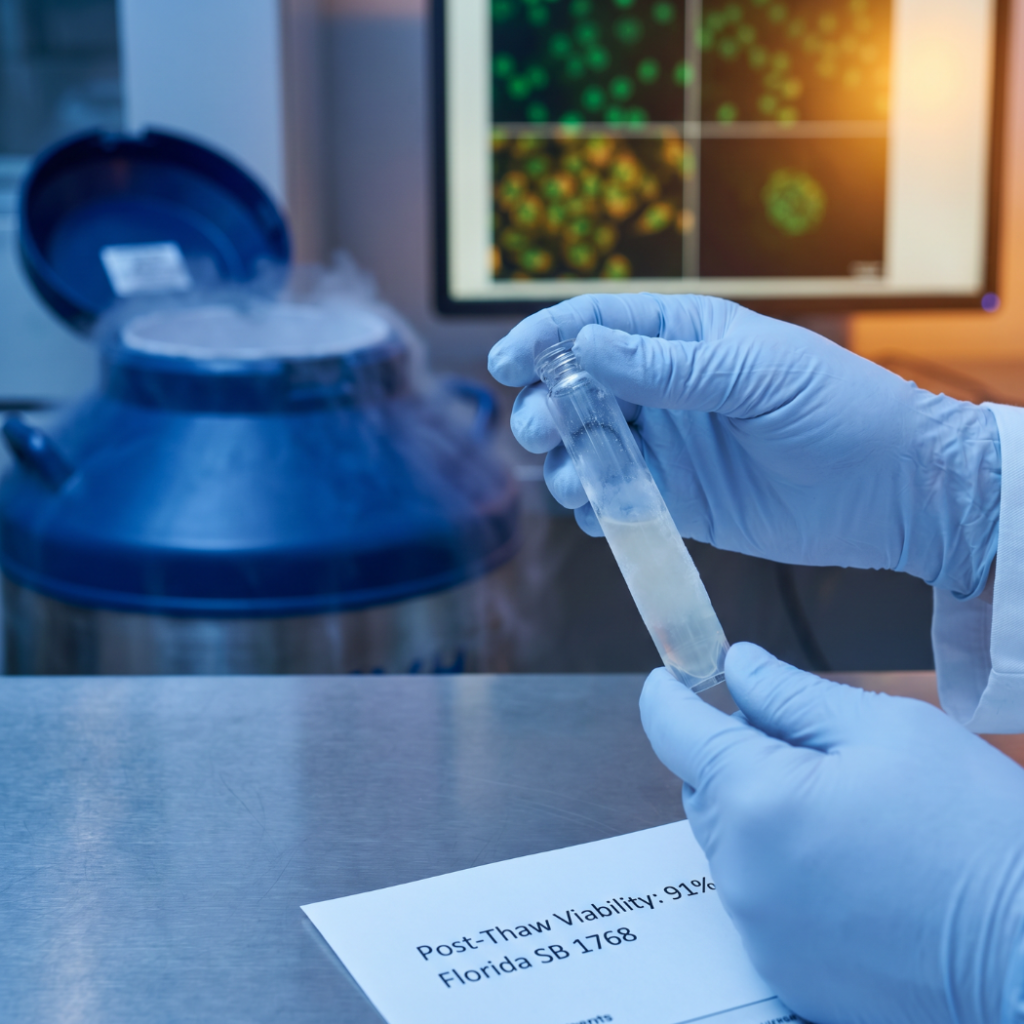
Cryopreservation and thawing can damage cell membranes and reduce the number of viable, functional cells, so a post-thaw analysis measures what fraction of cells in the thawed sample are alive and functional. Two methods are standard. Trypan blue exclusion relies on the fact that dead cells take up the dye while live cells exclude it; a technician counts stained and unstained cells under a microscope to calculate a viability percentage. Flow cytometry using 7-AAD or propidium iodide is more sensitive and quantitative, distinguishing live, dead, and apoptotic populations. Viability testing of this kind is part of the processing and process-control obligations at 21 CFR 1271.220. A commonly cited clinically acceptable threshold is above roughly 70%, but this varies by cell type and therapeutic application, and a physician should ask the processing partner what threshold it uses and what the clinical basis for that threshold is rather than assume a universal number. A complete report also typically reports total cell count, total viable cell count, viable cell concentration, and the method used.
What the Report Must Contain
| Report element | Status under SB 1768 | Clinical relevance |
|---|---|---|
| Patient name and identifier | Required in effect (links report to patient) | Confirms the tissue belongs to the patient being treated |
| Date and time of thaw | Required in effect (links report to the use) | Establishes when viability was assessed |
| Total cell count | Recommended | Whether sufficient cells are present for the intended dose |
| Viable cell count | Core of the analysis | Number of living cells available |
| Viability percentage | Core of the analysis | Quality metric, viable cells as a fraction of total |
| Assay method | Recommended | Lets the physician judge the reliability of the measurement |
| Analyst name or ID | Recommended | Accountability for the analysis |
| Accredited facility and accreditation status | Required, report must come from an accredited facility | Confirms the SB 1768 accreditation requirement is met |
| Batch/lot identifier | Recommended | Links the report to the processing batch record |
| Physician acknowledgment of review | Not specified by statute, strongly recommended | Documents compliance with the review requirement |
When the Report Must Be Received and Reviewed
The statutory sequencing is unambiguous: the report must be received and reviewed before the therapy is performed, which means it cannot be obtained after the fact. Operationally, the physician should establish a workflow with the processing partner so the report is transmitted at least 24 to 48 hours before the scheduled appointment. Same-day transmission introduces compliance risk if receipt or review is delayed. The physician should record the date and time of receipt and review and retain that documentation in the chart alongside the report itself, since the documented review is what evidences compliance with the statutory obligation.
What to Do If Viability Is Below Threshold
If the report shows viability below the clinically acceptable threshold, the physician should not proceed with that sample. The next step is to contact the processing facility to understand the cause, whether a storage issue, a thaw-protocol failure, or factors in the original tissue. If additional banked samples exist, a second thaw and viability assessment may be possible. The patient must be informed, and the consent process should disclose in advance that viability below threshold may require postponing or modifying the plan. Low-viability documentation should be retained, because it is itself evidence of proper compliance with the review requirement even when therapy does not proceed. The cross-state consent obligations that frame this disclosure are covered in the informed consent requirements guide.
How Viability Connects to Banking Quality
The viability report is the quality readout on the entire upstream process: harvest technique, container handling, transport conditions, processing protocol, and cryostorage all influence post-thaw viability. Consistently high viability across multiple thaw events is evidence of a high-quality banking and storage program; consistently low viability from a processing partner is a red flag that warrants escalation to a CGTP compliance review of that partner. In that sense the report is not only a per-use clearance but a continuing audit signal on the program that produced and stored the tissue.
Pre-Use Physician Checklist
- Post-thaw viability report received from the accredited facility.
- Report reviewed before the therapy appointment is finalized.
- Viability meets or exceeds the threshold confirmed with the processing partner.
- Report contains viable cell count, viability percentage, assay method, facility name, and accreditation reference.
- Report linked to the patient by name and identifier.
- Physician acknowledgment of receipt and review signed and dated.
- Report filed in the medical record.
- If below threshold: therapy postponed, facility contacted, patient notified, documentation retained.
Frequently Asked Questions
Is one viability report enough for all future uses of a patient’s banked tissue?
No. SB 1768 requires a report before each therapeutic use. Viability is specific to each thaw event, so a fresh report is required every time a sample is thawed for use.
What viability percentage is required?
The statute does not fix a single number. A threshold above roughly 70% is commonly cited, but it varies by cell type and application. Confirm the threshold and its clinical basis with the processing partner rather than assuming a universal figure.
Who can issue the report?
It must come from a facility accredited by AABB, NMDP, WMDA, or AATB. A report generated by the physician or an unaccredited third party does not satisfy the requirement.
Key Takeaways
The post-thaw viability report is a per-use prerequisite under SB 1768, not a one-time formality: the accredited facility must supply it, and the physician must receive and review it before every therapeutic use. Viability is measured by trypan blue exclusion or flow cytometry, with a commonly cited threshold above roughly 70% that nonetheless varies by application and should be confirmed with the partner. Below-threshold viability means the physician does not proceed with that sample, contacts the facility, informs the patient, and retains the documentation. Functionally, the report is the quality certificate on the entire upstream banking process and a continuing signal on the partner’s program. Banking remains a preservation decision separate from therapy, with no guarantee of future benefit.
Save My Fat connects patients and providers with a U.S.-based tissue bank. It is not a tissue bank, a laboratory, a medical practice, or a treatment provider. Stem cell and regenerative medicine regulations vary by state, including specific informed-consent and disclosure requirements in Florida, Utah, California, Georgia, and Tennessee governing tissue and stem cell services. Banking adipose tissue does not connect patients to any treatment pathway, and any future use depends on FDA regulatory status, physician guidance, and the availability of approved or investigational pathways at that time.
Florida physicians building a viability-review workflow can contact Save My Fat to discuss how reporting is handled on the processing side.
Save My Fat partners with a U.S.-based tissue bank for laboratory processing and storage.
This article is for educational purposes only and does not constitute medical or legal advice. Please consult your own licensed healthcare provider before making any decisions about treatment or research participation.
About the author: Oscar Tellez is the founder and CEO of Save My Fat. He holds a Bachelor of Science in Exercise Science and Health Promotion from Florida Atlantic University. He has spent a decade in the regenerative medicine industry across product distribution, laboratory and vendor relationships, and provider training. He is not a licensed clinician, and this article is educational, not medical advice.
Related guide: state stem cell laws.