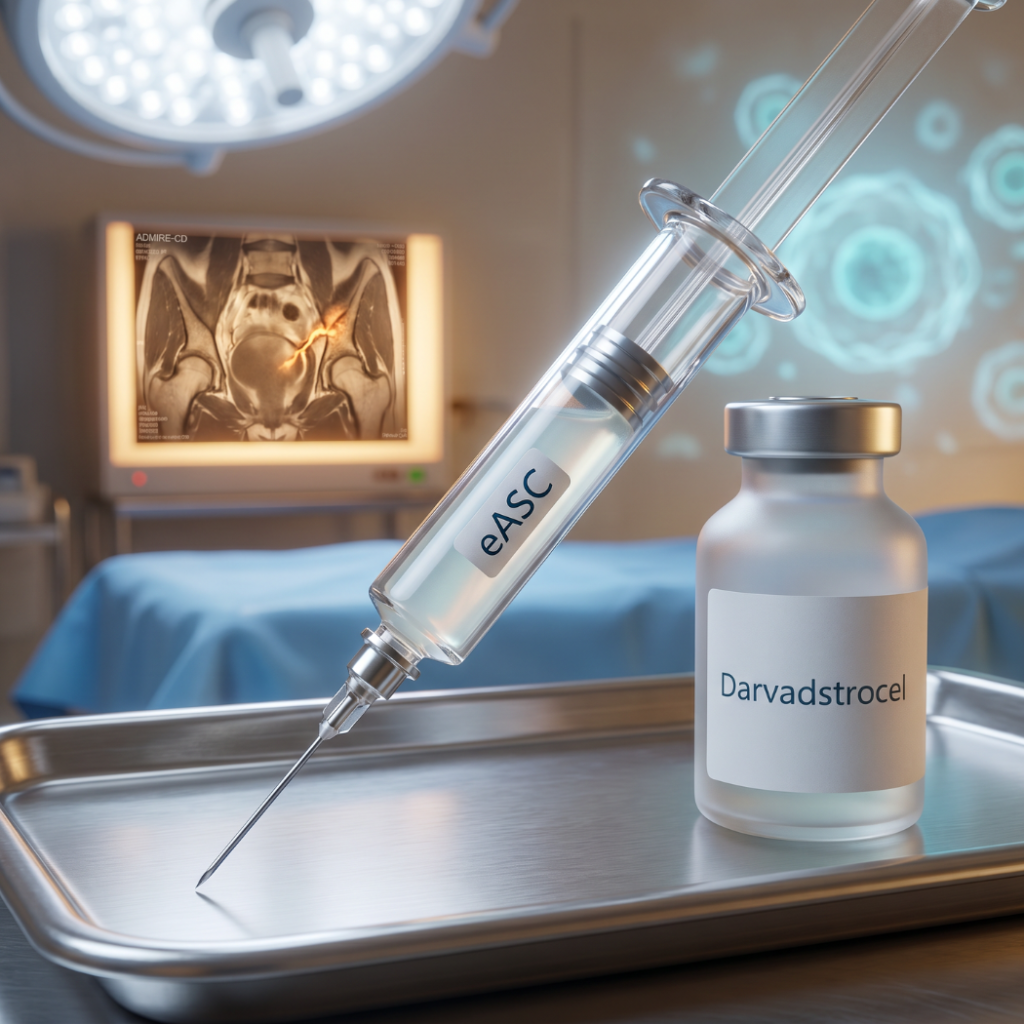
Darvadstrocel (cx601, marketed as Alofisel) was the first allogeneic adipose-derived mesenchymal stem cell therapy to receive central marketing authorization from a major regulator, when the European Commission approved it in 2018 for complex perianal fistulas in Crohn’s disease. It is also a cautionary case: the confirmatory Phase 3 trial failed in 2023, and the EU marketing authorization was withdrawn at the company’s request in December 2024. For GI physicians, the full arc, approval on one pivotal trial, then failure to confirm and withdrawal, is more instructive than the approval alone, and it is the version that survives contact with the current record.
TLDR: Darvadstrocel (cx601 / Alofisel), an allogeneic adipose-derived MSC therapy for complex perianal fistula in Crohn’s disease, was EMA-approved in March 2018 based on the ADMIRE-CD Phase 3 trial (combined remission 51.5% vs 35.6% placebo at 24 weeks; published in The Lancet, July 2016). The confirmatory ADMIRE-CD II trial (568 patients) did not meet its primary endpoint in 2023, and Takeda withdrew the EU marketing authorization in December 2024. There is no FDA-approved version in the US. Darvadstrocel is allogeneic, so it is not itself an autologous-banking pathway. Banking adipose tissue does not enroll a patient in therapy and does not guarantee any future eligibility, access, or benefit.
Important Disclaimer: Save My Fat does not provide FDA-approved treatments or cures for any disease. Banking adipose tissue today does not guarantee eligibility, access, or clinical benefit from any future therapy, clinical trial, or medical program. No adipose-derived stem cell product currently holds FDA approval for the conditions discussed in this article. All content is for educational purposes only and does not constitute medical advice. Patients must consult their own licensed healthcare professionals regarding all medical decisions.
It would be easy to tell this story as a straightforward proof of concept, and an earlier version of the regenerative-medicine narrative did exactly that. The current record does not support it. Telling the accurate version matters here more than usual, because a GI physician counseling a Crohn’s patient needs to know that the one adipose MSC product to reach approval in a major market subsequently failed its confirmatory trial and was pulled. That is the responsible thing to convey, and it is also genuinely useful.
Why This Story Matters Beyond GI
Darvadstrocel’s arc is a case study in the difference between reaching approval and sustaining it. When the European Commission approved Alofisel in March 2018, it was the first allogeneic stem cell therapy to receive central marketing authorization in Europe, and it was widely cited as proof that adipose-derived MSC therapy could move through Phase 3 and achieve approval. That framing held until the confirmatory data arrived. The lesson for the broader field, and for any physician weighing investigational cell therapies, is that a single positive pivotal trial is a milestone, not a guarantee of durable benefit, and confirmatory trials exist precisely because some approvals do not hold up. Understanding what trial phases establish and what they do not is foundational, as the explainer on clinical trial phases sets out.
What Is Crohn’s Perianal Fistula?
Perianal fistula is a treatment-refractory complication affecting a substantial minority of Crohn’s disease patients. Standard options include anti-TNF agents and surgical intervention, and many patients do not achieve durable remission. The investigational rationale for MSC therapy rested on the immunomodulatory properties of mesenchymal cells, which were hypothesized to address the inflammatory pathophysiology underlying fistula formation and persistence. That rationale produced a genuine signal in the first pivotal trial, which is what makes the confirmatory failure instructive rather than merely disappointing.
The Darvadstrocel Evidence Arc
The original Phase 3 trial, ADMIRE-CD, was a randomized, double-blind, placebo-controlled study in 212 adults with complex perianal fistula and non-active or mildly active luminal Crohn’s disease. A significantly greater proportion of the darvadstrocel group achieved the primary endpoint of combined remission at 24 weeks, 51.5% versus 35.6% for control, with the 24-week results published in The Lancet in July 2016. On that basis the EMA’s committees issued a positive opinion in December 2017, and the European Commission granted marketing authorization in March 2018 for complex perianal fistulas in adults with non-active or mildly active luminal Crohn’s disease who had responded inadequately to at least one conventional or biologic therapy.
The confirmatory trial changed the picture. ADMIRE-CD II, a 568-patient randomized placebo-controlled study intended to support a US Biologic License Application, did not meet its primary endpoint: combined remission at 24 weeks was 48.8% with darvadstrocel versus 46.3% with placebo, with no statistically significant difference, and secondary endpoints were similar. Following that result, Takeda withdrew the EU marketing authorization for Alofisel in December 2024. There is no FDA-approved darvadstrocel product in the US.
| Item | Detail |
|---|---|
| Product | Darvadstrocel (cx601 / Alofisel) |
| Developer | TiGenix, acquired by Takeda |
| Cell type | Allogeneic adipose-derived MSC |
| Indication | Complex perianal fistula in Crohn’s disease |
| Pivotal trial | ADMIRE-CD (n=212): 51.5% vs 35.6% combined remission at 24 weeks |
| Lancet publication | July 2016 |
| EMA approval | March 2018 |
| Confirmatory trial | ADMIRE-CD II (n=568): primary endpoint not met (2023) |
| EU status | Marketing authorization withdrawn December 2024 |
| US FDA status | No approved product |
What This Means for GI Physicians in the US
US physicians cannot prescribe darvadstrocel; there is no approved US product, and the EU authorization has been withdrawn. What a GI physician can do is understand this arc and represent it accurately to patients who ask: a product that looked like the field’s leading proof of concept failed its confirmatory trial and is no longer marketed in the EU. For patients interested in research participation, the appropriate step is to search current Crohn’s disease MSC trials at ClinicalTrials.gov, and physicians can use the guide on finding legitimate clinical trials to vet what they find. The banking point for Crohn’s patients must be made carefully and modestly: darvadstrocel was an allogeneic, donor-derived product, so its story is not itself an argument about autologous banking. The autologous adipose MSC pipeline for inflammatory conditions exists separately and is at earlier stages, and a patient who banks autologous tissue is preserving an option relevant to autologous pathways, not to this withdrawn allogeneic product.
The Broader Adipose MSC Pipeline for IBD
Beyond perianal fistula, adipose MSC research has explored applications in other inflammatory bowel conditions, but these are earlier-stage efforts and are mentioned here only as pipeline context, not as available options. The darvadstrocel experience is a useful calibration for how to read them: early signals warrant interest, but durable benefit is established only through confirmatory trials, some of which fail. A GI physician who stays current on this pipeline, with that calibration in mind, is better placed to counsel patients with chronic IBD realistically about long-term options.
Physician-Patient Discussion Guide
On darvadstrocel: it was EMA-approved in 2018 for perianal fistula based on one pivotal trial, its confirmatory trial failed in 2023, the EU authorization was withdrawn in December 2024, and there is no approved US product. On banking: adipose tissue banking is the preservation of a patient’s own fat-derived cells for potential future use; some patients with chronic conditions choose to bank, and it does not guarantee access to any therapy. What not to say: do not imply that banking will lead to treatment of a patient’s Crohn’s disease, which is neither established nor permissible to claim.
Frequently Asked Questions
Is Alofisel available anywhere now?
Its EU marketing authorization was withdrawn in December 2024 after the confirmatory ADMIRE-CD II trial did not meet its primary endpoint. There is no FDA-approved product in the US. A physician should verify current status in any specific jurisdiction before relying on it.
Does the darvadstrocel approval prove adipose banking works?
No. Darvadstrocel was an allogeneic, donor-derived product, so it is not an autologous-banking pathway, and its confirmatory trial failed. Banking concerns autologous tissue and a separate, earlier-stage pipeline; this product’s arc does not establish a banking benefit.
Can a US GI physician prescribe this for a Crohn’s patient?
No. There is no FDA-approved darvadstrocel product in the US, and the EU authorization has been withdrawn. Research participation through a current trial is the only investigational route, subject to eligibility.
Key Takeaways
Darvadstrocel is the most important case study in adipose-derived MSC therapy precisely because its story did not end at approval. EMA-approved in 2018 on the strength of ADMIRE-CD, it failed its confirmatory ADMIRE-CD II trial in 2023, and Takeda withdrew the EU authorization in December 2024; there is no approved US product. For GI physicians, the accurate version is the useful one: a single positive pivotal trial is a milestone, not proof of durable benefit, and confirmatory trials sometimes overturn the initial signal. Because darvadstrocel was allogeneic, its arc says nothing for or against autologous banking, which concerns a separate and earlier-stage pipeline. Banking remains a preservation decision separate from therapy, carrying no guarantee of future benefit, and nothing about it should be presented to a Crohn’s patient as a route to treating their disease.
Save My Fat connects patients and providers with a U.S.-based tissue bank. It is not a tissue bank, a laboratory, a medical practice, or a treatment provider. Stem cell and regenerative medicine regulations vary by state, including specific informed-consent and disclosure requirements in Florida, Utah, California, Georgia, and Tennessee governing tissue and stem cell services. Banking adipose tissue does not connect patients to any treatment pathway, and any future use depends on FDA regulatory status, physician guidance, and the availability of approved or investigational pathways at that time.
GI physicians counseling patients on the regenerative pipeline can contact Save My Fat to discuss the tissue-preservation side.
Save My Fat partners with a U.S.-based tissue bank for laboratory processing and storage.
This article is for educational purposes only and does not constitute medical or legal advice. Please consult your own licensed healthcare provider before making any decisions about treatment or research participation.
About the author: Oscar Tellez is the founder and CEO of Save My Fat. He holds a Bachelor of Science in Exercise Science and Health Promotion from Florida Atlantic University. He has spent a decade in the regenerative medicine industry across product distribution, laboratory and vendor relationships, and provider training. He is not a licensed clinician, and this article is educational, not medical advice.
Related guide: the adipose stem cell clinical trials directory.