Amyotrophic lateral sclerosis is a fatal, rapidly progressive neurodegenerative disease, and the speed of that progression creates the most time-sensitive banking consideration in regenerative medicine. Most patients lose the functional capacity for an outpatient harvest procedure within roughly 18 to 36 months of diagnosis. Mayo Clinic’s Phase 2 trial, NCT03268603, is studying intrathecal autologous adipose-derived mesenchymal stromal cells in ALS. What follows is what neurologists need to know about the trial as registered, the state of the evidence, and the disease-stage timing that makes the banking conversation, if it happens at all, an early-diagnosis conversation.
TLDR: NCT03268603 is a Mayo Clinic Phase 2 trial of intrathecal autologous adipose-derived mesenchymal stromal cells in ALS, active but not recruiting, enrollment 75, with an estimated completion at the end of 2026; its primary endpoint is adverse events, reflecting a safety-focused design. No MSC therapy is FDA-approved for ALS, and all current data is investigational. Because ALS progresses quickly and harvest requires a patient well enough for a minor outpatient procedure, the banking window is finite and closes as the disease advances. Banking adipose tissue does not enroll a patient in therapy, does not alter the course of ALS, and does not guarantee any future eligibility, access, or benefit.
Important Disclaimer: Save My Fat does not provide FDA-approved treatments or cures for any disease. Banking adipose tissue today does not guarantee eligibility, access, or clinical benefit from any future therapy, clinical trial, or medical program. No adipose-derived stem cell product currently holds FDA approval for ALS or any condition discussed here. This therapy is investigational. All content is for educational purposes only and does not constitute medical advice. Patients must consult their own licensed healthcare professionals regarding all medical decisions.
This is the post in the series where the timing argument is most pointed and where the discipline around it matters most. ALS forecloses the harvest window faster than almost any other condition, which makes the early-diagnosis banking conversation genuinely consequential. That same urgency is exactly why the framing has to stay honest: banking preserves an option, it does not slow the disease, and nothing about it should be presented to an ALS patient or family as treatment.
The Treatment Gap in ALS
ALS is a progressive neurodegenerative disease affecting upper and lower motor neurons, with median survival commonly cited at two to five years from symptom onset. The FDA-approved therapies, riluzole, edaravone, and the sodium phenylbutyrate-taurursodiol combination, modestly slow progression but do not halt or reverse the disease. The investigational rationale for MSC therapy rests on immunomodulatory and possible neuroprotective properties: preclinical work suggests MSCs may reduce neuroinflammation, support motor-neuron survival, and modulate glial activity. Intrathecal delivery is used to place cells in the cerebrospinal fluid, in closer proximity to affected motor neurons than systemic delivery allows. These mechanisms remain hypotheses under test, not established effects, which is the distinction the clinical trial phases explainer lays out.
The Mayo Clinic Intrathecal MSC Trial: NCT03268603
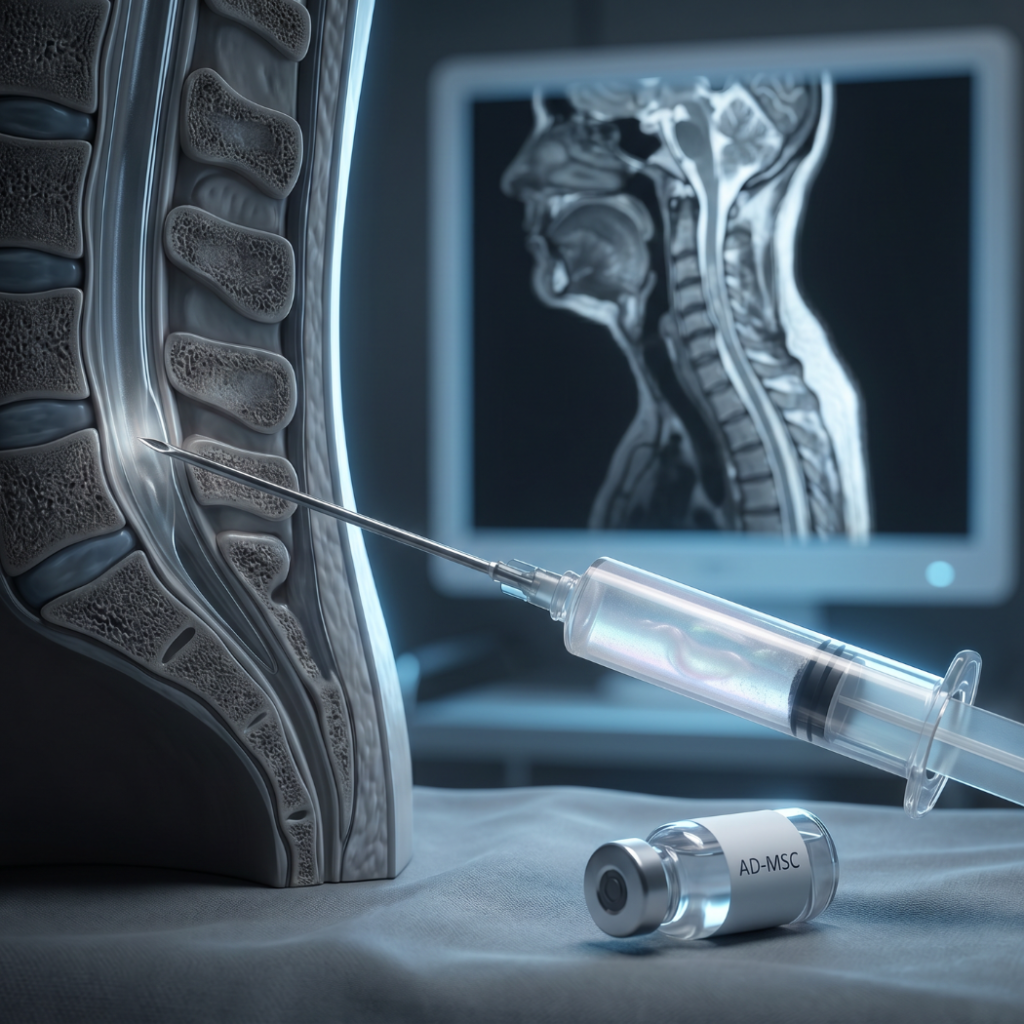
As registered on ClinicalTrials.gov, the trial studies intrathecal autologous adipose-derived mesenchymal stromal cells in ALS. The lead sponsor is Mayo Clinic, the phase is Phase 2, enrollment is 75, the study began in 2017, and estimated completion is the end of 2026. Its current status is active, not recruiting. The registered primary endpoint is adverse events, which signals that this Phase 2 is oriented heavily toward safety and tolerability rather than a powered efficacy outcome.
| Field | Detail (as registered) |
|---|---|
| NCT number | NCT03268603 |
| Condition | ALS |
| Phase | Phase 2 |
| Sponsor | Mayo Clinic |
| Cell type | Autologous adipose-derived MSC |
| Route | Intrathecal |
| Primary endpoint | Adverse events (safety) |
| Enrollment | 75 |
| Status | Active, not recruiting |
| Estimated completion | End of 2026 |
Because the trial is active but not recruiting, a neurologist with a potential candidate should verify current status at the trial record before any referral conversation, since an active-but-not-recruiting study may have no open enrollment slot.
What the Evidence Base Looks Like
This Phase 2 follows earlier-phase Mayo Clinic work on intrathecal autologous MSCs in ALS, which examined safety and dosing. The honest characterization is precise: there is no FDA-approved MSC therapy for ALS, all existing data is investigational, and a Phase 2 with adverse events as its primary endpoint is designed to characterize safety and tolerability at scale and to look for preliminary signals, not to establish efficacy or standard of care. Earlier intrathecal MSC work in ALS has reported the procedure to be feasible while underscoring that benefit remains unproven. A neurologist should treat the current state as hypothesis-testing and represent it that way to patients.
The ALS Banking-Timing Argument
This is where the disease course makes timing decisive, and it has to be written carefully. ALS stages can be described broadly as early, with ambulation maintained and upper-extremity function largely intact; middle, with progressive limb weakness and possible dysarthria; and late, with significant loss of mobility and frequently respiratory involvement. Adipose-tissue harvest is an outpatient procedure requiring the patient to tolerate minor anesthesia and a small incision. In early-stage disease that is generally feasible. In middle-stage disease it may still be feasible with anesthesia consultation and planning. In late-stage disease it may not be medically feasible at all. The consequence is concrete: once harvest is no longer appropriate, the autologous option is foreclosed regardless of what trials or therapies later become available. The physician who raises banking with a newly diagnosed ALS patient is not overselling a therapy; they are documenting a clinical option that, if not acted on in the early window, becomes permanently unavailable. That framing has to hold both halves at once. Banking preserves optionality, and banking does not guarantee access to any therapy, does not guarantee trial eligibility, and does not alter the course of ALS.
The ALS Disease-Stage Banking-Timing Guide
| ALS stage | Functional status | Harvest feasibility | Reasonable action |
|---|---|---|---|
| Early (ambulatory, upper-extremity function intact) | High | Generally feasible as outpatient | Introduce the banking discussion; if the patient is interested, do not delay |
| Middle (progressive weakness, mild dysarthria) | Moderate | May still be feasible; anesthesia consult advised | Assess feasibility now rather than later |
| Late (significant mobility loss, respiratory involvement) | Low | Often not medically feasible | Window may be closed; discuss allogeneic-trial and expanded-access options |
| Newly diagnosed (undifferentiated) | Varies | Assess at each visit | Make banking part of the early care-plan conversation |
Expanded Access for Patients Who Cannot Enroll
Not every ALS patient will meet a trial’s inclusion and exclusion criteria or be able to enroll. Expanded access, sometimes called compassionate use, allows a physician to request an investigational therapy for an individual patient outside a trial, subject to sponsor agreement and FDA authorization. The Reagan-Udall Expanded Access Navigator is the standard starting point for identifying which sponsors operate expanded-access programs and how to apply. Access is never assured, since it depends on the sponsor’s willingness to provide the investigational product, but it is a route worth understanding for patients who cannot enroll.
Physician Action Checklist
- Verify current trial status at the NCT03268603 record.
- Review inclusion and exclusion criteria for newly diagnosed patients.
- Contact the Mayo Clinic trial coordinator for potentially eligible patients.
- Introduce the banking discussion at the first or second visit after diagnosis.
- Document the banking discussion and the patient’s decision in the chart.
- For patients who cannot enroll, review expanded-access options.
- Reassess harvest feasibility at each follow-up for patients who have not yet banked.
Frequently Asked Questions
Is this ALS trial enrolling now?
As registered, its status is active, not recruiting, meaning it is ongoing but not currently enrolling. Confirm at the live trial record before pursuing a referral.
Does banking tissue slow ALS?
No. Banking is the preservation of a patient’s own adipose tissue. It does not alter the course of ALS and is not a treatment. Its only function is to preserve the option of an autologous approach if and when a suitable therapy or trial becomes available.
Why does timing matter so much in ALS specifically?
Because ALS progresses quickly, and harvest requires a patient well enough for a minor outpatient procedure. The window for harvest is finite and tends to close within a few years of diagnosis, after which the autologous option is foreclosed.
Key Takeaways
NCT03268603 is a Mayo Clinic Phase 2 trial of intrathecal autologous adipose-derived MSCs in ALS, active but not recruiting, enrolling 75, with a safety-oriented primary endpoint and estimated completion at the end of 2026. The evidence is investigational, no MSC therapy is approved for ALS, and a Phase 2 built around adverse events is testing safety and tolerability, not establishing benefit. What distinguishes ALS in this series is the speed at which the harvest window closes, which makes the banking conversation, if a patient wants to have it, an early-diagnosis conversation by necessity. That urgency does not change the substance: banking preserves an option that disease progression would otherwise foreclose, and it neither treats ALS nor guarantees access to anything. It remains a preservation decision separate from therapy, with no guarantee of future benefit.
Save My Fat connects patients and providers with a U.S.-based tissue bank. It is not a tissue bank, a laboratory, a medical practice, or a treatment provider. Stem cell and regenerative medicine regulations vary by state, including specific informed-consent and disclosure requirements in Florida, Utah, California, Georgia, and Tennessee governing tissue and stem cell services. Banking adipose tissue does not connect patients to any treatment pathway, and any future use depends on FDA regulatory status, physician guidance, and the availability of approved or investigational pathways at that time.
Neurologists counseling newly diagnosed ALS patients on preserving future options can contact Save My Fat to discuss the tissue-preservation side.
Save My Fat partners with a U.S.-based tissue bank for laboratory processing and storage.
This article is for educational purposes only and does not constitute medical or legal advice. Please consult your neurologist or neurosurgeon before making any decisions about neurologic treatment or research participation.
About the author: Oscar Tellez is the founder and CEO of Save My Fat. He holds a Bachelor of Science in Exercise Science and Health Promotion from Florida Atlantic University. He has spent a decade in the regenerative medicine industry across product distribution, laboratory and vendor relationships, and provider training. He is not a licensed clinician, and this article is educational, not medical advice.
Related guide: the adipose stem cell clinical trials directory.