Heart failure is a chronic, progressive condition affecting millions of Americans, and despite guideline-directed medical therapy, a substantial share of patients remain symptomatic. That has driven investigational interest in mesenchymal stem cell therapy on the basis of paracrine cardioprotective mechanisms. The most-cited adipose-derived program, the Danish CSCC_ASC trial (NCT03092284), is a useful anchor for understanding the evidence, with one important caveat: it studied an allogeneic product and has completed. What follows is an accurate read of that trial and the broader pipeline, and an honest version of why the long heart-failure time horizon shapes the banking conversation.
TLDR: NCT03092284 (the Danish CSCC_ASC trial) studied an allogeneic adipose-derived stem cell product against placebo in chronic heart failure, Phase 2, with a primary endpoint of change in left-ventricular end-systolic volume at 6 months; it has completed (it ran 2015 to 2022). Because it is allogeneic, it is not itself an autologous-banking pathway. No MSC therapy is FDA-approved for heart failure. The banking rationale for heart-failure patients rests on the long disease course and the broader autologous pipeline, not on this trial. Banking adipose tissue does not enroll a patient in therapy and does not guarantee any future eligibility, access, or benefit.
Important Disclaimer: Save My Fat does not provide FDA-approved treatments or cures for any disease. Banking adipose tissue today does not guarantee eligibility, access, or clinical benefit from any future therapy, clinical trial, or medical program. No adipose-derived stem cell product currently holds FDA approval for the conditions discussed in this article. The trials referenced here are investigational. All content is for educational purposes only and does not constitute medical advice. Patients must consult their own licensed healthcare professionals regarding all medical decisions.
A cardiologist reading a banking-relevant post about heart failure deserves the accurate version of the headline trial, not a tidied one. The CSCC_ASC trial is frequently cited as the marquee adipose heart-failure study, and it is worth knowing, but it is allogeneic and completed, which means it does not function as a reason to bank a patient’s own fat. The genuine banking argument for heart failure is different and more durable, and it stands on its own without overstating any single study.
Why Cell Therapy Is Being Investigated in Heart Failure
Even with optimal guideline-directed medical therapy, many heart-failure patients remain symptomatic and continue to progress, which is the gap cell therapy is being studied to address. The investigational rationale rests on paracrine mechanisms: MSCs are hypothesized to reduce myocardial fibrosis, promote angiogenesis, and modulate cardiac inflammation. Multiple Phase 1 and Phase 2 trials have examined safety and looked for preliminary functional signals, but no MSC therapy is FDA-approved for heart failure, and the mechanisms remain investigational rather than established. Understanding what each trial phase actually establishes is worth grounding through the clinical trial phases explainer.
The CSCC_ASC Trial: NCT03092284
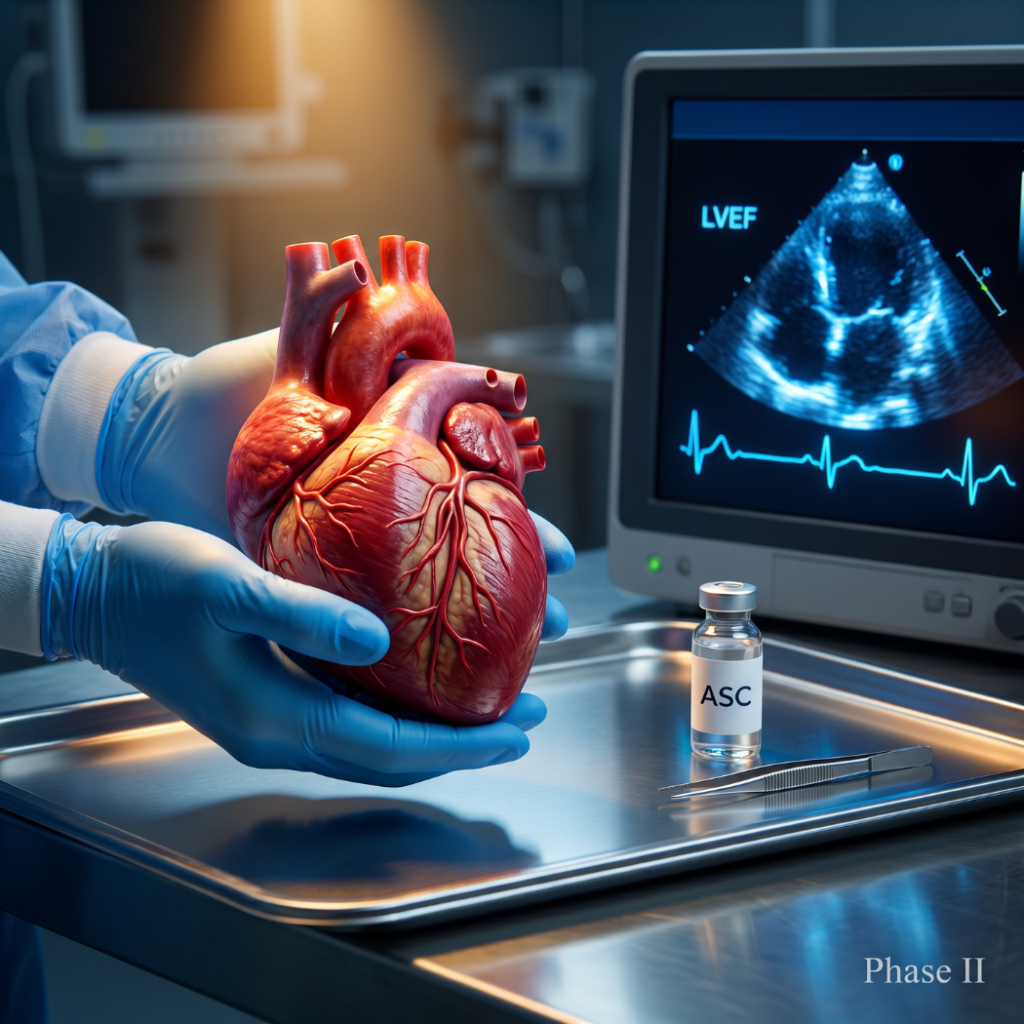
As registered on ClinicalTrials.gov, this Danish trial studied the Cardiology Stem Cell Centre adipose-derived stem cell product (CSCC_ASC) against placebo in chronic heart failure. Two facts about it shape how a cardiologist should read it. First, the cells are allogeneic, donor-derived rather than the patient’s own, so the trial does not test an autologous approach and does not bear on the rationale for a patient banking their own tissue. Second, the trial has completed; it ran from 2015 to 2022. Its phase is Phase 2, enrollment was 81, and its primary endpoint was change in left-ventricular end-systolic volume from baseline to six months, measured by echocardiography.
| Field | Detail (as registered) |
|---|---|
| NCT number | NCT03092284 |
| Condition | Chronic heart failure |
| Phase | Phase 2 |
| Sponsor | Investigator-sponsored (Denmark) |
| Cell type | Allogeneic adipose-derived stem cell (CSCC_ASC) |
| Comparator | Placebo |
| Primary endpoint | Change in LV end-systolic volume at 6 months (echocardiography) |
| Enrollment | 81 |
| Status | Completed (2022) |
Because it is allogeneic and completed, this trial is best read as part of the heart-failure cell-therapy evidence base, not as an enrollment opportunity and not as a banking rationale.
The Broader Heart-Failure MSC Evidence Base
Beyond this single trial, the broader heart-failure cell-therapy literature includes a range of Phase 1 and Phase 2 studies of adipose-derived and bone-marrow-derived MSCs, some autologous and some allogeneic, examining safety, ejection-fraction signals, and exercise-capacity measures. The honest summary of where the field stands: early-phase work has generally supported safety and produced mixed preliminary signals, but durable, Phase 3 outcomes data establishing benefit on hard endpoints has not been delivered, and that is what FDA approval would require. A cardiologist should treat the field as investigational and promising in parts, not as a source of available therapy.
The Long-Timeline Banking Argument for Heart-Failure Patients
The banking argument in heart failure is distinct from the one in rapidly progressive disease, and it does not depend on the CSCC_ASC trial. Heart failure often follows a long course with extended periods of relative stability, so the relevant feature is durability rather than a closing window. A patient diagnosed with reduced-ejection-fraction heart failure in their fifties may have a multi-decade disease course over which the autologous pipeline may evolve. Banking preserves that patient’s own tissue across that horizon. There is also a practical efficiency worth raising as a planning matter, not a protocol: patients undergoing cardiac surgery such as bypass or valve repair are already in a surgical episode, and where appropriate, adipose harvest could be discussed as an adjunct to a procedure the patient is already having. Any such harvest must be separately planned, consented, and executed in compliance with applicable tissue-banking and CGTP requirements under 21 CFR Part 1271; it is a conversation to have in advance with the processing partner, not something improvised intraoperatively. As always, the rationale is optionality across a long timeline, not a promise that any therapy will arrive or work.
How Cardiologists Can Stay Current
The heart-failure cell-therapy pipeline continues to post new trials, and a practical way to track it is a ClinicalTrials.gov search alert combining heart failure with mesenchymal stem cell or adipose terms. For patients asking about participation, the standard step is to review current trials and eligibility before any referral, and the guide on finding legitimate clinical trials helps separate registered research from clinics marketing unproven services. Where a patient cannot enroll, expanded access is a separate route to understand, with the usual caveat that access is never assured.
Cardiology Banking-Integration Checklist
- Identify heart-failure patients who are candidates for a banking discussion: stable, early-to-mid disease, functional for an outpatient procedure.
- Review active heart-failure cell-therapy trials for any patient interested in research participation.
- For patients undergoing cardiac surgery, assess whether adipose harvest can be appropriately discussed and consented as a planned adjunct.
- Ensure any harvest during a surgical episode is planned with the tissue-banking partner in advance.
- Document the banking discussion and the patient’s decision in the chart.
- Set a ClinicalTrials.gov alert for heart-failure MSC trials.
- Review expanded-access options for patients unable to enroll.
Frequently Asked Questions
Is the CSCC_ASC trial a reason for a patient to bank their own fat?
No. That trial used an allogeneic, donor-derived product, so banking a patient’s own tissue is not relevant to it, and the trial has completed. The banking rationale in heart failure rests on the long disease course and the broader autologous pipeline, not on this study.
Is any MSC therapy approved for heart failure?
No. The evidence is investigational. Early-phase trials have examined safety and preliminary signals, but no MSC therapy is FDA-approved for heart failure.
Can adipose tissue be harvested during cardiac surgery?
It can be discussed as a planned adjunct where appropriate, but it must be separately consented and executed in compliance with tissue-banking and CGTP requirements, arranged in advance with the processing partner rather than improvised during the procedure.
Key Takeaways
The CSCC_ASC trial (NCT03092284) is the most-cited adipose heart-failure study and is worth knowing, but a cardiologist should read it accurately: it is allogeneic and completed, so it is neither an enrollment opportunity nor a reason to bank a patient’s own tissue. No MSC therapy is approved for heart failure, and the broader evidence base supports safety with mixed preliminary signals and no established Phase 3 benefit. The banking argument in heart failure is genuinely different from the one in rapidly progressive disease: it rests on durability across a long, often stable disease course, with the surgical-episode harvest as a practical planning option that must still meet full tissue-banking and CGTP requirements. Banking remains a preservation decision separate from therapy, with no guarantee of future benefit.
Save My Fat connects patients and providers with a U.S.-based tissue bank. It is not a tissue bank, a laboratory, a medical practice, or a treatment provider. Stem cell and regenerative medicine regulations vary by state, including specific informed-consent and disclosure requirements in Florida, Utah, California, Georgia, and Tennessee governing tissue and stem cell services. Banking adipose tissue does not connect patients to any treatment pathway, and any future use depends on FDA regulatory status, physician guidance, and the availability of approved or investigational pathways at that time.
Cardiologists planning long-term heart-failure care can contact Save My Fat to discuss the tissue-preservation side.
Save My Fat partners with a U.S.-based tissue bank for laboratory processing and storage.
This article is for educational purposes only and does not constitute medical or legal advice. Please consult your own licensed healthcare provider before making any decisions about treatment or research participation.
About the author: Oscar Tellez is the founder and CEO of Save My Fat. He holds a Bachelor of Science in Exercise Science and Health Promotion from Florida Atlantic University. He has spent a decade in the regenerative medicine industry across product distribution, laboratory and vendor relationships, and provider training. He is not a licensed clinician, and this article is educational, not medical advice.
Related guide: the adipose stem cell clinical trials directory.