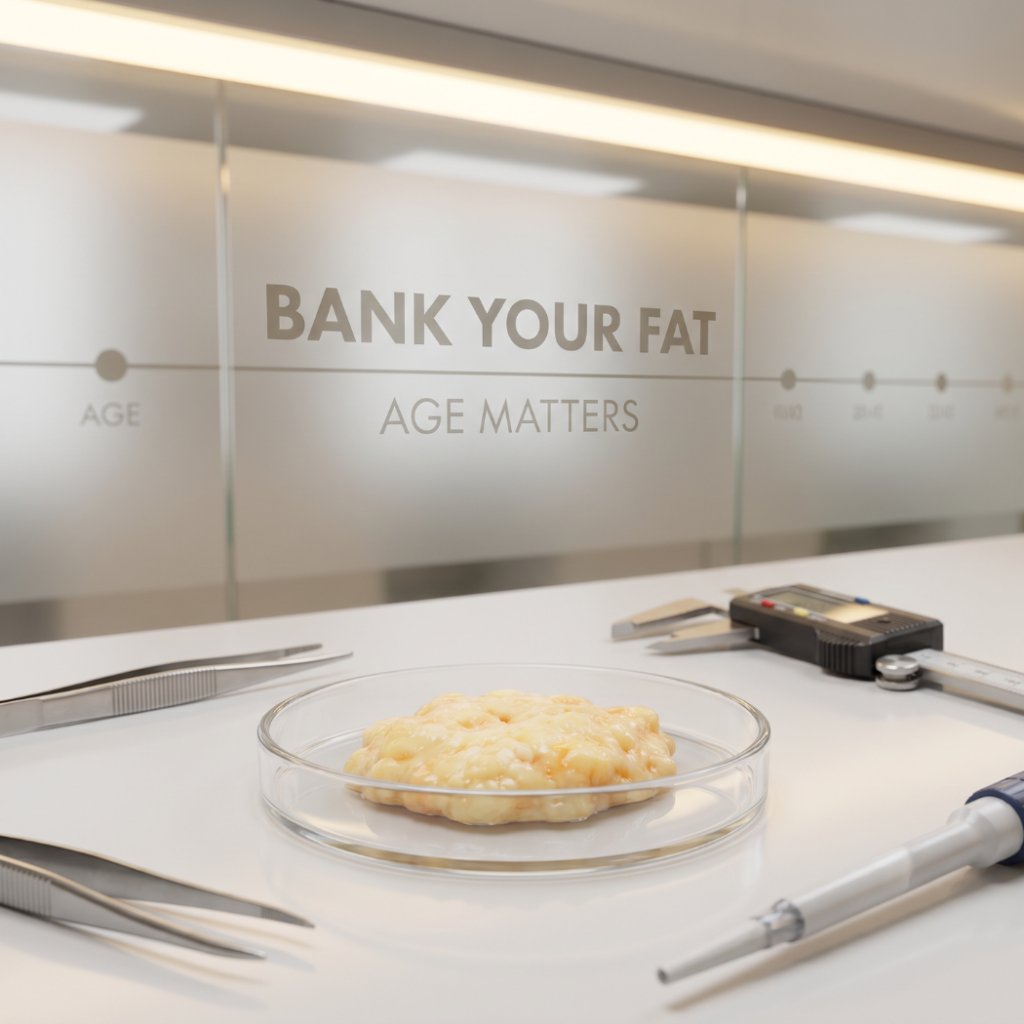
Many people considering adipose tissue banking ask a simple question: is there a right age to do it, and have they already missed the window? The honest answer is that age is one factor among several, not a strict cutoff. This guide explains how cell quality relates to age, what published research suggests about adipose stem cell yield over time, and the practical questions worth raising with a physician before deciding.
TLDR: Adipose tissue contains stem cells whose quantity and characteristics can shift with age, which is one reason some people choose to bank earlier rather than later. Published laboratory research suggests that the yield and growth potential of adipose-derived stem cells may decline as donors get older, though individual variation is wide and no validated age cutoff exists. Banking preserves a snapshot of a person’s own tissue under controlled conditions. It is not a treatment, and it does not guarantee eligibility, access, or clinical benefit from any future research or therapy.
Important Disclaimer: Save My Fat does not provide FDA-approved treatments or cures for any disease. Banking adipose tissue today does not guarantee eligibility, access, or clinical benefit from any future therapy, clinical trial, or medical program. All content is for educational purposes only and does not constitute medical advice. Patients must consult their own licensed healthcare professionals regarding all medical decisions.
The decision to bank adipose tissue is rarely about a single birthday. It is about understanding what is being preserved, why timing can matter, and how personal health circumstances shape the choice. For some people the question is whether they are too young to bother. For others it is whether they have aged past the point of collecting useful cells. Both questions deserve a clear, evidence-based answer rather than marketing pressure.
Why Cell Quality Matters at the Time of Banking
Cryopreservation works by pausing biological activity. When adipose tissue is banked, the laboratory preserves the cells roughly as they are at that moment. Whatever quantity and condition the tissue has on the day of collection is, broadly speaking, what remains available later. That is the core reason timing enters the conversation at all: banking captures a snapshot, and the snapshot reflects current biology.
This is why understanding cell viability matters when evaluating banking. Viability refers to the proportion of cells that remain intact and functional through freezing, storage, and thawing. The starting quality of the sample influences that picture. To see how collection and storage fit together, patients can review how banking works before booking a consultation.
What the Research Shows About Age and Adipose Stem Cell Yield
Adipose tissue is a recognized source of mesenchymal stem cells, and a body of laboratory research has examined how donor age relates to those cells. Some studies report that the yield and proliferative capacity of adipose-derived stem cells can be lower in older donors, and additional laboratory work on age and these cells has reached broadly similar conclusions in specific settings.
Two points keep this from becoming a simple rule. First, individual variation is large: overall health, lifestyle, and the specific tissue site all influence results, so chronological age alone is an imperfect predictor. Second, this research describes laboratory characteristics, not clinical outcomes. A measurable difference in a culture dish does not translate into a promise about any future therapy. For broader context on what the process involves, the adipose tissue banking overview covers the fundamentals.
The ALS Case: When the Window Closes Fast
For most people, the timing question is gradual. For individuals facing a rapidly progressive condition such as amyotrophic lateral sclerosis (ALS), the practical window to bank can narrow quickly. As ALS advances, the logistics of any elective procedure become harder, which is one reason some patients and families prioritize banking sooner when it aligns with their goals.
It helps to be precise here. Choosing to bank earlier in a fast-moving condition is a decision about preserving the opportunity to store one’s own tissue while doing so is still straightforward. It is not evidence that banking changes the course of ALS, and no adipose-derived stem cell product has FDA approval for ALS or any other neurologic disease. The urgency in these cases is logistical, not therapeutic.
Is There a Too-Late Age?
There is no validated age at which banking becomes pointless. Adults across a wide age range bank adipose tissue. Older donors may have different cell characteristics on average, as the research above suggests, but average trends do not determine any single person’s result, and the tissue can still be collected and stored.
The more useful framing is goals rather than cutoffs. A person weighing the decision later in life is really asking whether preservation fits their planning, their budget, and their physician’s guidance. Reviewing the profile of ideal candidates can help clarify whether banking aligns with individual circumstances, regardless of age.
Practical Questions to Ask Your Physician
A short list of questions keeps the conversation grounded. Patients can ask how their current health and any medications might affect a collection procedure, what realistic expectations are given their age and history, and how banking fits the broader regulatory framework. Adipose tissue banking operates under the federal framework for human cells and tissues described in 21 CFR Part 1271, which governs how such tissue is screened, handled, and stored.
It also helps to ask what banking does and does not do. A candid physician will confirm that storage preserves tissue for potential future use within approved or investigational pathways, and that it carries no guarantee of access or benefit.
Frequently Asked Questions
Is there a minimum age to bank adipose tissue?
Banking is generally considered for adults, and eligibility depends on a person’s health and a physician’s assessment rather than a fixed minimum age. A consultation is the appropriate place to confirm suitability.
Does banking younger guarantee better results later?
No. While research suggests cell yield and growth potential can be higher in younger donors on average, this describes laboratory measures, not clinical outcomes. Banking at any age does not guarantee eligibility, access, or benefit from future therapy or research.
Am I too old to bank in my sixties or seventies?
There is no validated upper age cutoff. Older adults can bank adipose tissue. Average cell characteristics may differ with age, but individual variation is wide, and the decision is best guided by personal goals and a physician’s input.
Why do people with ALS sometimes bank quickly?
In rapidly progressive conditions, the practical opportunity to undergo an elective collection can narrow over time, so some patients prioritize banking earlier for logistical reasons. This is not a claim that banking affects the disease.
What regulations govern adipose tissue banking?
Human cells and tissues, including banked adipose tissue, are handled under 21 CFR Part 1271. This federal framework addresses screening, processing, and storage standards for these products.
Key Takeaways
Age influences adipose stem cells, but it is one variable rather than a gate. Published laboratory research suggests that the yield and proliferative capacity of adipose-derived stem cells can decline with donor age, while also showing wide individual variation that makes chronological age an imperfect predictor. Because cryopreservation captures a snapshot of current biology, some people choose to bank earlier, and individuals facing fast-progressing conditions such as ALS may prioritize the logistics of banking sooner. There is no validated too-late age, so the decision is better framed around personal goals, physician guidance, and realistic expectations than around a single number. Above all, banking adipose tissue is a preservation service for potential future use; it is not a treatment, and it does not guarantee eligibility, access, or clinical benefit.
Save My Fat connects patients and providers with a U.S.-based tissue bank. It is not a tissue bank, a laboratory, a medical practice, or a treatment provider. Stem cell and regenerative medicine regulations vary by state, including specific informed-consent and disclosure requirements in Florida, Utah, California, Georgia, and Tennessee governing tissue and stem cell services. Banking adipose tissue does not connect patients to any treatment pathway, and any future use depends on FDA regulatory status, physician guidance, and the availability of approved or investigational pathways at that time.
To discuss whether the timing is right for individual circumstances, patients can contact the team and review the decision with a physician before deciding.
Save My Fat partners with a U.S.-based tissue bank for laboratory processing and storage.
This article is for educational purposes only and does not constitute medical or legal advice. Please consult your own licensed healthcare provider before making any decisions about treatment or research participation.
About the author: Oscar Tellez is the founder and CEO of Save My Fat. He holds a Bachelor of Science in Exercise Science and Health Promotion from Florida Atlantic University. He has spent a decade in the regenerative medicine industry across product distribution, laboratory and vendor relationships, and provider training. He is not a licensed clinician, and this article is educational, not medical advice.
Related guide: longevity and tissue banking.