Adipose-derived stem cells have attracted growing attention in neurology because they secrete growth factors that support damaged tissue, modulate inflammation, and appear to influence recovery in animal models of several serious neurologic conditions. Researchers are now testing whether these properties can translate into clinical benefit in conditions like ischemic stroke, spinal cord injury, ALS, and selected brain disorders. That translation is happening slowly and carefully, in early-phase clinical trials focused primarily on safety and feasibility, and the work remains investigational rather than established standard care.
TLDR: Adipose-derived stem cells and their exosomes show neuroprotective and anti-inflammatory effects in many preclinical models of stroke, spinal cord injury, ALS, and other brain conditions. Early human trials focus primarily on safety and feasibility, with some reports of stable or modestly improved neurologic function, but no definitive proof of benefit yet. These approaches are experimental and are not replacements for acute stroke care, SCI stabilization, ALS management, or other established treatments. Tissue banking preserves a potential future resource; it is not neurologic therapy.
Important Disclaimer: Save My Fat does not provide neurologic stem cell therapy, emergency stroke care, or any treatment for neurologic conditions. No adipose-derived stem cell or exosome product is FDA-approved to treat stroke, spinal cord injury, ALS, Alzheimer’s disease, traumatic brain injury, or any other neurologic condition. This article summarizes published research for educational purposes only and does not constitute medical or legal advice. Patients must rely on their neurologist, neurosurgeon, or rehabilitation team for all treatment decisions and should discuss any interest in clinical trials directly with their clinical care team.
For a family member managing care after a severe stroke or a person living with ALS, the phrase “stem cells from your own fat can help repair the brain or spinal cord” carries enormous weight. It is the kind of claim that spreads quickly online and that patients and caregivers encounter regularly, often without context about what the science actually shows and what stage it is at.
The underlying biology is real. Adipose-derived stem cells do produce molecules that influence neural tissue in laboratory and animal settings. Preclinical models of stroke, traumatic injury, and neurodegeneration have produced findings compelling enough to justify moving into early human trials. What is also real is the distance between a rodent stroke model and a randomized controlled trial in humans, and between an early-phase safety study and an FDA-approved therapy.
This guide explains why ADSCs have attracted neurologic research interest, what the preclinical evidence shows in stroke and spinal cord injury, how early human trials in those areas and in ALS are designed, what exosome research adds, and what all of this does and does not mean for someone considering tissue banking while living with or at risk for neurologic disease.
Why Adipose-Derived Cells Interest Neurologists
Neurotrophic and Paracrine Effects
The central nervous system (CNS), comprising the brain and spinal cord, has limited capacity to repair itself after injury or degeneration. Neurons that die from stroke, trauma, or disease are largely not replaced. Secondary processes, including spreading inflammation, excitotoxicity, and glial scarring, often expand the initial injury zone in the hours and days that follow acute events.
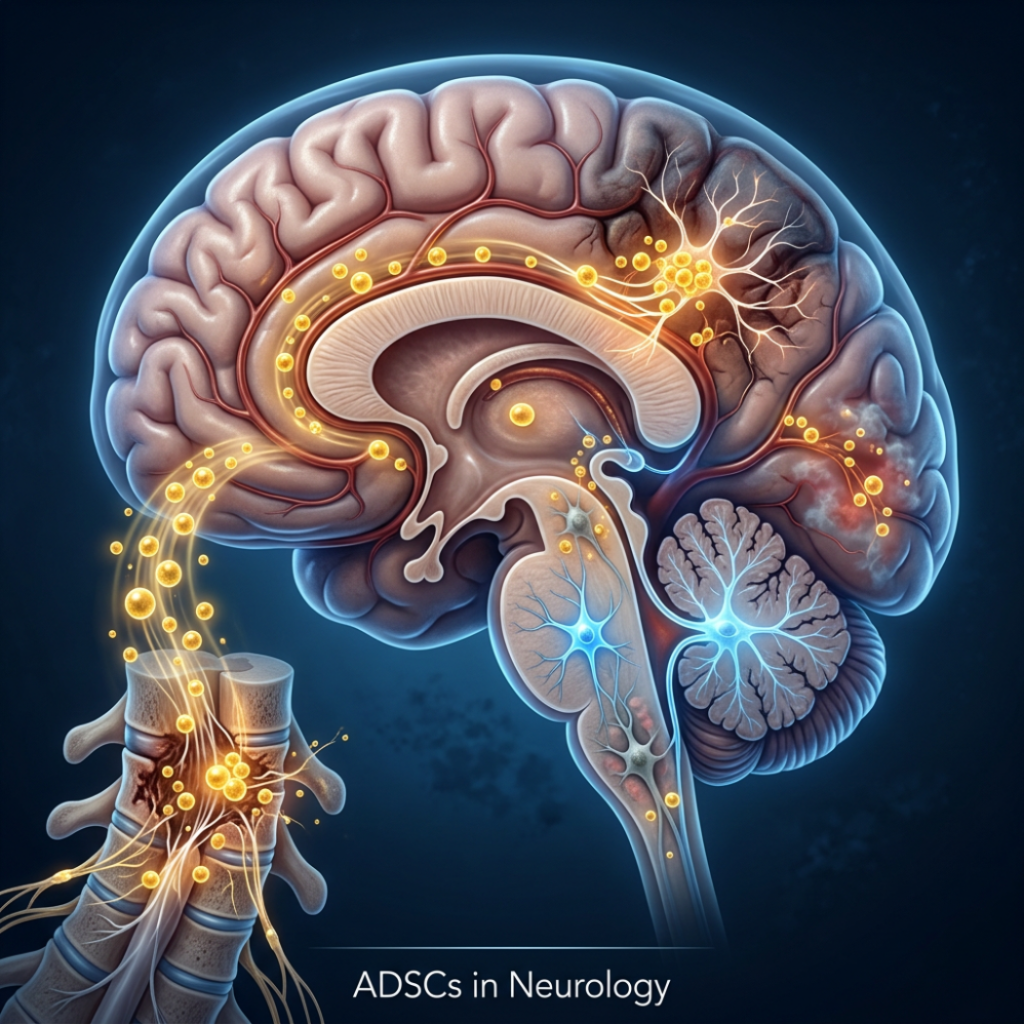
Adipose-derived stem cells (ADSCs, also called AD-MSCs) secrete a range of factors relevant to this injury biology. Published reviews of ADSC neurology research describe secretion of brain-derived neurotrophic factor (BDNF), glial cell line-derived neurotrophic factor (GDNF), ciliary neurotrophic factor (CNTF), and neurotrophin-4, along with anti-inflammatory cytokines. In experimental settings, these neurotrophic factors can reduce neuronal cell death, support axonal regrowth in damaged pathways, and enhance synaptic plasticity. These properties are the scientific foundation of research interest in ADSCs for neurologic conditions. For a broader explanation of what ADSCs are and how they are characterized, the patient’s guide to adipose-derived stem cells provides that background.
Immunomodulation and Microenvironment Repair
Secondary neurologic injury after stroke or trauma is driven in part by the immune response. Microglial activation, infiltrating macrophages, and pro-inflammatory cytokine release in the injury zone can kill surviving neurons and expand tissue loss. MSCs including ADSCs can shift immune responses toward more regulatory, less destructive patterns in these settings, according to preclinical evidence.
Beyond immune modulation, ADSCs can promote angiogenesis (new blood vessel formation) in injured tissue and may influence the behavior of astrocytes and the formation of glial scar, the barrier of reactive cells that can obstruct axonal regeneration after spinal cord injury. Each of these mechanisms represents a potential therapeutic lever that researchers are attempting to engage through cell or exosome-based approaches.
Practical Advantages of ADSCs in Research
Adipose tissue is abundant and accessible through minimally invasive liposuction procedures. ADSCs can be isolated from lipoaspirate in relatively large numbers and can be expanded in culture to achieve cell doses required for clinical use. These logistical properties make ADSCs attractive candidates for cell therapy research compared with some other stem cell sources. They do not, however, remove the regulatory and safety requirements that apply to any clinical use of cell-based products in the CNS.
Stroke and Brain Injury: From Preclinical Models to Early Trials
Preclinical Stroke and Brain Injury Evidence
Animal models of ischemic stroke, the most common form caused by arterial blockage, have produced consistent findings when ADSCs or their exosomes are administered in the hours to days following experimental stroke. Published preclinical work describes reduced infarct volume (the area of dead tissue), better performance on neurologic function tests, increased markers of new neuron formation (neurogenesis), enhanced new blood vessel growth in the injury zone, and reduced microglial inflammatory activation in treated animals compared with controls.
At the exosome level, a study accessible at PMC6413259 examined exosomes from ADSCs that had been modified to carry higher levels of microRNA-126 (miR-126), a molecule associated with vascular repair. The study reported improved functional recovery, neurogenesis, and blood vessel formation in rat stroke models following treatment. This kind of finding, where exosomes are engineered as targeted delivery vehicles for neuroprotective RNA, represents one direction of active preclinical investigation.
Clinical Trials of ADSCs and Exosomes in Stroke
The translation to humans is proceeding in early-phase trials. NCT02813512 is a registered study examining autologous ADSC transplantation into chronic ischemic stroke patients, using clinical scales including the NIHSS (National Institutes of Health Stroke Scale, measuring neurologic deficits), mRS (modified Rankin Scale, measuring disability), and Barthel Index to track function. Primary objectives focused on safety and feasibility of the cell transplantation procedure.
NCT03384433 examined allogeneic MSC-derived exosomes given intravenously in acute ischemic stroke, with primary safety endpoints including adverse events, recurrent stroke, and brain edema, and a secondary endpoint of modified Rankin Scale score at 12 months.
NCT07398612 is a phase I/II trial evaluating intranasal administration of ADSC-derived exosomes for acute ischemic stroke, using a dose-escalation design to characterize safety and exploring changes in neurologic scales as secondary measures.
What These Stroke Trials Have Shown
Across early-phase stroke trials using MSCs and ADSC-derived products, the published picture is one of generally acceptable safety profiles in carefully monitored patients, with hints of functional improvement in some individuals that cannot be definitively attributed to the cell or exosome intervention given the absence of randomized control arms in most studies. Sample sizes range from a handful to a few dozen patients. No stroke trial using ADSCs or ADSC exosomes has yet produced phase III results, and no ADSC-based therapy has been compared with best standard stroke care in a large randomized trial. Standard stroke care, including thrombolysis (IV tPA) and thrombectomy where applicable, followed by rehabilitation, remains the evidence-based standard for acute ischemic stroke.
Spinal Cord Injury and Adipose-Derived Cells
Preclinical SCI Evidence
Traumatic spinal cord injury (SCI) presents a dual challenge: the initial mechanical injury destroys axons and neurons, and the secondary inflammatory cascade extends damage into surrounding tissue in the hours and days that follow. In animal models of traumatic SCI, ADSC transplantation has been associated with reduced cavity formation at the injury site, improved preservation of myelin (the insulating sheath around axons), enhanced motor function scores on behavioral tests, and secretion of neurotrophic factors that protect surviving neurons and support axonal sprouting.
Reviews of SCI-specific ADSC research, including a 2024 review accessible at PMC11394073 and a systematic review available at PubMed, summarize these preclinical findings consistently and note the mechanistic coherence between ADSC properties and the biology of secondary SCI injury. The consistent direction of effect in animal models provided scientific rationale for moving into human studies.
Early Human SCI Trials with ADSCs
NCT03308565, the CELLTOP trial, is among the registered studies examining intrathecal (into the spinal fluid space) administration of autologous AD-MSCs in patients with chronic traumatic spinal cord injury. Intrathecal delivery is one approach to getting cells closer to the injured spinal cord without requiring direct surgical injection into spinal tissue. Primary outcomes in CELLTOP and similar trials have focused on safety: documenting the incidence and severity of adverse events following intrathecal injection, which has included common events like headache, transient musculoskeletal pain, and fever, without dose-limiting toxicities reported in the published preliminary series.
Some patients in early SCI trials have shown changes in American Spinal Injury Association Impairment Scale (AIS) grade classification, a standard measure of injury completeness ranging from complete motor and sensory loss (AIS A) to nearly normal function (AIS E). Reports of individual patients improving from complete (AIS A) to incomplete (AIS B or C) status during follow-up have appeared in published case series. These observations are scientifically interesting, but they come from uncontrolled designs where aggressive rehabilitation, natural history variation, and other interventions cannot be separated from any contribution of the cell treatment.
How Reviews Interpret the SCI Data
Reviews of ADSC therapy in spinal cord injury consistently characterize the approach as feasible and generally safe in small series, with functional changes in some patients that provide rationale for larger controlled trials. They also consistently flag the same limitation: without matched control groups receiving identical rehabilitation but not cells, it is not possible to assign the observed changes to the cell therapy. Randomized, controlled SCI trials are the necessary next step, and several are in development or early stages.
ALS and Other Neurodegenerative Diseases
Why ALS Researchers Study ADSCs
Amyotrophic lateral sclerosis (ALS) is a progressive neurodegenerative disease that destroys the motor neurons responsible for voluntary movement, leading to progressive paralysis and respiratory failure. No cure exists; approved disease-modifying therapies slow progression in some patients but do not reverse or halt the disease. ALS involves both motor neuron loss and neuroinflammatory processes, which makes it a theoretically plausible target for ADSC-based approaches that combine neurotrophic support and immunomodulation.
Preclinical work in ALS mouse models has described ADSCs slowing motor neuron loss, reducing inflammatory markers in spinal tissue, and modestly extending survival compared with untreated controls. Whether these effects translate to human patients with a more complex disease course is the research question that clinical trials are designed to address.
ALS Clinical Trials Using ADSCs
A phase I/II clinical program evaluating intravenous autologous adipose-derived MSC infusions in ALS patients has evaluated safety over multi-year follow-up, documenting the feasibility of repeated manufacturing and administration and characterizing adverse event profiles. Reported findings from these programs describe acceptable tolerability and no major cell-related serious adverse events in the monitored cohorts. Effects on ALSFRS-R (ALS Functional Rating Scale Revised, the standard measure of functional decline in ALS), disease progression rate, and survival have been mixed across published reports, with some patients appearing to have slower decline during the treatment period. Investigators have been careful in publications to note the absence of concurrent control groups and the small sample sizes, which prevent drawing conclusions about whether ADSCs slow ALS progression.
Alzheimer’s Disease and Other Brain Disorders
NCT04388982 represents an early registered study examining allogeneic adipose-derived MSC exosomes delivered intranasally in patients with mild to moderate Alzheimer’s disease. The intranasal delivery route is being explored because it may allow exosomes to reach the brain by traveling along olfactory nerve pathways, bypassing the blood-brain barrier that limits delivery of many substances from the bloodstream into brain tissue. The trial is primarily designed to assess safety and tolerability, with exploratory cognitive endpoints.
Traumatic brain injury (TBI) and other brain conditions have also been explored in pilot-level MSC trials using various cell sources, primarily focused on dose finding and adverse event characterization. These remain at early phases.
How ADSC Exosomes Fit Into CNS Research
Why Exosomes Are Specifically Interesting in Neurology
One of the most significant barriers to cell-based CNS therapy is delivery: getting live cells to the right location in the brain or spinal cord, keeping them alive once there, and ensuring they interact with the intended targets rather than migrating elsewhere. Exosomes, the small membrane-bound vesicles that ADSCs and other cells release as part of normal biology, offer a potential cell-free alternative. They are much smaller than whole cells, they can carry therapeutic cargo including microRNAs and proteins, and published preclinical evidence suggests they can cross the blood-brain barrier (BBB), the selective barrier that separates the bloodstream from brain tissue, more readily than whole cells.
Intranasal administration, used in several registered trials, delivers exosomes directly through the nose where they can travel along olfactory nerve pathways into the brain. This non-invasive route is under active investigation as a practical delivery method that avoids the risks of intracranial surgery or intrathecal injection.
What Clinical Exosome CNS Trials Are Exploring
The registered exosome trials in stroke and Alzheimer’s disease described earlier share a common design philosophy: they are primarily safety and tolerability studies with exploratory secondary endpoints in neurologic function or imaging biomarkers. They are not designed to prove that exosomes improve outcomes; they are designed to establish that administration is safe and to generate data on dose, route, and early signals that would inform larger controlled trials.
As of April 2026, no ADSC-derived exosome product has completed phase II efficacy trials in any CNS condition, and none has been submitted to the FDA for approval as a neurologic treatment. The field is progressing from preclinical work into early human safety trials, which is the appropriate sequence. It is also a slow one.
Remaining Unanswered Questions
Key open questions across CNS exosome research include optimal dosing and frequency, how long therapeutic exosome effects persist in neural tissue, whether repeated administration maintains efficacy or triggers immune reactions, and how to manufacture exosomes at clinical scale with consistent biological activity. These are engineering and biology questions that must be resolved through research before exosome-based CNS therapies can be developed as practical treatments.
Risks, Unknowns, and Regulatory Status
Safety Signals in Early CNS Trials
Across published early-phase CNS trials using ADSCs and ADSC-derived exosomes, the most common adverse events have been procedural, including headache and transient pain related to intrathecal or intranasal administration, and minor infusion-related reactions in intravenous protocols. No dose-limiting toxicities have been reported in the published series reviewed here. Long-term safety monitoring, particularly for tumor formation, ectopic tissue development, and delayed immune reactions, remains ongoing and is an explicit priority in all registered protocols.
Reviews of MSC and ADSC neurologic applications emphasize that the safety profile of trial-grade, manufactured products monitored under formal protocols differs substantially from what unregulated clinics offer. The latter typically lack the independent safety monitoring, adverse event reporting requirements, and regulatory accountability of registered trials.
Regulatory Status
As of April 2026, all ADSC and ADSC exosome CNS applications are investigational. They operate under Investigational New Drug (IND) applications for studies conducted in the United States. No adipose-derived stem cell or exosome product is FDA-approved as a treatment for stroke, spinal cord injury, ALS, Alzheimer’s disease, or traumatic brain injury. Being in a clinical trial, or having a study registered on ClinicalTrials.gov, does not mean the therapy is approved or proven effective.
Commercial Clinics and Patient Protection
Clinics offering “proven” neurologic stem cell therapies outside of registered trial frameworks are offering unapproved products for serious medical conditions. The FDA has issued enforcement actions against several such clinics. Patients considering any stem cell offer for a neurologic condition should ask for the ClinicalTrials.gov NCT number, the FDA IND number, and the IRB approval documentation. Legitimate research programs provide all three without hesitation.
What This Means for Tissue Banking
Banking vs Treatment Today
Tissue banking stores frozen adipose tissue. It does not deliver any cells to the brain or spinal cord, does not reverse existing neurologic damage, and does not substitute for any element of acute or chronic neurologic care. For what banking actually involves, the complete guide to adipose tissue banking and the how banking works article explain the process from collection through long-term storage. Banking is the preservation of a biological resource within a regulated framework, not a neurologic intervention.
Matching Future Therapies to Banked Tissue
If ADSC-based neurologic therapies eventually receive FDA approval, their specific manufacturing requirements, cell quality criteria, and clinical protocols would be defined at that time. Whether previously banked tissue from a consumer service would satisfy those requirements depends entirely on specifications that do not yet exist. Current neurologic trials typically use either freshly collected autologous tissue or standardized allogeneic cell products manufactured under formal protocols, not tissue banked months or years earlier by a consumer banking service. Banking preserves an option. It does not pre-qualify anyone for any specific future therapy.
Thinking About Banking with a Neurologic Condition
People living with a neurologic condition who are considering tissue banking should discuss the decision with their neurologist in the context of their specific disease trajectory and prognosis. Banking is most straightforwardly interpreted as a long-term preservation decision made in the context of an uncertain but scientifically active research landscape. For those interested in how clinical trial participation works and how to evaluate whether a specific trial might be appropriate, the guide to clinical trials for regenerative medicine provides a practical framework. The emerging research page tracks active areas of ADSC investigation across conditions.
Frequently Asked Questions
Can adipose-derived stem cells cure stroke or spinal cord injury today?
No. No ADSC-based product is FDA-approved to treat stroke, spinal cord injury, or any other neurologic condition in the United States. Early-phase clinical trials in both conditions have demonstrated safety and feasibility of cell administration and have reported some exploratory functional signals, but these are not definitive evidence of efficacy, and no trial has reached phase III. For stroke, standard care includes thrombolysis (IV tPA) and mechanical thrombectomy where applicable, followed by rehabilitation. For SCI, acute stabilization, decompressive surgery when indicated, and intensive rehabilitation remain the evidence-based standards.
What have early clinical trials of ADSCs in stroke actually measured?
Registered stroke trials including NCT02813512 and NCT03384433 have primarily measured safety endpoints: adverse events, recurrent stroke, brain edema, and procedure-related complications. Secondary and exploratory endpoints have included clinical scales like the NIHSS (measuring neurologic deficits) and the modified Rankin Scale (measuring disability). Published reports from these early-phase studies describe acceptable short-term safety profiles in small, carefully monitored cohorts. They do not demonstrate statistically proven improvement in stroke recovery attributable to the cell or exosome intervention.
What does the research say about ADSCs for spinal cord injury recovery?
Preclinical evidence reviewed in PMC11394073 and the systematic review at PubMed describes consistent findings of improved motor function, reduced injury cavity, and preserved myelin in animal SCI models following ADSC treatment. In early human trials, including the CELLTOP study (NCT03308565), intrathecal ADSC administration has been generally well tolerated. Some patients in uncontrolled series have shown improvements in AIS grade during follow-up. The absence of control groups prevents attribution of those changes to the cell treatment, and larger randomized trials are needed.
Are adipose-derived stem cells being used in ALS trials and what have they shown so far?
Yes. Phase I/II programs evaluating intravenous autologous AD-MSCs in ALS patients have been conducted and reported in the literature. Published findings describe feasibility of repeated cell manufacturing and administration, and acceptable safety profiles with no major cell-related toxicities reported in monitored cohorts. Effects on ALSFRS-R decline and survival have been mixed and have not met the threshold for claiming disease modification, largely because these studies were not powered or designed to detect efficacy. They have demonstrated that the approach can be studied safely, which is the necessary foundation for larger trials.
How do ADSC exosomes reach the brain, and what have stroke models found?
Exosomes are small enough to cross the blood-brain barrier through natural transport mechanisms, particularly when delivered intranasally, a route that allows them to travel along olfactory nerve pathways into brain tissue. Preclinical work described at PMC6413259 showed that exosomes from miR-126-modified ADSCs improved functional recovery, neurogenesis, and vascularization in rat stroke models. Registered clinical trials including NCT07398612 are now evaluating the safety of intranasal ADSC exosome delivery in human stroke patients. These are early-phase safety studies, not efficacy trials.
If I bank my fat now, will I automatically qualify for future neurologic stem cell therapies?
No. Banking preserves your tissue in cryogenic storage. Eligibility for any future neurologic therapy would be determined by that therapy’s clinical protocols, regulatory approvals, and eligibility criteria, none of which currently exist in final form for ADSC-based CNS treatments. Current neurologic trials typically use freshly collected autologous tissue or standardized allogeneic products, not previously banked consumer samples. Banking creates a preserved biological resource. It does not create trial eligibility or guaranteed access to any future therapy.
How can I tell if a neurologic stem cell offer is part of a real clinical trial?
Ask for the ClinicalTrials.gov registration number (NCT number) and verify it independently at ClinicalTrials.gov. Confirm that the study has an IND from the FDA. Ask for the IRB approval documentation and the name of the independent ethics oversight body. Confirm whether the procedure is free to participants (as research procedures should be) or whether you are being charged out of pocket for what is described as research. A legitimate trial will answer all of these questions specifically. For more context on what distinguishes legitimate clinical research from commercial services, the guide to clinical trials for regenerative medicine provides a practical checklist.
Where can I read more about ADSCs in neurologic disease from reputable sources?
The PMC reviews at PMC11394073 and the PubMed review at pubmed.ncbi.nlm.nih.gov/39161365 cover ADSC therapy in spinal cord injury specifically. The exosome and stroke work is reviewed in PMC6413259. ClinicalTrials.gov is the authoritative registry for currently registered trials. The patient’s guide to adipose-derived stem cells on this site provides foundational biology. For a broader context on regenerative medicine clinical research, the emerging research page tracks active areas.
Key Takeaways for People Facing Neurologic Disease
Stroke, spinal cord injury, ALS, and dementia are among the most serious diagnoses a person or family can receive. The intensity of the desire for new options is proportional to the severity of the conditions, and it is completely understandable. What patients deserve is an honest account of where the science is, not where advocates or marketing would prefer it to be.
Save My Fat’s role is to explain where adipose-derived cell science actually stands in neurology, so that hope is grounded in data rather than in hype.
The current picture:
- ADSCs and their exosomes show neuroprotective and anti-inflammatory effects in many animal models of stroke, SCI, ALS, and related conditions.
- Human CNS trials so far focus primarily on safety and feasibility. Some exploratory signals of functional stability or improvement have been reported, but these require larger, controlled trials to confirm.
- No ADSC-based therapy is approved by the FDA as a standard treatment for stroke, spinal cord injury, ALS, Alzheimer’s disease, or traumatic brain injury.
- Banking adipose tissue preserves a potential resource. It does not replace emergency stroke or SCI care, rehabilitation, or any approved disease-modifying therapy, and it does not guarantee access to future experimental treatments.
Patients and caregivers are encouraged to bring questions about stem cell trials in neurology to their neurologist or rehabilitation team, who can evaluate whether a specific registered trial might be appropriate for an individual’s clinical situation. For additional context on the banking process, the complete guide to adipose tissue banking and the how banking works article explain what banking involves and preserves. Service information is available on the pricing page, providers page, and family page. The about page describes who Save My Fat is.
This article is for educational purposes only and does not constitute medical or legal advice. Please consult your neurologist or neurosurgeon before making any decisions about neurologic treatment or research participation.
About the author: Oscar Tellez is the founder and CEO of Save My Fat. He holds a Bachelor of Science in Exercise Science and Health Promotion from Florida Atlantic University. He has spent a decade in the regenerative medicine industry across product distribution, laboratory and vendor relationships, and provider training. He is not a licensed clinician, and this article is educational, not medical advice.
Related guide: the adipose stem cell clinical trials directory.
Last Updated: April 20, 2026