Plastic surgeons already harvest adipose tissue at higher volume than any other specialty, through liposuction, lipoaspirate collection for fat grafting, and body contouring. For them, adding banking is a workflow modification rather than a new procedure: tissue that is already being removed is diverted to a banking container instead of discarded. The incremental procedural burden is minimal; the real work is in documentation and consent. What follows is a practical, compliance-grounded guide to integrating banking into an existing harvest workflow, including the two-consents rule, the harvest documentation set, HIPAA considerations specific to aesthetic practices, and the Florida scope limit that plastic surgeons in particular need to understand.
TLDR: Plastic surgeons harvest adipose tissue routinely, so banking integration is a workflow change, not a new procedure: divert a documented volume into a pre-labeled sterile container, complete the case with the rest. The documentation set is an operative-record notation, a container label, a transfer record, and a separate banking consent. Banking consent must be separate from the surgical consent, two procedures, two risk profiles, two forms. Banking records are HIPAA-covered (45 CFR Parts 160 and 164). Florida SB 1768 does not authorize stem cell therapy for cosmetic indications. Banking adipose tissue does not enroll a patient in therapy and does not guarantee any future eligibility, access, or benefit.
Important Disclaimer: Save My Fat does not provide FDA-approved treatments or cures for any disease. Banking adipose tissue today does not guarantee eligibility, access, or clinical benefit from any future therapy, clinical trial, or medical program. No adipose-derived stem cell product currently holds FDA approval for the conditions discussed in this article. Florida SB 1768 authorizes stem cell therapy for specific conditions only, and aesthetic applications are not within its scope. All content is for educational purposes only and does not constitute medical or legal advice. Patients must consult their own licensed healthcare professionals regarding all medical decisions.
The appeal of banking integration for a plastic surgery practice is real, the marginal procedural cost is close to zero when the tissue is already being removed, but that low procedural cost is precisely what tempts practices to treat the documentation as an afterthought. It is not. The labeling, the transfer record, and above all the separation of banking consent from surgical consent are where compliance is won or lost, and they have to be set up before the first integrated case rather than retrofitted.
Why Plastic Surgeons Are the Natural Banking Specialty
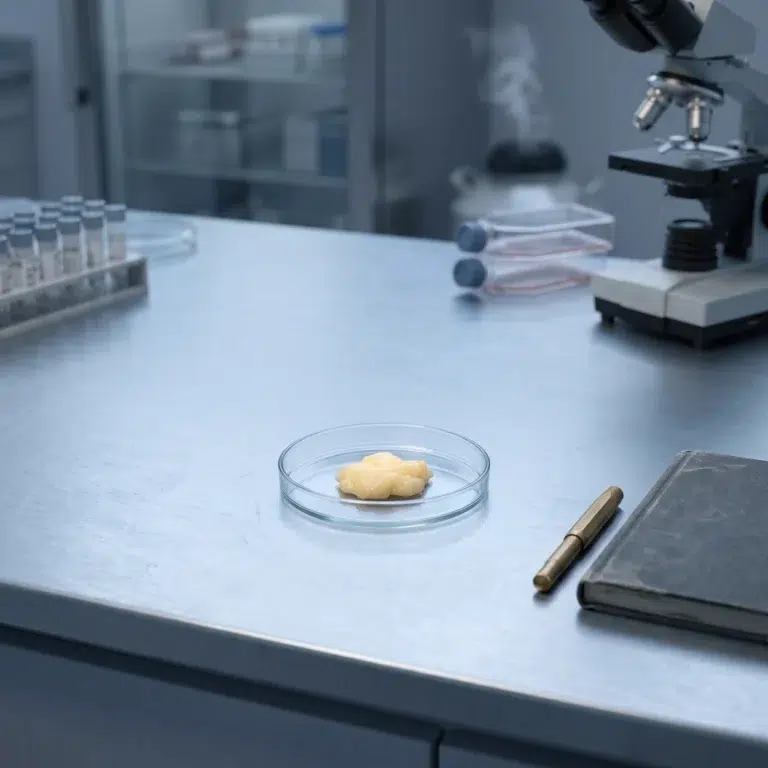
No other specialty removes adipose tissue at the volume plastic surgeons do. Because the tissue is already being aspirated, banking does not require a new procedure; it requires diverting a portion of what is already removed into a banking container rather than discarding it. The incremental procedural burden is minimal, and the work shifts to documentation and consent. The forward-looking framing for the patient is narrow and accurate: a patient undergoing liposuction who simultaneously banks tissue preserves the option of future autologous approaches at essentially no additional procedural cost, while banking guarantees no therapy and treats nothing. The general case for adding banking is covered in why physicians add banking.
What Changes in the Surgical Workflow
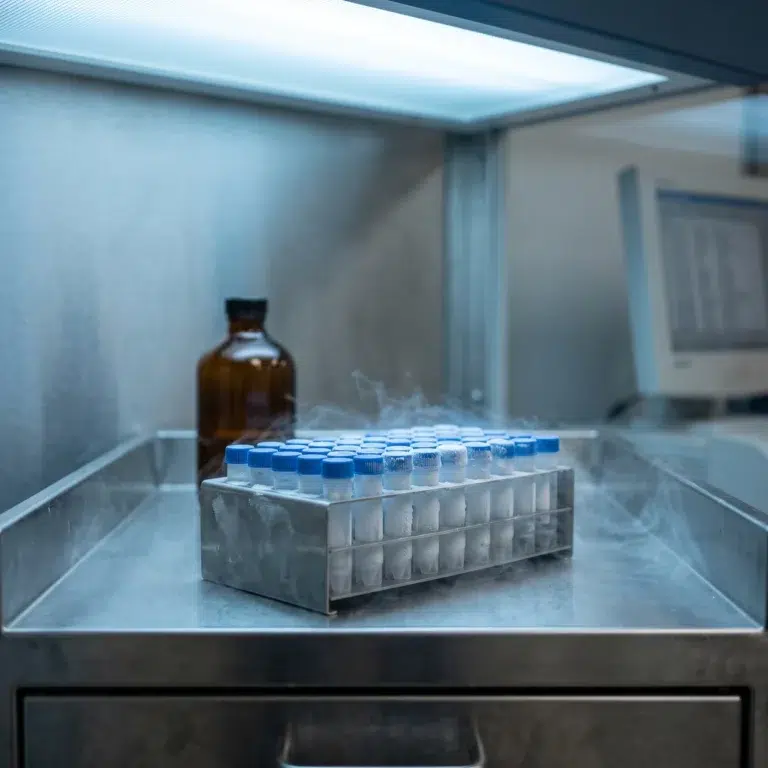
A standard liposuction workflow runs infiltration, aspiration, then discard or processing for fat grafting. A banking-integrated workflow runs infiltration, aspiration, diversion of a specified volume of lipoaspirate into a pre-labeled sterile banking container, then completion of the procedure with the remaining tissue. The single most important operational change is that the banking container must be labeled with the patient’s identifying information before the case begins, not after, because labeling after the fact introduces a chain-of-custody gap. The diverted volume must be documented in the operative record, and the container’s temperature and handling requirements must be confirmed with the processing partner before the case. The tissue classification underlying lipoaspirate is discussed in what intact adipose tissue means.
Harvest Documentation Requirements
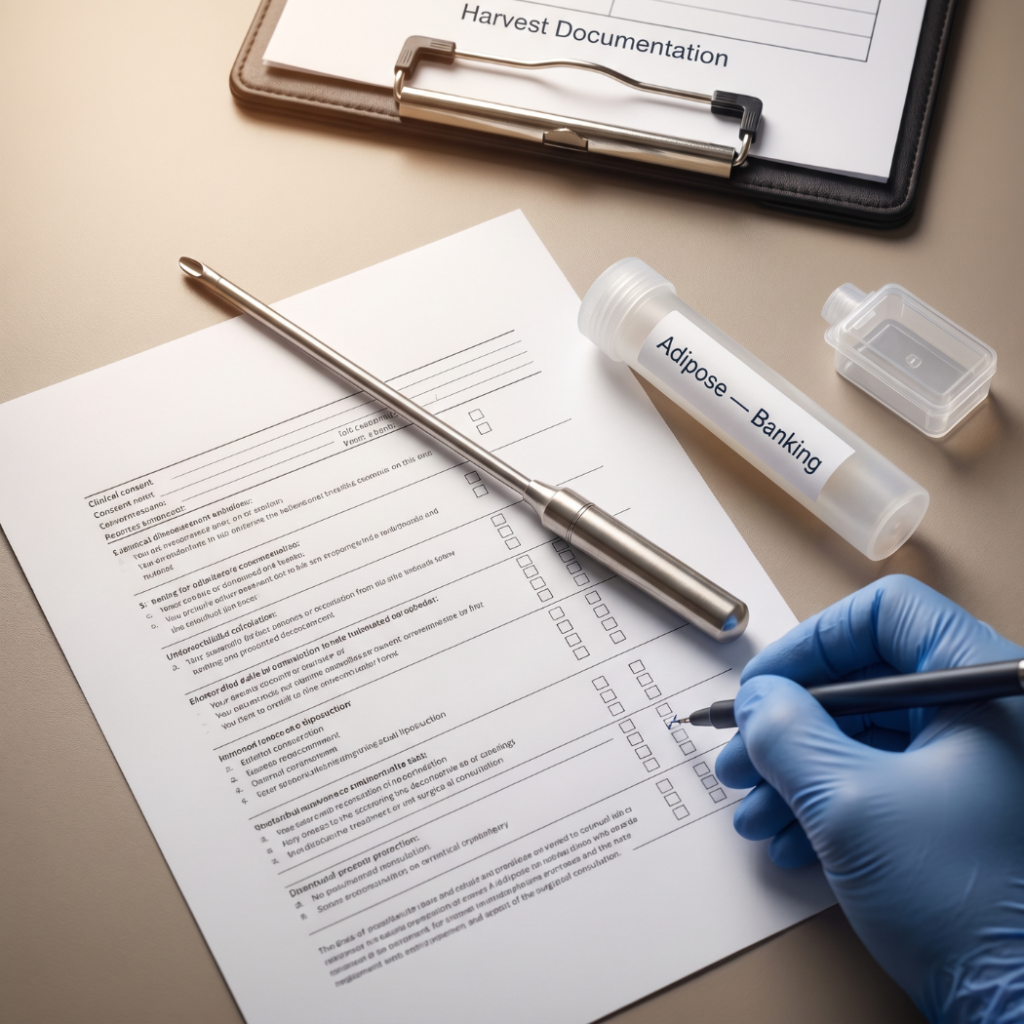
Every banking-integrated procedure generates four documents. The operative-record notation captures the volume diverted, the harvest site, confirmation that the container label was verified, and the transfer time. The collection container label carries the patient identifier, the date and time, the harvest site, the surgeon, and the facility. The transfer record, signed by the OR nurse or surgical tech who handed off the container, records the transfer time, the recipient (courier or lab intake), and temperature conditions. And the banking consent, signed separately from the surgical consent, documents the patient’s agreement to the harvest and cryopreservation. Each of these is a discrete record because each serves a distinct function in the chain of custody under 21 CFR Part 1271, and an annotation buried in the surgical note does not substitute for a standalone transfer or labeling record. The full documentation chain is detailed in the chain of custody discussion.
Two Consents, Not One
The most common documentation error in banking integration is combining the banking consent with the surgical consent. They must be separate documents because they cover distinct procedures with distinct risk profiles, purposes, and regulatory frameworks. The surgical consent covers the liposuction or aesthetic procedure under standard plastic surgery consent elements. The banking consent covers the harvest of a portion of tissue for cryopreservation and potential future use, and must disclose what banking is, that banked tissue is not a treatment, that future therapeutic use is investigational and not guaranteed, that the tissue is stored for the patient’s potential future use, and the conditions under which it may be released or discarded. A further point specific to physicians who may later administer banked tissue therapeutically under Florida SB 1768: a third, separate consent will be required at that time meeting all five statutory elements. The cross-state consent requirements are detailed in the informed consent requirements guide.
HIPAA and Banking Records in an Aesthetic Practice
Banking records, chain-of-custody documentation, viability reports, storage confirmations, are health records subject to HIPAA under 45 CFR Part 164 and Part 160. In an aesthetic practice where many patients pay out of pocket, this carries a practical wrinkle: banking records must be maintained in the medical record and not disclosed without authorization, and a patient may not expect or want banking information shared with an insurer. Where banking is part of a procedure billed to insurance, the banking documentation becomes part of the billable record, so a practice should consult counsel on whether a separate self-pay banking record raises any HIPAA or billing-compliance considerations. The point is not that banking records are unusual under HIPAA, but that the payment patterns common in aesthetic practices make disclosure expectations worth handling deliberately.
State Scope: Florida Plastic Surgeons in Particular
SB 1768 authorizes stem cell therapy for orthopedic conditions, wound care, and pain management, not for aesthetic or cosmetic indications. This matters specifically for plastic surgeons, because the specialty most likely to harvest adipose tissue is also the specialty whose primary indications fall outside the statute’s authorized scope. A plastic surgeon who banks tissue and later wishes to administer it therapeutically must ensure the intended use falls within SB 1768’s authorized conditions; using banked tissue for a cosmetic indication is outside the statute. Banking the tissue is a preservation step that does not depend on indication, but therapeutic administration does, and conflating the two is a scope error worth flagging at the consent stage.
Banking-Integrated vs. Standard Workflow
| Step | Standard liposuction | Banking-integrated liposuction |
|---|---|---|
| Pre-op consent | Surgical consent only | Surgical consent plus separate banking consent |
| Pre-op labeling | Standard specimen labeling | Banking container pre-labeled before the case |
| Intraoperative | Full lipoaspirate used or discarded | Specified volume diverted to the banking container |
| Operative record | Standard documentation | Adds volume diverted, label confirmed, transfer time |
| Post-op transfer | Standard cleanup | Container transferred per chain-of-custody protocol |
| Documentation | Operative note | Operative note plus transfer record plus chain-of-custody initiation |
Harvest Documentation and Consent Checklist
Pre-case: banking consent signed and filed separately from the surgical consent; banking container pre-labeled with the patient identifier; processing partner contacted and transfer protocol confirmed; volume to be diverted documented in the pre-op plan.
Intraoperative: divert the specified volume to the pre-labeled container; keep the container sealed and labeled throughout; update the operative record with volume diverted, harvest site, and label confirmation.
Post-case: complete and sign the transfer record at handoff; document transport temperature conditions; initiate the chain-of-custody form and send it with the container.
Frequently Asked Questions
Can banking consent be folded into the surgical consent form?
No. They cover distinct procedures with distinct risk profiles and regulatory frameworks and must be separate documents. Combining them is the most common documentation error in banking integration.
Does SB 1768 let a plastic surgeon use banked tissue for cosmetic work?
No. SB 1768 authorizes orthopedic conditions, wound care, and pain management. Cosmetic and aesthetic indications fall outside the statute’s authorized scope, so therapeutic use for those purposes is not within it.
When must the banking container be labeled?
Before the case begins. Labeling after harvest introduces a chain-of-custody gap, so the container must carry the patient identifier and required elements before any tissue is diverted into it.
Key Takeaways
For plastic surgeons, banking integration is a workflow change rather than a new procedure, which makes the marginal procedural cost low and the documentation discipline the real task. The container must be pre-labeled, the diverted volume documented, the transfer recorded, and, most importantly, banking consent kept separate from surgical consent, with a further separate consent required if banked tissue is ever administered therapeutically under SB 1768. Banking records are HIPAA-covered, which the out-of-pocket payment patterns common in aesthetic practices make worth handling deliberately. And the scope limit is specific to this specialty: SB 1768 does not authorize cosmetic indications, so therapeutic use must fall within its authorized conditions. Banking itself remains a preservation decision separate from therapy, with no guarantee of future benefit.
Save My Fat connects patients and providers with a U.S.-based tissue bank. It is not a tissue bank, a laboratory, a medical practice, or a treatment provider. Stem cell and regenerative medicine regulations vary by state, including specific informed-consent and disclosure requirements in Florida, Utah, California, Georgia, and Tennessee governing tissue and stem cell services. Banking adipose tissue does not connect patients to any treatment pathway, and any future use depends on FDA regulatory status, physician guidance, and the availability of approved or investigational pathways at that time.
Plastic surgery practices integrating banking into a harvest workflow can contact Save My Fat to coordinate container labeling and transfer logistics.
Save My Fat partners with a U.S.-based tissue bank for laboratory processing and storage.
This article is for educational purposes only and does not constitute medical or legal advice. Please consult your own licensed healthcare provider before making any decisions about treatment or research participation.
About the author: Oscar Tellez is the founder and CEO of Save My Fat. He holds a Bachelor of Science in Exercise Science and Health Promotion from Florida Atlantic University. He has spent a decade in the regenerative medicine industry across product distribution, laboratory and vendor relationships, and provider training. He is not a licensed clinician, and this article is educational, not medical advice.
Related guide: the physician resource center.