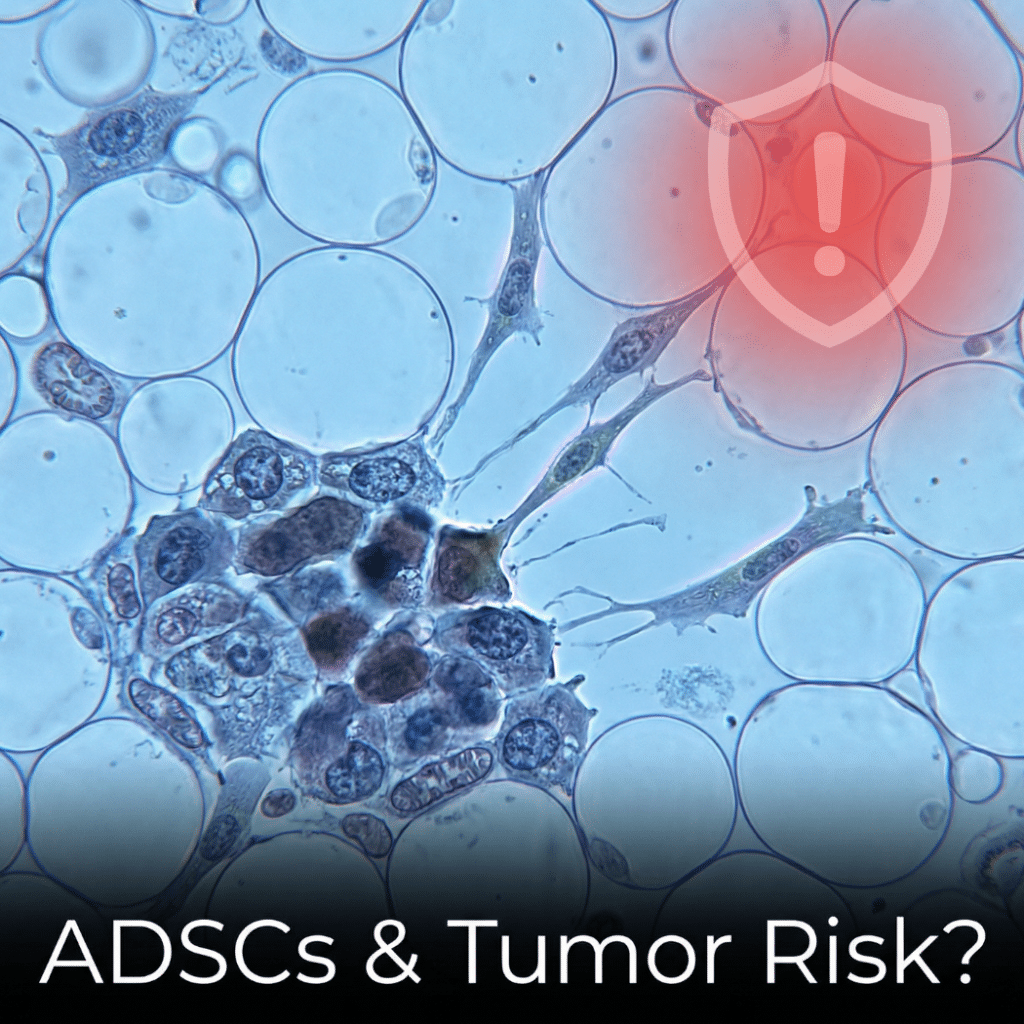
Adipose-derived stem or stromal cells are present in and around many tumors, particularly in organs where fat tissue is abundant, such as the breast. Researchers have spent the last decade studying how these cells interact with cancer, and the findings are more complex and context-dependent than most patients hear. Some laboratory and animal studies suggest pro-tumor effects under certain conditions; others suggest neutral or context-dependent results; and clinical series following fat grafting procedures have not, so far, demonstrated a clear overall increase in cancer recurrence. Patients often encounter simplified versions of this story on both ends of the spectrum, and understanding the full picture requires holding uncertainty in view.
TLDR: Laboratory and animal studies show that adipose-derived stem or stromal cells can influence tumor behavior, sometimes supporting and sometimes not affecting cancer growth, depending on the experimental model, cancer type, and donor characteristics. Clinical follow-up data from reconstructive fat grafting, with and without cellular enrichment, have not shown a clear increase in recurrence within available study windows, but these data are limited in size, follow-up duration, and design. Tissue banking itself, which involves storing frozen tissue, does not expose tumors to stem cells. Any decision about fat-based procedures after cancer requires your oncology team’s direct involvement.
Important Disclaimer: Save My Fat does not provide cancer diagnosis, cancer treatment, or oncology advice of any kind. Adipose-derived procedures must never be used as a substitute for established cancer therapies. This article summarizes published research on adipose-derived cells and the tumor microenvironment for educational purposes only and does not constitute medical or legal advice. Patients with a current or prior cancer diagnosis must discuss any adipose-based procedure and any future use of banked tissue with their oncologist and surgical team before proceeding.
A breast cancer survivor who is considering reconstruction is offered fat grafting and wonders: if fat contains stem cells, and stem cells can promote growth, could those injected cells fuel any remaining cancer cells that imaging does not yet detect? This is not an unreasonable concern, and it reflects exactly the question oncologists and researchers have been asking in controlled settings over the past decade.
The concern arises from real science. Adipose tissue is biologically active, and the stromal cells it contains communicate with surrounding tissues, including tumors. The way they communicate is not simple, and the outcomes differ depending on the cancer type, the cellular preparation, the inflammatory environment, and factors including whether the donor carries obesity or metabolic disease. Researchers working in cell culture dishes and animal models have documented both pro-tumor and context-neutral findings. The question of whether those laboratory effects appear in patients undergoing reconstructive procedures remains important and is the subject of ongoing clinical study.
This guide explains what the tumor microenvironment is and why it matters, what laboratory and animal studies show about adipose-derived stromal cells and cancer, what clinical data from fat grafting series have and have not demonstrated, how these considerations apply to tissue banking, and why the single most important thing any cancer patient can do before any fat-based procedure is involve their oncology team.
Understanding the Tumor Microenvironment
Tumors as Communities, Not Just Cells
A tumor is not a uniform mass of identical cancer cells. It is a complex community that includes the cancer cells themselves, blood vessels that supply them, immune cells that may or may not be attacking them, fibroblasts that lay down structural proteins, adipocytes (fat cells), and mesenchymal stromal cells including adipose-derived cells. Together with the extracellular matrix, these components form the tumor microenvironment (TME), the surrounding biological “neighborhood” that can either help restrain or actively support tumor growth, angiogenesis (new blood vessel formation), invasion into surrounding tissue, and evasion of the immune system.
A tumor’s behavior is shaped not just by the mutations in its cancer cells but by the signals it receives from and sends to this surrounding community. Understanding the TME has become central to modern oncology research, because therapies that disrupt supportive signals in the microenvironment represent a strategy for controlling tumors even when the cancer cells themselves are genetically resistant.
Where Adipose Tissue and ADSCs Fit In
Many common tumor types develop in or adjacent to adipose tissue. Breast cancer, skin cancers including melanoma, and abdominal cancers all grow in environments rich in fat and the stromal cells it contains. Adipose-derived stromal cells (ASCs, also called ADSCs) can be recruited into the tumor microenvironment, where tumor-derived signals may alter their behavior. A review of adipose-derived stem cells in cancer progression published at PMC6651808 describes how this recruitment and the subsequent crosstalk between ASCs and cancer cells can influence tumor biology in ways that are distinct from how these cells behave in healthy tissue.
Separately, adipocytes themselves (the mature fat cells, as opposed to the stromal cells) also contribute to the TME, and some published work has examined whether ASCs and adipocytes exert different effects on tumors. Both cell populations can release growth factors, cytokines, and signaling molecules into the tumor’s environment, but their specific contributions differ.
Carcinoma-Associated Mesenchymal Stromal Cells
A concept important to understanding this area is the carcinoma-associated mesenchymal stromal cell (CA-MSC). When MSCs, including ASCs, spend time in or near a tumor, they can be educated by tumor-derived signals to adopt a modified functional state. CA-MSCs may behave differently from stromal cells in healthy tissue: published reviews describe CA-MSCs as potentially promoting tumor growth, supporting metastasis (spread to other sites), and contributing to local immune suppression in experimental models. This distinction matters because some laboratory findings that appear alarming were generated using ASCs that had already been educated by tumor signals, which is a different situation from introducing healthy, untreated ASCs into tissue.
What Lab and Animal Studies Show About ASCs and Cancer
Pro-Tumor Signals in Experimental Models
The laboratory and animal literature on ASCs and cancer includes multiple studies showing that ASCs can support tumor growth under certain experimental conditions. A review of crosstalk between ASCs and cancer cells in Stem Cells Translational Medicine and a 2014 study at PMC3943443 describe co-culture and xenograft experiments in which ASCs increased cancer cell proliferation, migration, and tumor initiation for breast cancer and other tumor types.
Specific experimental findings that appear in the reviewed literature include the following. ASCs from obese donors, whose cells showed altered cytokine profiles, enhanced breast cancer cell malignancy through chemokine signaling pathways in some models. In a breast premalignant model, co-culture with ASCs increased the incidence of tumor formation and accelerated progression in mice, though ASCs alone in normal tissue did not generate tumors. Adipose-derived mesenchymal stromal cells enhanced malignant features in cervical cancer cell lines through activation of specific intracellular signaling cascades. These findings are consistent enough across research groups that the scientific community takes them seriously as a signal warranting continued investigation.
Neutral or Anti-Tumor Findings
Not all laboratory evidence points in the same direction. Some experimental systems have described ASC-conditioned media or exosomes (cell-derived vesicles) suppressing tumor growth or inducing apoptosis (programmed cell death) in specific cancer cell lines, including some hepatocellular carcinoma models. These anti-tumor effects depend substantially on the specific cell preparation, the cancer cell line, the concentrations used, and the molecular pathways involved. They are not universal, and they do not generalize across cancer types or experimental contexts.
Why Results Are Mixed and What That Means
The inconsistency across experimental findings is not a failure of the science. It reflects genuine biological complexity. The outcome of ASC-cancer cell interactions depends on the type of cancer, its molecular subtype and stage, whether the donor’s metabolic state (lean versus obese) affects cell secretion profiles, whether the ASCs used have been freshly isolated or culture-expanded, the ratio of ASCs to cancer cells in the experimental system, and the presence or absence of inflammatory signaling in the environment.
The following table summarizes examples of experimental models and their reported findings. These are laboratory and animal results that cannot be directly applied to clinical predictions.
| Experimental model | Reported ASC effect | Key context |
|---|---|---|
| Breast cancer co-culture and xenografts | Often pro-proliferative and pro-invasive | Effects stronger with obesity-associated ASC donors |
| Premalignant breast epithelial cells in mice | Increased tumor incidence and accelerated progression | No tumors reported when ASCs were used alone in normal tissue |
| Cervical cancer cell lines | Enhanced malignant traits and markers of invasion | Specific signaling pathways (NF-kB, PI3K-AKT) implicated |
| Selected hepatocellular carcinoma models | Some anti-tumor effects reported | Dependent on exosome preparation and model specifics |
These are experimental findings in laboratory and animal settings. They do not directly predict what happens in a given patient undergoing a specific clinical procedure.
Clinical Experience and Oncologic Safety Signals
What Clinical Series and Meta-Analyses Show
The clinical data on adipose-derived procedures and cancer come primarily from reconstructive surgery: specifically, autologous fat transfer (fat grafting) performed for breast reconstruction after mastectomy. Several clinical series and a meta-analysis of the oncological safety of autologous fat transfer after breast cancer, accessible at PMC6055707, have examined whether patients who received fat grafting experienced higher rates of local recurrence or distant metastasis compared with patients who did not.
The available meta-analysis and most reviewed clinical series have not found a statistically significant overall increase in recurrence rates attributable to fat grafting. This finding has been reasonably consistent across breast reconstruction cohorts. A review of fat grafting in oncologic patients, published in the Aesthetic Surgery Journal and accessible at asj.article/41/Supplement_1/S61, examined breast, head and neck, and sarcoma patients and similarly found no clear clinical signal of elevated recurrence in available series. A 2025 scoping review of fat grafting in head and neck cancer patients, at PMC11993506, reported no observed recurrence attributable to the procedure in the cohorts reviewed.
Important Limitations of Clinical Data
These results must be understood in context. A safety review of adipose-derived cell therapy in clinical practice, referenced at pubmed.ncbi.nlm.nih.gov/28722289, and the oncologic safety review at PMC6616456 both emphasize a set of important limitations that prevent interpreting current clinical data as definitive clearance for all scenarios.
The limitations include the following. Most clinical series were not originally designed to detect oncologic outcomes as a primary endpoint; they were reconstructive studies where recurrence was tracked secondarily. Sample sizes are relatively small for detecting rare events like recurrence, particularly in already low-recurrence settings. Follow-up periods vary across studies and may not be long enough to capture late recurrences for slow-growing tumor subtypes. The techniques used for fat grafting are not standardized across institutions, making comparisons difficult. ASC-enriched grafting has been performed in far fewer patients than standard fat grafting, limiting conclusions specifically about cell-enriched procedures.
The consistent scientific conclusion is: current clinical evidence has not shown a clear increase in recurrence with fat grafting in the cohorts studied, but absence of an observed signal in limited, heterogeneous studies is not the same as demonstrated safety for all cancer types, stages, procedures, and time horizons.
ASC-Enriched vs Standard Fat Grafting
Some reconstructive procedures use cell-assisted lipotransfer, in which the fat graft is supplemented with concentrated stromal cells to potentially improve graft take and volume retention. The oncologic safety literature specifically examining ASC-enriched grafting is smaller than the literature on standard fat grafting. Reviews of available ASC-enriched series have not found definitive evidence of increased recurrence attributable to cellular enrichment, but the combination of smaller datasets, variable techniques, and theoretical preclinical concern has led expert bodies to recommend caution and individualized assessment rather than blanket endorsement.
How ASCs Might Influence Tumors Biologically
Growth Factors, Angiogenesis, and Matrix Remodeling
ASCs secrete a range of factors relevant to both tissue repair and, potentially, tumor biology. VEGF (vascular endothelial growth factor), HGF (hepatocyte growth factor), and TGF-beta (transforming growth factor beta) are among the molecules that ADSCs produce and that can promote angiogenesis and extracellular matrix remodeling. In the context of wound healing and tissue reconstruction, these properties are beneficial. In a tumor microenvironment that contains residual cancer cells, the same signals could theoretically support tumor vascularization and expansion.
This biological plausibility is the foundation of the concern. It does not mean that clinical harm is occurring at the rates the preclinical models might suggest. The difference between a co-culture dish and the complex physiology of a human patient, with an immune system, normal tissue architecture, and standard cancer surveillance, is substantial.
Immune Modulation Within the Tumor Microenvironment
As described in the immunomodulation science covered in our guide to how adipose-derived stem cells affect the immune system, ASCs can dampen local immune responses by promoting regulatory immune cells and reducing cytotoxic activity in some experimental models. Within a tumor microenvironment, these same properties might theoretically contribute to an environment where cancer cells are less efficiently detected and eliminated. This is a recognized concern in the scientific literature and one reason oncologists approach adipose-based procedures with care in certain clinical contexts.
Cancer Stem Cells and Epithelial-to-Mesenchymal Transition
Several published studies describe ASC co-culture increasing the expression of cancer stem cell markers in breast and other cancer cells, and promoting epithelial-to-mesenchymal transition (EMT, a cellular process associated with invasion and metastatic potential). These findings are from experimental models. EMT and cancer stemness enhancement in a laboratory dish do not confirm that clinical metastasis would be accelerated in a patient. But these findings contribute to the rationale for careful clinical assessment rather than assuming no risk.
When and Where These Concerns Matter Most Clinically
Proximity to Prior or Active Tumor Sites
The oncologic concerns associated with ASC effects are highest when cells would be placed in direct proximity to tissue that may harbor residual cancer cells, such as the previously involved breast tissue, a radiation field, or a surgical margin that was close. In those settings, the theoretical mechanism has the most plausible opportunity to operate. Procedures at anatomical sites far from prior tumor involvement may carry a different level of theoretical concern, but individualized assessment remains necessary.
What Expert Reviews Actually Recommend
The broad consensus of surgical and oncology reviews examining this topic recommends against dismissing the preclinical concern, while acknowledging that current clinical series have not demonstrated the feared outcomes at the population level. The position adopted by most expert reviews is that fat grafting after breast cancer can be discussed and performed in appropriate candidates, that ASC-enriched approaches should be used with additional caution and ideally within study protocols, and that multidisciplinary review is the appropriate standard of care. For patients with high-risk tumor biology, recent recurrence, or short disease-free intervals, the threshold for caution should be higher.
Role of Multidisciplinary Review
No surgical oncologist or plastic surgeon practicing at a reputable cancer center makes decisions about fat grafting after cancer unilaterally. The standard is multidisciplinary review that includes the patient’s treating oncologist, the reconstructive surgeon, and, where relevant, other members of the tumor board. This is not bureaucratic caution. It is the appropriate application of a complex, evolving evidence base to an individual patient whose specific tumor biology, treatment history, and current status must inform the decision.
What This Means for Tissue Banking
Banking vs Using Banked Tissue
Tissue banking is the collection and cryogenic storage of adipose tissue. While tissue is in storage, it is frozen and does not interact biologically with anything. The oncologic questions discussed in this article apply to the use of adipose-derived cells near tumor sites or in systemic applications, not to the act of storing tissue in a controlled freezer. There are no published data suggesting that banking adipose tissue changes a person’s cancer risk. For more on what the banking process involves, the complete guide to adipose tissue banking and the how banking works article explain each step.
No Evidence That Banking Alone Changes Cancer Risk
The concern about ASCs and tumor promotion is specifically about how cells interact with cancer cells in close proximity, not about their existence within a person’s body or in frozen storage. Banking does not place cells near a tumor. It does not alter the tumor microenvironment of a stored patient’s tissues. It does not concentrate cells in ways that preclinical studies describe as concerning. Current evidence provides no basis for suggesting that the decision to bank adipose tissue affects a person’s baseline cancer risk.
Why Cancer History Still Matters for Future Use Decisions
A personal cancer history is directly relevant to how banked tissue might eventually be used and must be disclosed at the time of banking and at the time of any planned future use. If banked tissue were used in proximity to a prior tumor site, the questions described in this article become directly applicable to that decision. Future use of banked tissue in a cancer survivor, particularly near or in the context of prior tumor involvement, should be evaluated with explicit oncology input at the time of that decision, using whatever evidence is then available.
For patients interested in clinical trial research as a potential future pathway, the guide to clinical trials for regenerative medicine provides context on how trial eligibility and regulatory pathways work.
How to Read Oncologic Safety Claims in Marketing
Red Flags That Should Prompt Questions
Claims stating that adipose-derived procedures are “proven safe after any cancer,” without specifying which cancer types, which procedures, and within what evidence limitations, overstate what the available data support. Claims that ASC infusions can “clean up” residual cancer, or that cells can seek and destroy cancer cells in human patients based on laboratory findings, are not supported by clinical evidence and misrepresent preclinical data. Offers of high-dose systemic SVF or ASC infusions for oncologic purposes outside of registered, IRB-approved clinical trials are offering unapproved interventions for cancer-related indications.
Signs of Responsible Oncologic Communication
A responsible communication about fat grafting or ASC procedures in a cancer survivor context will cite specific studies and acknowledge their limitations. It will explicitly recommend involving the patient’s oncologist before proceeding. It will distinguish clearly between reconstruction and cancer treatment. It will describe biological plausibility as a reason for caution, not as proof of harm, and will describe the absence of observed recurrence in current series as a reassuring but provisional finding.
Frequently Asked Questions
Can adipose-derived stem cells cause cancer to start in a healthy person?
Current laboratory and animal data have shown that ADSCs can influence the behavior of cancer cells in experimental models, particularly when cancer cells are already present. The question of whether ADSCs themselves initiate de novo cancer in a person who does not already have cancer has not been established by the published data reviewed in this article. Most preclinical studies examine ASC effects on pre-existing cancer cells or premalignant cells, not on completely normal tissue. There are no human studies establishing that fat grafting or banking adipose tissue in an otherwise healthy individual initiates cancer. This is an area of ongoing research, and the science does not support either panic or dismissal.
If I have had breast cancer, is fat grafting with or without cell enrichment safe for reconstruction?
The clinical literature on autologous fat grafting after breast cancer has not found a statistically significant increase in overall recurrence in the cohorts studied, as summarized in the meta-analysis at PMC6055707. However, the evidence is limited by study size, follow-up duration, and design. ASC-enriched procedures have been studied in smaller numbers of patients with less long-term follow-up. No article and no banking service can tell an individual patient whether fat grafting is safe for their specific situation. That decision belongs to a multidisciplinary conversation with your oncologist and reconstructive surgeon, who can weigh your tumor subtype, disease-free interval, and prior treatment against current evidence.
Why do some lab studies show ASCs promoting cancer while clinical studies do not show higher recurrence?
Several factors contribute to this apparent gap. Laboratory co-culture and mouse model studies often use conditions that maximize cell contact and signal exposure in ways that differ substantially from the human reconstructive surgery context. Clinical procedures introduce much smaller quantities of cells into a different anatomical and immunological environment. Follow-up periods in clinical series may also not yet be long enough to capture all potential signals, particularly for slow-growing tumor subtypes. The oncologic safety review at PMC6616456 addresses this tension directly and concludes that biological plausibility of concern coexists with the absence of confirmed harm in available clinical data.
Does the risk change if ASCs are used far from my prior tumor site?
Theoretical risk from ASC-tumor cell proximity is most plausible when cells are placed in or near tissue that may contain residual cancer cells. Reconstructive procedures in a site remote from the prior tumor bed carry a different theoretical profile, but that does not mean they are without any considerations. The available clinical series largely describe breast reconstruction, where the fat graft is placed in proximity to or within the previously involved breast. Individualized assessment with an oncologist is appropriate regardless of anatomical location.
Does banking my fat today increase my chance of cancer in the future?
There is no published evidence that banking adipose tissue changes a person’s baseline cancer risk. Oncologic concerns about ASCs relate to how and where cells are used in proximity to tumor-involved tissue, not to cryogenic storage of intact tissue. Banking involves freezing tissue, not introducing cells into a biologically active environment. Disclosing a personal cancer history at the time of banking and at any future planned use is important, but the act of banking itself has not been associated with cancer risk change in any available published data.
Are adipose-derived stem cells ever used directly as part of cancer treatment?
No adipose-derived stem cell product is FDA-approved as a cancer treatment in the United States. Some preclinical research has explored whether ADSC-derived exosomes or conditioned media might deliver targeted agents to tumors, but these are early experimental approaches, not established therapies. If you encounter a clinic or service offering adipose-derived cells or exosomes as a cancer treatment, it is important to ask for ClinicalTrials.gov registration, IND documentation, and independent oncology verification before proceeding.
What questions should I ask my oncologist and surgeon before any fat-based procedure after cancer?
The most important questions include: Is my disease status stable enough for an elective reconstructive procedure? Is there any published data on fat grafting in patients with my specific tumor type and stage? If cell-enriched grafting is proposed, what is the evidence and institutional experience specifically with ASC-enriched procedures after my type of cancer? Has this recommendation been reviewed at a multidisciplinary level? What specific follow-up monitoring would you recommend after the procedure? These conversations are what make fat-based reconstruction after cancer a thoughtful, individualized clinical decision rather than a routine one.
Where can I read more about ASCs, fat grafting, and cancer from reputable sources?
The PMC6651808 review provides a broad overview of ASC interactions with cancer models. The oncologic safety synthesis at PMC6616456 is the most focused review of what the clinical safety data show and their limitations. The breast cancer fat grafting meta-analysis at PMC6055707 is the most relevant clinical dataset summary for breast reconstruction patients. The patient’s guide to adipose-derived stem cells on this site provides foundational biology context.
Key Takeaways for Patients Worried About Cancer and Fat-Based Procedures
Living with a cancer diagnosis or history changes how every new procedure is perceived. The question “could this hurt me?” deserves a real answer, not reassurance that skips past genuine complexity.
Save My Fat’s priority is to describe what is known and unknown about adipose-derived cells and cancer risk with honesty and nuance, rather than offering false certainty in either direction.
The evidence as it currently stands:
- Laboratory and animal data show that ASCs can support tumor growth in some experimental models and may have neutral or context-dependent effects in others. These findings are real and have motivated clinical caution.
- Current clinical series of fat grafting after breast cancer and other cancers have not demonstrated a clear overall increase in recurrence. This finding is reassuring but limited by study size, follow-up, and design, and does not cover all cancer types, procedure types, or time horizons.
- Oncologic risk from ASC-tumor proximity is most relevant when cells are placed near tissue that may harbor residual cancer, not when tissue is stored in frozen preservation.
- Banking adipose tissue preserves a resource. It does not, by itself, change your cancer risk, and it does not provide or promise any cancer-related therapy.
- Any decision about fat-based reconstruction or any future use of banked tissue in a cancer survivor requires a direct conversation with an oncologist. No article replaces that conversation.
Patients are encouraged to bring this article as a starting point to their surgical and oncology appointments. For additional context on the biology of adipose-derived cells, the patient’s guide to adipose-derived stem cells, the what are clinical trials for regenerative medicine guide, and the emerging research page provide relevant background. For service details including the banking process, providers, pricing, and family eligibility options, the providers page, pricing page, and family page provide that information. The about page describes who Save My Fat is and the standards it holds itself to.
This article is for educational purposes only and does not constitute medical, surgical, or oncologic advice. Legal review and medical review including oncology and plastic surgery input is required before publication. Patients with a cancer history must consult their oncologist and surgical team before any adipose-based procedure or before any planned future use of banked tissue.
Related guide: the adipose stem cell clinical trials directory.
Last Updated: April 18, 2026