Save My Fat is a tissue banking program that allows adults to preserve their own adipose-derived stem cells through a thirty-minute outpatient harvest procedure, processed and cryopreserved by L2 Bio for long-term storage and potential future use in clinical trials, expanded access programs, and FDA-approved therapies as they develop. The program connects patients with trained partner providers across the United States, operates under the FDA Section 361 HCT/P regulatory framework, and gives each patient a viability certificate documenting exactly what was banked and its biological quality. This post explains everything you need to know about how Save My Fat works, who it is for, what the process looks like, and how to get started.
TLDR: Save My Fat is a compliant adipose tissue banking program. You have a thirty-minute harvest at a partner provider’s office. L2 Bio processes and cryopreserves a documented vial inventory typically in the 200 to 400 range of your adipose-derived stem cells. You receive a viability certificate. Your cells are stored in liquid nitrogen under controlled conditions. You own them. They are available for potential future use in clinical trials, expanded access, or FDA-approved therapies as they develop. Banking costs between $8,000 and $15,000 plus annual storage.
Important Disclaimer: Save My Fat is a tissue preservation service, not a medical treatment provider. Banking does not treat, cure, or prevent any disease. No ADSC-based therapy for any specific condition has been approved for clinical use through the Save My Fat banking program. All banked cells are preserved for potential future use under FDA-compliant conditions. All content is for educational purposes only and does not constitute medical advice.
The name says it plainly. Save My Fat. The premise is equally plain. Your fat tissue contains a population of your own stem cells, called adipose-derived stem cells, that can be harvested, processed, and preserved at their current biological quality before age or disease reduces what is available. Save My Fat built the partner network, the laboratory partnership, and the regulatory framework to make that preservation accessible to adults who want to act now rather than wait until they need their cells and can no longer bank at peak quality.
More than four hundred active clinical trials are investigating adipose-derived stem cells in orthopedic, autoimmune, neurological, and aesthetic applications. The FDA approved its first MSC-based therapy in December 2024. The market is moving, the science is maturing, and the patients who bank in 2026 are preserving access to a pipeline that will be significantly more developed in five, ten, and twenty years than it is today. Save My Fat exists to make that preservation real, accessible, and regulatory-compliant.
Here is everything you need to know about how it works.
The Four Parts of the Save My Fat Program
Save My Fat operates as a coordinated program with four distinct components working together under a single chain-of-custody framework.
- The partner provider network, which consists of trained physicians across the United States who perform the harvest procedure in their existing practice settings.
- L2 Bio, the FDA-registered tissue processing laboratory that isolates, cryopreserves, and stores the banked cells under Section 361 HCT/P-compliant operations.
- The banking protocol, which is the standardized chain-of-custody process covering harvest, packaging, shipping, processing, and long-term storage.
- Patient support, which covers the education, documentation, and follow-up infrastructure that connects patients to the program from consultation through long-term storage.
Save My Fat’s overview of how banking works covers the patient-facing process in more depth for anyone who wants to read further before moving to the step-by-step walkthrough below.
Step by Step: How the Banking Process Works
Step 1: Consultation. You connect with a Save My Fat partner provider for a pre-banking consultation. The provider reviews your health history, confirms you are a candidate for the harvest procedure, and answers your clinical questions. The consultation may be at the provider’s office or via telehealth depending on the provider’s practice setup and your location. There is no obligation to proceed after the consultation.
Step 2: The Harvest Procedure. The harvest is performed at the partner provider’s office or clinic. Under local anesthesia, a small-bore cannula removes a small volume of adipose tissue from the abdomen or flank. The procedure takes approximately thirty minutes. No general anesthesia is required. No hospital stay is required. No stitches are required in most cases. Most patients return to normal activity the same day or the next day.
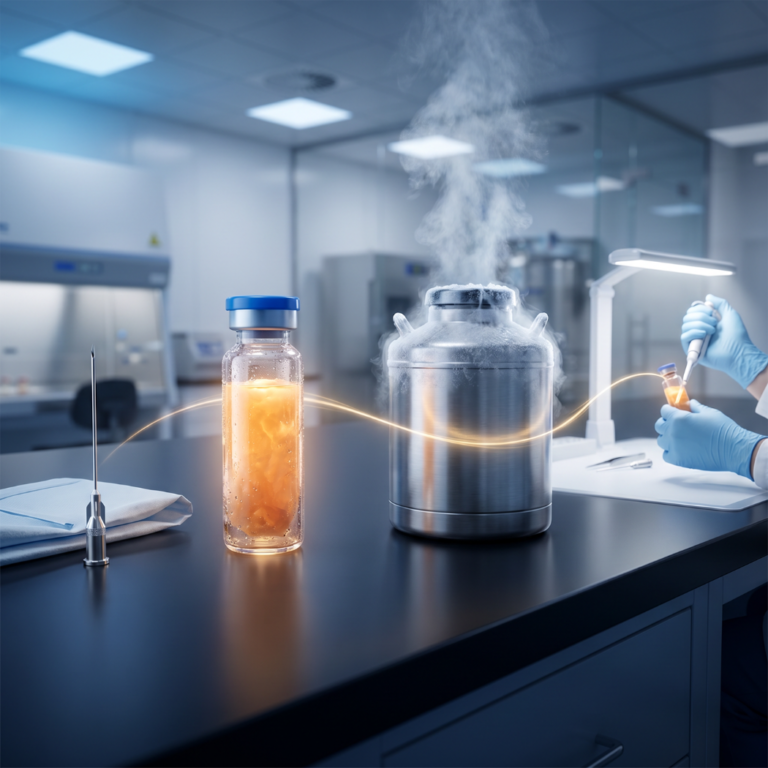
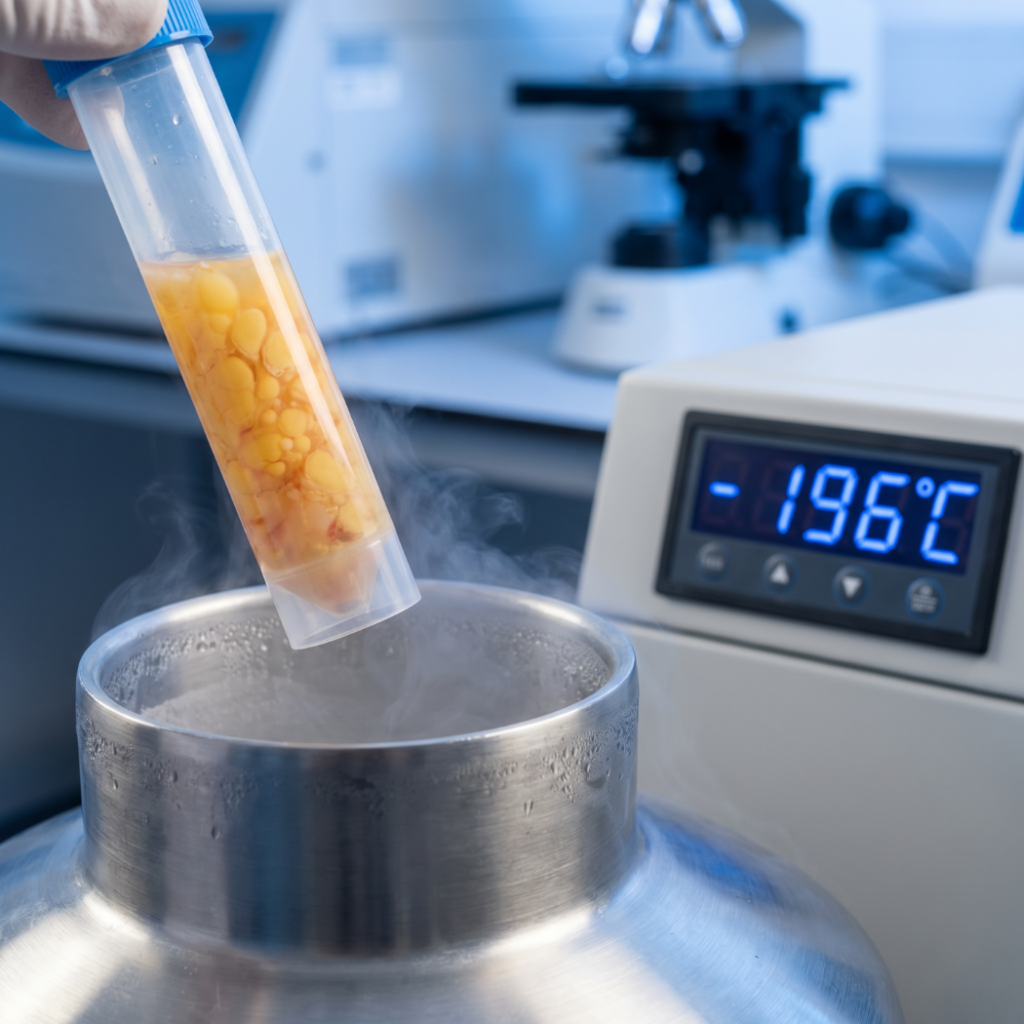
Step 3: Specimen Processing. The harvested tissue is packaged using Save My Fat’s chain-of-custody protocol and shipped to L2 Bio, the FDA-registered processing laboratory. L2 Bio processes the tissue, isolates the adipose-derived stem cell population, performs viability testing, and cryopreserves a documented vial inventory typically in the 200 to 400 range using a controlled-rate cryopreservation protocol. The cells are transferred to liquid nitrogen storage at approximately negative 196 degrees Celsius.
Step 4: Viability Certificate. You receive a viability certificate documenting the total cell yield, the post-processing viability percentage, the vial count, and storage confirmation. This document is your record of what was banked and the biological quality of those cells at the time of cryopreservation. The foundational Zuk 2002 paper established the scientific basis for adipose as the preferred cell source, and the viability certificate translates that scientific foundation into a documented record for your specific banking event.
Step 5: Long-Term Storage. Your cells are stored in liquid nitrogen at L2 Bio under long-term cryopreservation, with annual storage fees maintaining your storage account. Published long-term cryopreservation research has demonstrated viable cell recovery after twenty to thirty years of storage with maintained differentiation potential, and Save My Fat’s overviews of cryopreservation viability and long-term storage duration cover the evidence base in patient-accessible depth.
Step 6: Future Access. When and if you need to access your banked cells, whether for a clinical trial, an expanded access program, or a future FDA-approved therapy, you work with your physician and Save My Fat to arrange vial release and shipping to the treatment facility or trial site. The decision to access your cells is always yours and your physician’s. The regulatory framework at 21 CFR Part 1271 governs the compliant chain-of-custody that applies both to the initial banking and to any future vial release.
What Banking Costs
Banking is a cash-pay service priced between approximately $8,000 and $15,000 for the initial package, which covers all steps from consultation through first-year storage. Annual storage fees apply after year one and are comparable to annual fees for cord blood banking services, which is the closest analogous consumer product in the market. Insurance does not cover banking as of 2026, because banking under Section 361 HCT/P is tissue preservation rather than medical treatment, and insurance coverage generally does not apply to preservation services of this type.
Current package pricing is published directly on the Save My Fat website at savemyfat.com/pricing. Confirm current pricing and package terms with Save My Fat before making any financial commitment.
Who Banking Is For
Banking is designed for adults who are in generally good health and are candidates for a minor outpatient procedure under local anesthesia. The primary patient profiles fall into a few overlapping categories. Health-forward adults who want to preserve their biological options before age or disease reduces cell quality are the core demographic. Adults already engaged in proactive, longevity-oriented health practices, including genetic testing, functional medicine, and advanced diagnostic monitoring, are a natural fit. Patients with a personal or family health history that makes the orthopedic, autoimmune, neurological, or aesthetic ADSC pipeline particularly relevant have a stronger baseline reason to bank. Patients who understand that banking is a preservation service rather than a treatment, and who are comfortable with the option-value framework, tend to make the most informed banking decisions.
Banking is most valuable for patients who act earlier, before conditions develop and before cell quality declines with age. The published MSC biology literature documents why earlier preservation matters, and Save My Fat’s complete guide to banking covers the timing rationale in patient-facing depth.
What Makes Save My Fat Different from Stem Cell Clinics
This distinction matters because the stem cell space includes many unregulated clinics making treatment claims that the FDA has challenged and, in some cases, taken enforcement action against. Save My Fat is different in four specific ways, and each of the four is a structural feature of the program rather than a marketing claim.
- Banking only, with no treatment claims. Save My Fat preserves cells and makes no claims about treating, curing, or preventing any disease. Clinics offering “stem cell treatments” for specific conditions are operating under a different, and often non-compliant, framework.
- FDA-registered laboratory. L2 Bio is an FDA-registered tissue establishment operating under 21 CFR Part 1271. Processing is compliant, documented, and independently auditable, and Save My Fat’s overview of FDA regulations for adipose tissue covers the regulatory structure in more depth.
- Viability certification. Every banked sample comes with a viability certificate. Patients know exactly what they have, in documented form, at the time of cryopreservation. This is not a marketing document. It is a laboratory record.
- Partner provider network. The harvest is performed by trained partner providers in clinical settings, not at unregulated wellness centers or overseas clinics. The partner network is the operational backbone of the program, and Save My Fat’s comparison of banking vs. stem cell treatment clinics covers the distinction between banking and the unregulated sector in detail.
The broader regulatory context for how the FDA approaches cellular therapy approvals is visible in the FDA approved cellular and gene therapy products database, and Save My Fat’s resource on fake stem cell clinic red flags covers the pattern that patients should watch for when evaluating any cellular-therapy-related service.
The Science Behind What Is Being Banked
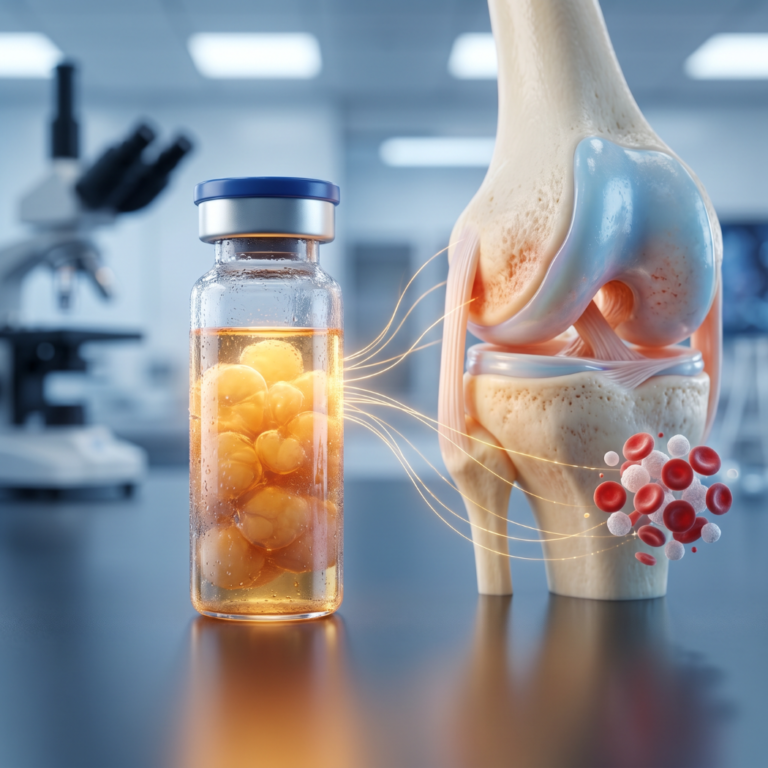
Adipose tissue is not just fat. It contains a population of mesenchymal stem cells, specifically adipose-derived stem cells, that have documented multipotent differentiation capacity, meaning the ability to become bone, cartilage, fat, and other cell types, and paracrine immunomodulatory activity, meaning the ability to influence surrounding tissue through secreted signaling factors. Gram for gram, adipose tissue yields substantially more stem cells than bone marrow, as the foundational Zuk 2002 paper established, which is what makes it the most practical source for autologous cell banking in adults. Save My Fat’s patient-facing introduction to adipose-derived stem cells and comparison of mesenchymal stem cells across sources cover the biology in accessible depth, and the 2019 MSC biology review from Pittenger and colleagues is the reference paper for the underlying mesenchymal stem cell science.
More than four hundred active clinical trials on ClinicalTrials.gov are investigating ADSCs and related MSC therapies across orthopedic, autoimmune, neurological, and aesthetic applications. The FDA approved the first MSC-based biologic in December 2024, which is listed in the FDA approved cellular and gene therapy products database. The pipeline banking preserves access to is real, growing, and moving toward clinical approval across multiple application categories.
Frequently Asked Questions
Do I need a referral to bank with Save My Fat?
No physician referral is required to begin the process. You connect directly with a Save My Fat partner provider for the consultation. Many patients choose to discuss banking with their existing physician as well, and that is a reasonable step, but the referral is not a prerequisite. Save My Fat’s provider program overview is the starting point for finding a partner provider.
How do I find a Save My Fat provider near me?
The Save My Fat provider page is the primary resource for locating partner providers by location. The provider directory is updated as new partners join the network, and patients in areas without a local partner provider can contact Save My Fat directly to discuss the nearest options.
What if I have a question before I decide?
Save My Fat’s resource on questions to ask before banking is the best starting point for patients who want to work through the decision systematically before scheduling a consultation.
Is my fat actually useful for stem cell banking?
Yes. Adipose tissue is one of the most cell-dense adult tissues available for MSC banking. A standard harvest provides enough tissue to yield a documented vial inventory typically in the 200 to 400 range of isolated adipose-derived stem cells, and the viability of those cells is documented and certified at the time of banking. The foundational Zuk 2002 paper established the scientific basis for adipose as the preferred cell source, and the published MSC biology literature continues to support this across the two decades since.
What happens if Save My Fat or L2 Bio closes?
This is a fair question to ask any banking service and one worth resolving before banking. Before committing, confirm the specific contractual terms covering long-term storage continuity, cell ownership in the event of service discontinuation, and what happens to stored samples if the laboratory closes. Review these provisions in the patient agreement before signing, and Save My Fat’s resource on questions to ask before banking covers the full due diligence checklist.
For physicians: how do I join the Save My Fat provider network?
The Save My Fat provider program overview covers the framework, and the partner sign-up page is the starting point for physicians interested in onboarding.
Key Takeaways
Save My Fat is an adipose tissue banking program rather than a treatment provider. The program preserves autologous cells under FDA-compliant conditions for potential future use in clinical trials, expanded access programs, and FDA-approved therapies as they develop. The distinction between banking and treatment is the most important thing to understand about the program, because it determines both the regulatory framework and the appropriate expectations for what banking does and does not provide.
The process has six steps from the patient perspective: consultation, a thirty-minute outpatient harvest under local anesthesia, L2 Bio processing and cryopreservation, delivery of a viability certificate documenting what was banked, long-term liquid nitrogen storage, and future access through the patient’s physician when and if the cells become clinically relevant.
Banking costs between $8,000 and $15,000 for the initial package, with annual storage fees after year one. It is cash-pay, and insurance does not cover it. HSA and FSA eligibility depends on individual plan terms. Save My Fat’s published pricing is the authoritative reference, and confirming current pricing directly with Save My Fat is the right final step before any financial commitment.
Banking is for health-forward adults who want to preserve their biological options before cell quality declines with age or disease. Earlier banking means higher-quality cells, and the biological case for acting now rather than waiting is stronger than the case for most other elective health investments because the cells lost to aging cannot be recovered.
Save My Fat is different from unregulated stem cell clinics across four structural dimensions. No treatment claims. FDA-registered laboratory. Viability certification on every sample. Trained partner provider network operating in clinical settings rather than wellness centers. Each of the four is an operational feature of the program rather than a marketing claim, and each can be verified independently.
The ADSC pipeline that banked cells are being preserved for is real, growing, and regulatory-precedent supported. More than four hundred active clinical trials, the December 2024 FDA MSC approval, and independent market projections of double-digit compound annual growth through the end of the decade together make a coherent case that the pipeline will be significantly more mature in five, ten, and twenty years than it is today.
Ready to Start?
Before moving forward: adipose tissue banking is a preservation service for potential future use in FDA-regulated pathways, not a treatment or a guarantee of access to any specific clinical trial, therapy, or product. No adipose-derived product is FDA-approved for general disease treatment, and banking cannot be represented as a treatment for any condition. Consult your physician about whether banking is appropriate for your specific situation. Physicians considering partnership should independently verify applicable state licensing and informed-consent requirements, particularly in Florida, Utah, and Nevada, which have stem cell-specific statutes.
To understand the full process, visit the Save My Fat overview of how banking works. To find a provider near you, visit the provider page. To see current pricing, visit savemyfat.com/pricing. To prepare your questions before deciding, visit the resource on questions to ask before banking.
Save My Fat provides adipose tissue banking services in partnership with L2 Bio for laboratory operations. Save My Fat does not provide medical treatments, clinical trial enrollment, or Expanded Access services.
This article is for educational purposes only and does not constitute medical or legal advice. Legal and medical review including neurology and neurosurgery input is required before publication. Please consult your neurologist or neurosurgeon before making any decisions about neurologic treatment or research participation.
Related guide: about SaveMyFat.