
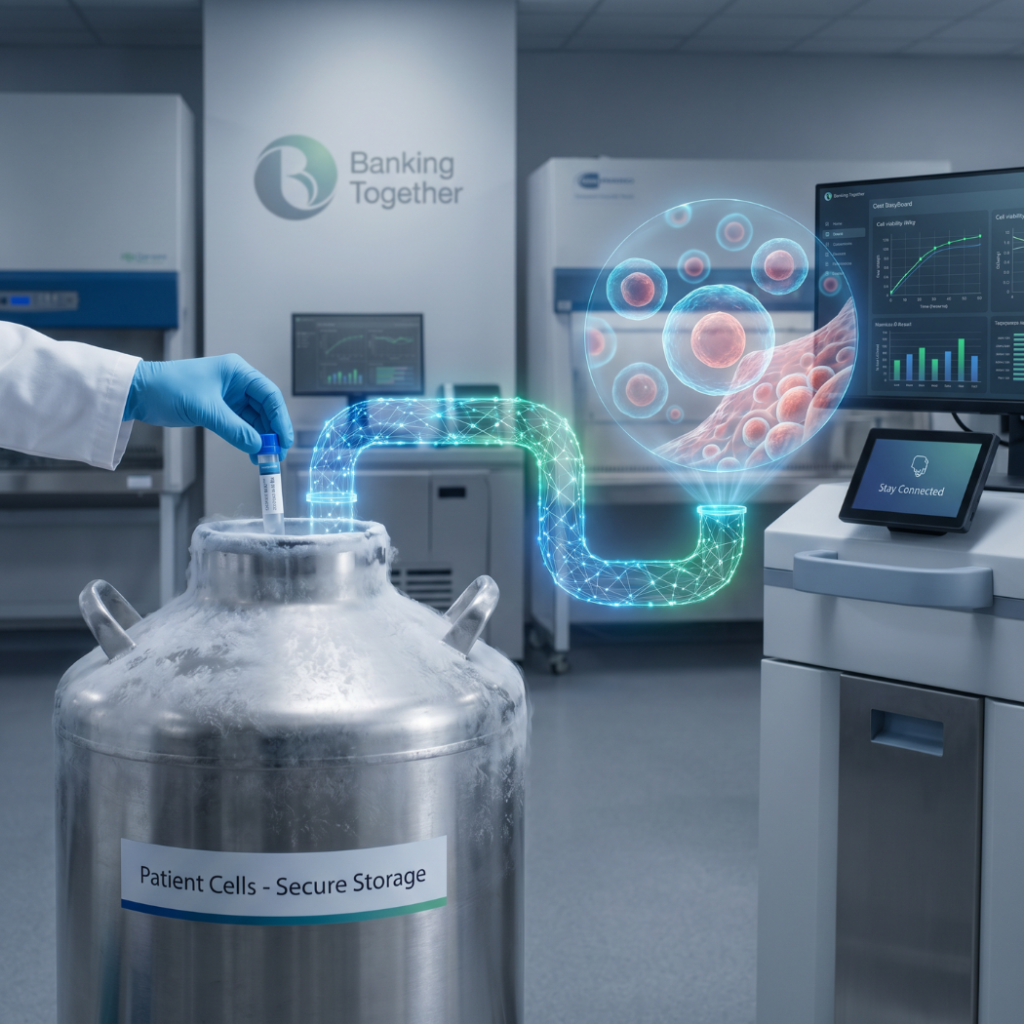
Once your viability certificate arrives and your cells are in cryostorage, the active phase of banking is complete, but the value of what you have preserved is just beginning to develop as the ADSC clinical trial pipeline matures toward approvals. The post-banking relationship involves three ongoing responsibilities: maintaining your storage account, staying informed about pipeline developments relevant to your health profile, and knowing the steps to access your cells when the time comes. This guide covers all three, plus what to do if your health situation changes after banking.
TLDR: After banking you receive your viability certificate, file it with your health records, pay annual storage fees to maintain your account, and stay informed about ADSC pipeline developments relevant to your health profile. If you ever need your cells, work with your physician and Save My Fat to arrange vial release and shipping. Your cells do not age in cryostorage. The quality you banked is the quality you access, years or decades from now.
Important Disclaimer: Banking is tissue preservation, not a guarantee of future treatment access or clinical benefit. The pipeline developments described in this post are ongoing research. No ADSC therapy for any specific condition is available through Save My Fat as a treatment. Accessing banked cells for a clinical trial or expanded access program requires physician involvement and independent eligibility assessment at the receiving facility. All content is for educational purposes only and does not constitute medical advice.
The day your viability certificate arrives is the moment banking shifts from a decision and a procedure into a long-term asset. The cells are stored, the quality is documented, and the cryopreservation clock has stopped. From this point forward, your job is not to do anything urgent. It is to stay informed, maintain your account, and be ready when the pipeline produces something relevant to you.
Most banked patients will go years without needing to think about their cells actively. That is the ideal outcome, because it means they are healthy, their preventive banking decision has not been tested yet, and the pipeline is still maturing toward the applications that will eventually matter to them. This guide is for when that changes, and for how to stay connected in the meantime.
Immediately After Banking: What to Do
Receive and file your viability certificate. Your viability certificate from a U.S.-based tissue bank documents your cell yield, post-processing viability percentage, vial count, and storage confirmation. When it arrives, typically within a few weeks of the procedure, file it with your permanent health records alongside other important health documents. This is the documentation you will reference if you ever access your cells, and it should be retrievable without a search if you need it on short notice. The published MSC biology literature supports why viability documentation matters for any future clinical application, and Save My Fat’s overview of cryopreservation viability covers what each data point on the certificate represents.
Share the document with your physician. Give a copy of your viability certificate to your primary care physician or relevant specialist for inclusion in your medical record. A physician who knows you have banked cells and knows your vial count and viability is better positioned to help you evaluate trial eligibility or expanded access options when the time comes, and the inclusion of the certificate in your active medical record avoids any scramble to locate it in the moment a clinical question arises.
Set up annual storage fee reminders. Annual storage fees keep your account active and your cells in cryostorage. Set up a calendar reminder or automatic payment arrangement to ensure storage fees are paid on time each year. Missed fees can result in complications with long-term storage continuity, so confirm the specific payment terms and any grace period provisions with Save My Fat at the time of banking. Save My Fat’s overview of long-term storage duration covers the storage side of the relationship in more depth.
Your Cells in Long-Term Storage
The cells in your cryostorage account are preserved in liquid nitrogen at approximately negative 196 degrees Celsius. At this temperature, all biological activity is arrested. Cellular metabolism, aging, and degradation do not occur. Published long-term cryopreservation research has demonstrated viable cell recovery after twenty to thirty years of storage with maintained differentiation potential, and Save My Fat’s overview of long-term cryopreservation covers the evidence base in patient-accessible terms.
What this means practically is that the biological quality you preserved at the time of banking is the quality you access whenever you need your cells, whether that is five years from now or twenty-five. The pipeline that did not exist when you banked may exist by then, and your cells will be waiting at the same quality as the day they were frozen. The regulatory framework at 21 CFR Part 1271 governs the compliant storage conditions that protect this preservation value across the storage term.
Staying Connected to the Pipeline
Monitor Clinical Trial Activity
The most practical way to stay informed about ADSC pipeline developments relevant to your health profile is to monitor ClinicalTrials.gov for trials in your areas of interest. Active recruiting trials are updated continuously, and the active ADSC trial search on ClinicalTrials.gov is the reference query for the full pipeline. A patient who banked because of a family history of knee osteoarthritis should check the orthopedic ADSC trial pipeline annually. A patient who banked because of early multiple sclerosis should monitor the autoimmune and neurological pipeline. A patient who banked for general longevity reasons can set a broader alert and receive updates across all indication areas.
ClinicalTrials.gov allows email alerts for new studies matching specific search terms. Setting up a search alert for “adipose stem cells” or a condition-specific term takes about five minutes and delivers relevant pipeline updates automatically without requiring active monitoring on your part. Save My Fat’s resources on finding legitimate clinical trials and what ClinicalTrials.gov phases mean cover the evaluation framework patients should use when reviewing specific trial listings that come through the alert feed.
Follow FDA Approvals in the MSC Space
The December 2024 approval of Ryoncil established the precedent for FDA-approved MSC therapies. Future approvals in the orthopedic, autoimmune, or neurological categories will be announced on the FDA’s approved cellular and gene therapy products page, which is the authoritative federal source for approved cellular therapies. A patient who monitors this page annually, or who checks it when prompted by a pipeline-specific development they have heard about, will know when the first ADSC approval in their area of interest occurs.
Stay Connected to Save My Fat
Save My Fat will communicate pipeline developments relevant to banked patients through its patient communication channels. Ensuring your contact information is current with Save My Fat is the simplest way to receive relevant updates without active monitoring on your part. The patient communication infrastructure is designed to surface the developments most likely to matter to banked patients based on the pipeline activity the program is tracking across the field. Save My Fat’s complete guide to banking covers the ongoing patient relationship in more depth.
How to Access Your Cells When the Time Comes
When a clinical development makes your banked cells relevant, whether that is a trial you are eligible for, an expanded access program, or a future FDA-approved therapy, the access process involves three parties working together: you, your physician, and Save My Fat.
- Identify the clinical pathway. Is this a clinical trial enrollment, an expanded access request, or a future FDA-approved therapy prescribed by your physician? Each pathway has a different access mechanism. Your physician and Save My Fat can help identify which pathway applies to the specific situation. Save My Fat’s overview of expanded access programs covers one of the three main pathways in patient-facing depth.
- Confirm eligibility. Clinical trials have eligibility criteria specific to each protocol. Expanded access requires physician initiation and FDA review. A future approved therapy will have prescribing indications that determine which patients are candidates. Eligibility confirmation comes before vial release, and no cells are shipped until the clinical pathway has confirmed the patient’s place in it.
- Arrange vial release and shipping. Once eligibility is confirmed and the clinical pathway is established, Save My Fat coordinates vial release from a U.S.-based tissue bank and shipping to the treatment facility or trial site under the compliant chain of custody the 21 CFR Part 1271 framework requires. The chain-of-custody documentation follows the vials from storage to destination.
- Your physician manages the clinical process. Once your cells arrive at the treatment site, the clinical process is managed by the physician or clinical team at the receiving facility. Save My Fat’s role ends at vial delivery, and the patient-physician relationship at the receiving site governs everything that happens from that point forward. Save My Fat’s overview of ClinicalTrials.gov phases covers the framework patients should use when evaluating what the receiving site’s protocol involves.
If Your Health Situation Changes After Banking
If you develop a condition relevant to the ADSC pipeline. Notify your physician that you have banked cells and share your viability certificate if you have not already added it to your medical record. Discuss whether any active trials or expanded access programs are relevant to your situation. The Reagan-Udall Foundation’s Expanded Access Navigator is the best starting resource for expanded access evaluation, and Save My Fat’s overview of expanded access programs covers the framework in patient-facing terms.
If you want to bank additional cells. A second harvest is possible and some patients elect to add to their vial count at a later date. Cells from a second harvest will reflect the biological quality at the time of the second procedure, which per the published MSC biology literature will be lower than the biological quality at your first harvest if meaningful time has passed. Contact Save My Fat to discuss whether a second banking procedure is appropriate for your situation and what the logistics would involve.
If you move or your contact information changes. Update your contact information with Save My Fat immediately. Your storage account communications, viability updates, and any pipeline developments will reach you only if your contact details are current, and an outdated address or phone number can result in missed communications that matter when the pipeline produces something relevant to your profile.
If you are considering canceling your storage account. Before canceling, review the terms for what happens to stored cells upon account closure. Understand that once cells are destroyed, the option they represented cannot be recovered. If cost is the underlying concern, discuss with Save My Fat whether alternative storage fee arrangements are available before taking the irreversible step of closure. Save My Fat’s resource on questions to ask before banking covers the storage continuity framework, and the same due diligence applies to closure decisions as to initial banking decisions.
The Long View: What Banked Patients Should Expect Over Time
Year 1 is the recovery and setup year. You complete the harvest, receive your viability certificate, establish annual storage payment, and set up pipeline monitoring alerts. No other active steps are required beyond these, and most patients find that the post-banking year is notably low-effort compared to the research and decision-making that preceded banking.
Years 2 through 5 are the monitoring years. Review the pipeline annually, share your viability certificate with any new physicians who enter your care, maintain your storage account through consistent annual payments. The orthopedic ADSC trial pipeline is most likely to produce Phase 3 data and approval submissions during this window based on current trial timelines, so patients who banked for orthopedic reasons may see directly relevant developments emerge in this period.
Years 5 through 10 are the maturation years. The ADSC approval landscape will likely look significantly different from today. Patients who banked in 2026 will have cells preserved at their 2026 biological quality available for applications that may be approved and accessible by 2031 to 2036. The long-term cryopreservation literature supports viable cell recovery across this timeframe with maintained differentiation potential, so the preservation value is fully intact across the window.
Year 10 and beyond are the compounding years. Cryopreservation maintains cell quality indefinitely. The option value of banked cells does not decline with storage time. It increases as the pipeline matures and produces more approvals and trials, and as the gap widens between the biological quality of the banked cells and the biological quality a patient would be able to preserve if they waited until year fifteen or twenty to bank for the first time. The active ADSC trial pipeline on ClinicalTrials.gov is worth revisiting every few years to see how the indication areas have evolved.
Key Takeaways
Immediately after banking you file your viability certificate with your health records and share a copy with your physician, set up annual storage fee reminders or automatic payments, and ensure your contact information is current with Save My Fat. These three actions take a single afternoon and cover the entire post-banking setup.
Your cells do not age in cryostorage. The quality you banked is the quality you access, years or decades from now. This is the structural feature that makes banking a long-term preservation decision rather than a time-sensitive treatment decision, and it is what justifies banking as early as possible while cells are at their highest quality.
Staying connected to the pipeline is low-effort ongoing work. Set ClinicalTrials.gov alerts for relevant search terms. Monitor the FDA approved cellular and gene therapy products page for MSC approvals. Keep your contact information current with Save My Fat so pipeline communications reach you. An hour a year is enough to stay meaningfully informed about developments relevant to your health profile.
When you need your cells, the access process involves four steps. Identify the clinical pathway. Confirm eligibility. Arrange vial release and shipping through Save My Fat and a U.S.-based tissue bank. Work with your physician at the receiving facility. The process is coordinated rather than self-managed, but the patient and the patient’s physician remain in the decision-making role throughout.
If your health situation changes, the four scenarios covered above give you clear next steps. Developing a relevant condition means notifying your physician and evaluating trial or expanded access options. Wanting to bank again means contacting Save My Fat to discuss a second harvest. Moving or changing contact information means updating Save My Fat immediately. Considering cancellation means pausing to review the terms and exploring alternative arrangements before taking an irreversible step.
The long view is the most important frame for banked patients. The pipeline will be significantly more developed in five, ten, and twenty years than it is today. Banked patients who maintain their accounts are preserving access to that future without doing anything else, and the option value of preserved cells compounds rather than decays across the storage term.
Stay Informed and Ready
Before taking any next steps: adipose tissue banking is a preservation service for potential future use in FDA-regulated pathways, not a treatment or a guarantee of access to any specific clinical trial, therapy, or product. No adipose-derived product is FDA-approved for general disease treatment, and banked cells cannot be accessed outside the compliant clinical pathways described in this post. Consult your physician about any clinical decision involving your banked cells. Physicians considering partnership should independently verify applicable state licensing and informed-consent requirements, particularly in Florida, Utah, California, Georgia, and Tennessee, which have stem cell-specific statutes.
To search active trials relevant to your health profile, visit the ADSC trial search on ClinicalTrials.gov. To understand expanded access options, visit Save My Fat’s overview of expanded access programs and the Reagan-Udall Expanded Access Navigator. To find a provider for a potential second banking procedure, visit the provider page.
Save My Fat provides adipose tissue banking services in partnership with a U.S.-based tissue bank for laboratory operations. Save My Fat does not provide medical treatments, clinical trial enrollment, or Expanded Access services.
This article is for educational purposes only and does not constitute medical or legal advice. Legal and medical review including neurology and neurosurgery input is required before publication. Please consult your neurologist or neurosurgeon before making any decisions about neurologic treatment or research participation.
About the author: Oscar Tellez is the founder and CEO of Save My Fat. He holds a Bachelor of Science in Exercise Science and Health Promotion from Florida Atlantic University. He has spent more than a decade in the regenerative medicine industry across product distribution, laboratory and vendor relationships, and provider training. He is not a licensed clinician, and this article is educational, not medical advice.
Related guide: the stem cell science glossary.