
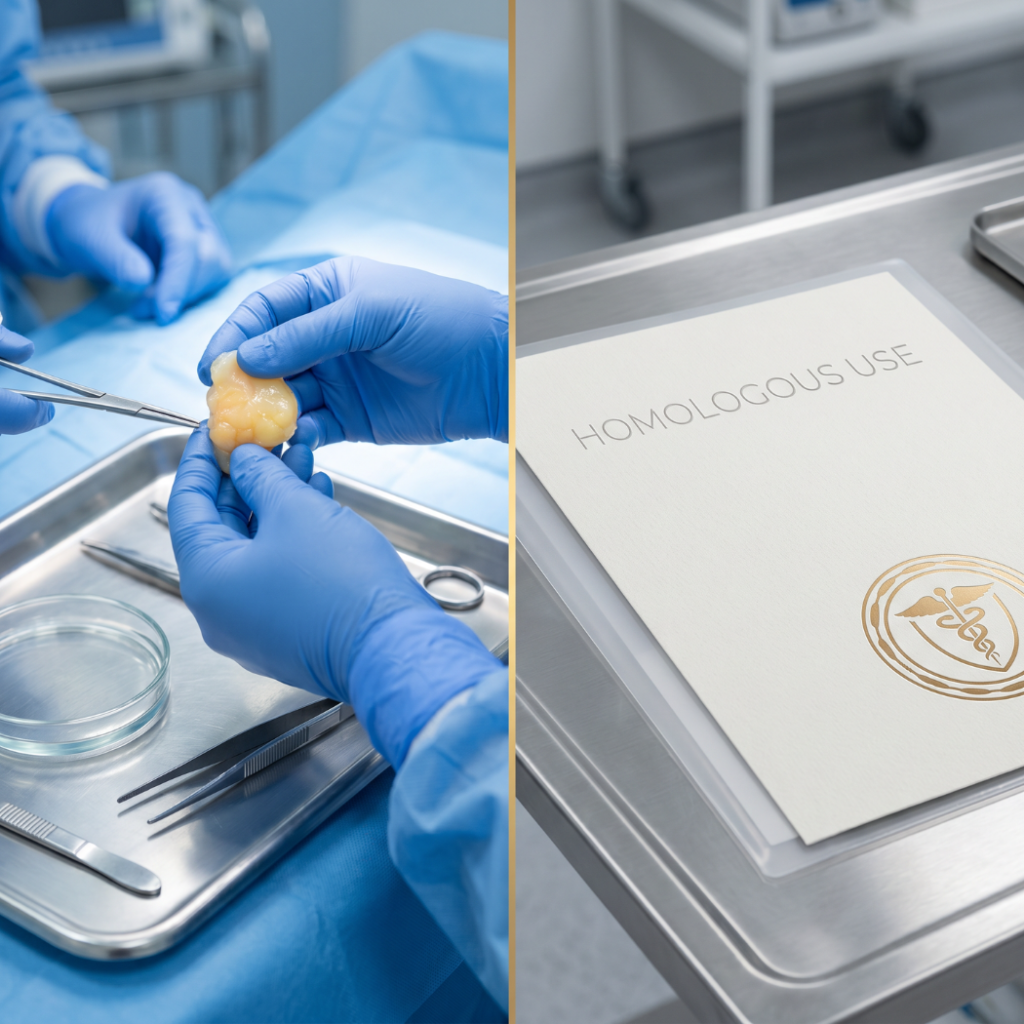
Minimal manipulation gets most of the attention, but homologous use is the criterion that catches physicians off guard most often. A physician can use a properly processed, genuinely minimally manipulated tissue product and still convert it into a 351 biologic, requiring an IND, simply by using it for a purpose outside the tissue’s basic function. The FDA has issued numerous warning letters on exactly this point in the adipose and stem cell space. This is the direct companion to the discussion of minimal manipulation, and it covers what homologous use means, how the FDA applies it to adipose tissue, and the due diligence a physician owes before any use.
TLDR: Homologous use, defined in 21 CFR 1271.3(c), means using an HCT/P to repair, reconstruct, replace, or supplement a recipient’s tissue with a product that performs the same basic function it performed in the donor. For adipose tissue, the basic functions are cushioning, support, and structural filling. Using adipose or adipose-derived cells for systemic, inflammatory, neurological, or musculoskeletal conditions is non-homologous and requires an IND. The FDA’s July 2020 guidance states plainly that treating arthritis or tendonitis with an adipose HCT/P is non-homologous. Banking adipose tissue does not enroll a patient in therapy and does not guarantee any future eligibility, access, or benefit.
Important Disclaimer: Save My Fat does not provide FDA-approved treatments or cures for any disease. Banking adipose tissue today does not guarantee eligibility, access, or clinical benefit from any future therapy, clinical trial, or medical program. No adipose-derived stem cell product currently holds FDA approval for the conditions discussed in this article. All content is for educational purposes only and does not constitute medical advice. Patients must consult their own licensed healthcare professionals regarding all medical decisions.
The trap here is subtle in a way that minimal manipulation is not. A physician who has carefully confirmed that a product was minimally manipulated can feel they have cleared the regulatory hurdle, and then administer it for an indication that fails a different criterion entirely. Homologous use is judged by what the tissue is used for, not how it was processed, which means it has to be evaluated separately for every intended clinical application.
Why Homologous Use Is the Compliance Tripwire
The four criteria under 21 CFR 1271.10 are cumulative, so clearing one says nothing about the others. Minimal manipulation, covered in the companion discussion of intact adipose tissue, is about processing. Homologous use is about purpose. A minimally manipulated adipose product used for soft-tissue filling is homologous; the same product injected to treat a systemic disease is not, and that single change converts it to a 351 biologic requiring an IND before clinical use. Because the determination depends on the indication rather than the product, it has to be made fresh for each use, and that is precisely why physicians miss it.
The Regulatory Definition of Homologous Use
21 CFR 1271.3(c) defines homologous use as the repair, reconstruction, replacement, or supplementation of a recipient’s cells or tissues with an HCT/P that performs the same basic function or functions in the recipient as in the donor. The operative phrase is “same basic function or functions.” The recipient tissue does not have to be identical to the donor tissue, and the product need not perform all of the same functions, but it must perform at least one of the same basic functions. The FDA assesses intended use through the product’s labeling, advertising, and other indications of the manufacturer’s objective intent, which means how a product is marketed can itself establish a non-homologous, and therefore non-compliant, use.
How the FDA Defines Homologous Use for Adipose Tissue
The FDA’s July 2020 guidance is unusually direct about adipose tissue. The basic functions of adipose tissue are cushioning and support for other tissues, energy storage in the form of lipids, and insulation. Homologous uses therefore include soft-tissue augmentation, reconstruction of soft-tissue defects, and cushioning or structural support where adipose tissue normally resides. Non-homologous uses include treating degenerative, inflammatory, or demyelinating disorders. The guidance is explicit that this category captures musculoskeletal conditions such as arthritis or tendonitis: using an adipose HCT/P to regenerate or promote regeneration of articular cartilage or tendon is generally not homologous, because that is not a basic function of adipose tissue. That is a sharper line than many practices assume, and it is the FDA’s stated position, not an inference.
The Florida Scope Tension Physicians Must Understand
There is a genuine conflict that Florida physicians in particular need to see clearly. Florida’s SB 1768 authorizes non-FDA-approved stem cell therapy for orthopedics, wound care, and pain management. But the FDA’s July 2020 guidance treats musculoskeletal use of an adipose HCT/P as non-homologous, which means it would require an IND under federal law. So a use that Florida affirmatively authorizes at the state level can simultaneously be a non-homologous use that federal law says requires an IND. State authorization does not resolve the federal question, because federal law is not preempted by a state statute. A Florida physician operating in the orthopedic space under SB 1768 should treat this overlap as an open legal question to work through with counsel before proceeding, not as a conflict the state law has settled in their favor.
Homologous vs. Non-Homologous Use Examples
| Intended use | Tissue type | Homologous? | Regulatory consequence |
|---|---|---|---|
| Soft-tissue augmentation (cosmetic) | Adipose | Yes | 361 HCT/P if other criteria met |
| Wound filling / soft-tissue reconstruction | Adipose | Yes | 361 HCT/P if other criteria met |
| Orthopedic joint injection (knee, hip) | Adipose-derived cells | No; not a basic adipose function in joints | 351 biologic; IND required |
| Treatment of COPD or lung disease | Adipose-derived cells | No | 351 biologic; IND required |
| Treatment of neurological conditions | Adipose-derived cells | No | 351 biologic; IND required |
| Autologous fat grafting to breast after mastectomy | Adipose | Yes; structural/filling function | 361 HCT/P if other criteria met |
| Systemic infusion of isolated fraction | Adipose-derived fraction | No | 351 biologic; IND required (fraction isolation also fails minimal manipulation) |
FDA and FTC Enforcement on Non-Homologous Use
Enforcement on this criterion is active and documented. The FDA has issued warning letters to providers administering adipose-derived or other stem cell products for non-homologous purposes without an IND, with recurring targets being intravenous infusions for neurological conditions, autism, COPD, and systemic disease. On the marketing side, the FTC and the Georgia Attorney General obtained court orders in January 2025 against the co-founders of the Stem Cell Institute of America, permanently banning them from marketing regenerative medicine treatments and imposing $5,155,146 in penalties and refunds, in a case built around unproven claims for arthritis, joint pain, and other orthopedic ailments, indications that also map onto non-homologous use. The enforcement and warning-letter patterns are detailed separately in the broader FDA regulations overview.
Physician Due Diligence Checklist for Homologous Use
- Confirm the intended use is described as homologous for this tissue type in the FDA’s July 2020 guidance.
- Obtain a written regulatory opinion from the processing partner specifically addressing homologous use.
- Check whether the intended clinical use matches the tissue’s normal function in the body.
- If the use is potentially non-homologous, consult a regulatory affairs attorney before proceeding.
- If an IND is required, determine the pathway: join an existing sponsored trial, obtain a physician-sponsored IND, or pursue expanded access.
- Document the homologous-use determination in the clinical record.
Frequently Asked Questions
Can a minimally manipulated product still require an IND?
Yes. Minimal manipulation and homologous use are separate criteria. A minimally manipulated product used for a non-homologous purpose becomes a 351 biologic and requires an IND, regardless of how carefully it was processed.
Is an orthopedic joint injection of adipose-derived cells homologous?
Per the FDA’s July 2020 guidance, no. Regenerating or promoting regeneration of cartilage or tendon is not a basic function of adipose tissue, so musculoskeletal use is generally non-homologous and would require an IND.
Does Florida SB 1768 resolve the federal homologous-use question for orthopedic use?
No. SB 1768 authorizes orthopedic use at the state level, but federal law is not preempted, and the FDA treats musculoskeletal adipose use as non-homologous. The overlap is an open legal question to work through with counsel.
Key Takeaways
Homologous use is the criterion that turns careful processing into a false sense of security, because it is judged by the indication, not the product, and has to be evaluated for every use. The FDA’s July 2020 guidance draws a sharp line for adipose tissue: cushioning, support, and structural filling are homologous, while degenerative, inflammatory, demyelinating, and musculoskeletal uses, arthritis and tendonitis explicitly included, are not, and a non-homologous use is a 351 biologic requiring an IND. The Florida wrinkle is real and worth raising with counsel: SB 1768 authorizes orthopedic use that the FDA would treat as non-homologous, and state authorization does not settle the federal question. The enforcement record, both FDA warning letters and the FTC’s 2025 action, tracks exactly these non-homologous indications. As always, none of this concerns banking, which is a preservation decision separate from any therapeutic use and carries no guarantee of future benefit.
Save My Fat connects patients and providers with a U.S.-based tissue bank. It is not a tissue bank, a laboratory, a medical practice, or a treatment provider. Stem cell and regenerative medicine regulations vary by state, including specific informed-consent and disclosure requirements in Florida, Utah, California, Georgia, and Tennessee governing tissue and stem cell services. Banking adipose tissue does not connect patients to any treatment pathway, and any future use depends on FDA regulatory status, physician guidance, and the availability of approved or investigational pathways at that time.
Physicians working through a homologous-use determination can contact Save My Fat to discuss how tissue preservation fits. Service and processing details are available at https://savemyfat.com/pricing/.
Save My Fat partners with a U.S.-based tissue bank for laboratory processing and storage.
This article is for educational purposes only and does not constitute medical or legal advice. Please consult your own licensed healthcare provider before making any decisions about treatment or research participation.
About the author: Oscar Tellez is the founder and CEO of Save My Fat. He holds a Bachelor of Science in Exercise Science and Health Promotion from Florida Atlantic University. He has spent a decade in the regenerative medicine industry across product distribution, laboratory and vendor relationships, and provider training. He is not a licensed clinician, and this article is educational, not medical advice.
Related guide: FDA regulation of adipose tissue and stem cells.