
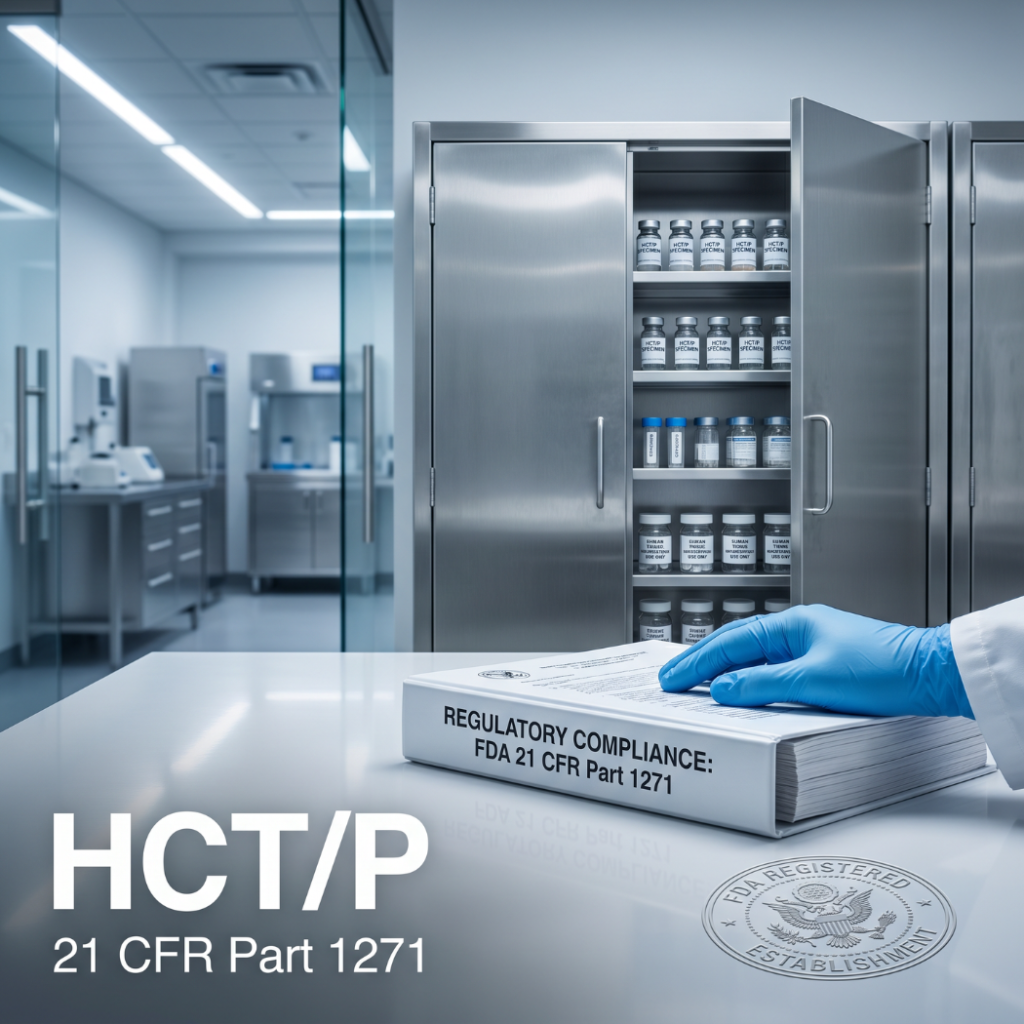
A common assumption among physicians entering regenerative medicine is that 361 HCT/Ps carry no FDA obligations because they require no pre-market approval. That is wrong, and the misunderstanding can be expensive. 21 CFR Part 1271 imposes registration, listing, and Current Good Tissue Practice requirements on every establishment that manufactures HCT/Ps, including those that qualify under Section 361. Florida’s SB 1768 leans directly on this when it requires that stem cells be manufactured in a facility “registered and regulated by FDA.” What that registration is, what it does not mean, and what the physician using a registered facility still has to do are covered below.
TLDR: Under 21 CFR Part 1271, any establishment that manufactures HCT/Ps must register with the FDA through HCTERS within 5 days of beginning operations and update annually in December, even for 361 tissues that need no pre-market approval. Registration is a notification, not an FDA approval, inspection, or quality certification, and the FDA states acceptance of a registration does not mean the establishment is compliant or the product is approved. A physician using a registered facility must still verify registration in the public registry, review CGTP compliance, and, for Florida, confirm separate accreditation. Banking adipose tissue does not enroll a patient in therapy and does not guarantee any future eligibility, access, or benefit.
Important Disclaimer: Save My Fat does not provide FDA-approved treatments or cures for any disease. Banking adipose tissue today does not guarantee eligibility, access, or clinical benefit from any future therapy, clinical trial, or medical program. No adipose-derived stem cell product currently holds FDA approval for the conditions discussed in this article. All content is for educational purposes only and does not constitute medical advice. Patients must consult their own licensed healthcare professionals regarding all medical decisions.
The phrase “no pre-market approval required” does a lot of damage when physicians read it as “no FDA involvement.” Those are different statements. The 361 pathway exempts a qualifying tissue from the IND and licensure process; it does not exempt the establishment that makes the tissue from registering, listing, and following federal tissue-practice rules. Understanding that gap is what separates a compliant entry into this space from an expensive misstep.
The Misconception: “361 Means No FDA Involvement”
The 361 designation, named for Section 361 of the Public Health Service Act, covers HCT/Ps that meet specific criteria and therefore do not require an IND or a biologics license to be lawfully distributed. Because there is no approval step, some physicians conclude there is no FDA touchpoint at all. But 21 CFR Part 1271 imposes registration, listing, and Current Good Tissue Practice obligations on all establishments that manufacture HCT/Ps, 361 tissues included. When Florida’s SB 1768 requires sourcing from a facility “registered and regulated by FDA,” it is pointing at exactly this Part 1271 registration requirement. The distinction between a 361 tissue and a 351 product turns on minimal manipulation and homologous use, the subject of the explainer on intact adipose tissue.
What FDA Establishment Registration Is
Any establishment that manufactures HCT/Ps must register with the FDA through the Human Cell and Tissue Establishment Registration System and submit a list of every HCT/P it manufactures. The timing is specific. Under 21 CFR 1271.21, an establishment must register and list within 5 days after beginning operations, and must update its registration annually in December. “Manufacture” is defined broadly and includes recovery, processing, storage, labeling, packaging, and distribution, so a facility that merely processes and stores tissue is squarely within the requirement.
The defining feature of registration is what it is not. It is a notification mechanism, not a quality gate. The FDA does not review or approve an establishment’s operations through registration, and the agency states plainly that its acceptance of a registration does not mean the establishment complies with applicable rules or that the HCT/P is licensed or approved.
What Registration Does and Does Not Mean
| Registration means | Registration does NOT mean |
|---|---|
| The establishment has notified the FDA of its existence and the HCT/Ps it manufactures | The FDA has inspected or approved the establishment’s operations |
| The establishment is subject to FDA inspection under 21 CFR Part 1271 | The products manufactured necessarily meet 361 HCT/P criteria |
| The establishment must comply with CGTP requirements under Subpart D | The establishment is exempt from FDA enforcement |
| Florida SB 1768’s “registered and regulated by FDA” condition is satisfied | The physician is relieved of due diligence on the facility’s compliance |
The right mental model: registration tells you the facility exists and is on the FDA’s radar for inspection. It tells you nothing about whether the facility is actually following the rules. That second question is the physician’s to answer.
The Physician’s Responsibility When Using a Registered Facility
Using a registered third-party facility does not transfer the physician’s responsibility to that facility. The physician who administers the HCT/P sits in the distribution chain and carries obligations of its own. At minimum, verify the facility’s registration in the public registry before first use and periodically after, and request and review the facility’s CGTP compliance documentation rather than taking registration as a proxy for quality.
Florida adds a separate layer. SB 1768 requires not only FDA registration but also accreditation by the National Marrow Donor Program, the World Marrow Donor Association, the Association for the Advancement of Blood and Biotherapies, or the American Association of Tissue Banks. Registration and accreditation are different things: registration is a mandatory federal notification under Part 1271, while accreditation is a voluntary third-party quality certification that Florida has elevated into a statutory precondition. A facility can be registered and not accredited, which satisfies federal law but fails Florida’s statute. One note of correction worth making, because it circulates in summaries: the enrolled Florida statute conditions sourcing on FDA registration, accreditation, and a post-thaw viability report; the specific clean-room and HEPA-filtration language that appeared in an earlier draft of the bill is not what governs, so verify facility-environment expectations against CGTP and the enrolled statute rather than a superseded version. The full Florida requirement set is laid out in the discussion of why physicians add adipose banking.
How to Verify a Facility’s Registration
The FDA maintains a publicly searchable database of registered HCT/P establishments through HCTERS. To verify a facility, search the public registry by establishment name, confirm that the registration is current, and check that the HCT/Ps listed in the registration actually include the products you are buying. If a facility cannot be found in the registry, that absence is itself a finding: do not proceed on the facility’s say-so. Document your verification with a dated screenshot or printout retained in the vendor file, so that your due diligence is provable if it is ever questioned.
What Happens If a Physician Uses an Unregistered Facility
Sourcing HCT/Ps from an unregistered facility exposes the physician to FDA enforcement, which can include warning letters, injunctions, and, in egregious cases, criminal referral. The FDA has acted against operators marketing unapproved stem cell products. Under Florida SB 1768, using tissue from a non-FDA-registered facility would independently violate the statute, layering a Board of Medicine problem on top of the federal exposure. The two risks are cumulative, not alternative.
Registration Verification Checklist
- Facility name confirmed in the HCTERS public registry.
- Registration current, with the annual December update reflected.
- HCT/Ps listed in the registration match the products being purchased.
- Accreditation status confirmed separately for Florida providers.
- Verification documented and dated in the vendor file.
- Reverification scheduled annually.
Frequently Asked Questions
If a tissue is a 361 HCT/P, does the facility still have to register with the FDA?
Yes. The 361 pathway exempts a qualifying tissue from pre-market approval, but the establishment that manufactures it must still register, list its products, and follow CGTP under 21 CFR Part 1271.
Does FDA registration mean the facility is FDA-approved?
No. Registration is a notification, not an approval, inspection, or certification. The FDA states that accepting a registration does not mean the establishment is compliant or the product is approved.
Is registration the same as the accreditation Florida requires?
No. Registration is a federal requirement under Part 1271. Accreditation by AABB, NMDP, WMDA, or AATB is a separate, voluntary quality certification that Florida’s SB 1768 made a statutory precondition. A facility must satisfy both to source tissue for Florida providers.
Key Takeaways
The “361 means no FDA involvement” belief is the single most consequential misconception for a physician entering this space, because it leads people to skip a verification step that the law treats as mandatory. Part 1271 requires every HCT/P manufacturer to register through HCTERS within 5 days of starting operations and update annually, and that requirement applies to 361 tissues that need no approval. But registration is only a notification: it does not mean the FDA inspected or blessed the facility, and the physician who uses the tissue still owns the due diligence of verifying registration in the public registry, reviewing CGTP compliance, and, in Florida, confirming separate accreditation. Sourcing from an unregistered facility stacks federal and state exposure. None of this is about banking, which is a preservation decision separate from therapeutic use, but the registration and accreditation questions are exactly what a physician should be asking of any lab partner before the first patient.
Save My Fat operates as a tissue preservation service, not a medical practice or treatment provider. Stem cell and regenerative medicine regulations vary by state, including specific informed-consent and disclosure requirements in Florida, Utah, and Nevada governing tissue and stem cell services. Banking adipose tissue does not connect patients to any treatment pathway, and any future use depends on FDA regulatory status, physician guidance, and the availability of approved or investigational pathways at that time.
Physicians evaluating a lab partner’s FDA standing can contact Save My Fat to discuss how tissue preservation and sourcing work. Service and processing details are available at https://savemyfat.com/pricing/.
Save My Fat partners with L2 Bio for laboratory processing and storage.
This article is for educational purposes only and does not constitute medical or legal advice. Legal and medical review including neurology and neurosurgery input is required before publication. Please consult your neurologist or neurosurgeon before making any decisions about neurologic treatment or research participation.
Related guide: FDA regulation of adipose tissue and stem cells.