Roswell is a city of 91,505 people spanning Fulton and Cobb counties, about 20 miles northeast of Atlanta. Residents asking about adipose banking want three answers: who qualifies, what happens before collection, and what they sign.
TLDR Adipose banking means storing your own fat tissue for possible future use, not receiving care. Federal rules in 21 CFR Part 1271 set how that tissue is handled, and the autologous exception at 1271.90 replaces donor screening with required labeling. Georgia’s stem cell law reaches licensed clinicians, not storage. Banking does not guarantee eligibility, access, or clinical benefit from any future therapy or clinical trial.
Important Disclaimer: Save My Fat does not provide FDA-approved treatments or cures for any disease. Banking adipose tissue today does not guarantee eligibility, access, or clinical benefit from any future therapy, clinical trial, or medical program. No adipose-derived product currently has FDA approval for any disease. All content is for educational purposes only and does not constitute medical advice. Patients must consult their own licensed healthcare professionals regarding all medical decisions.
Banking adipose tissue is a storage decision. A physician collects the tissue and a laboratory handles it under federal rules. Nothing in that sequence makes a therapy available, and no adipose-derived product carries FDA approval for any disease, as the agency states in its consumer alert.
Save My Fat is a connector that links patients and providers with a United States tissue bank. It does not collect, process, store, or treat tissue.
Who Is Eligible to Bank Adipose Tissue in Roswell?
Eligibility runs through two gates. The first is clinical, since a physician decides who is a candidate for the collection procedure. The second is federal, because human cells, tissues, and cellular and tissue-based products fall under 21 CFR Part 1271.
Banked tissue is stored for the person it came from, which makes it autologous. That one word drives the rest, from screening to the label. Readers wanting the full sequence can review how banking works.
Adipose Banking Eligibility Criteria Under Federal Rules
The criteria describe how tissue is handled and what it is intended for, not patient traits. The four Section 361 criteria call for minimal manipulation, homologous use only, tight limits on combining tissue with other articles, and a fourth condition that autologous use satisfies.
Anything failing those criteria, and not otherwise excepted, is regulated as a drug, device, and/or biological product. The second criterion names labeling and advertising, so marketing claims can change how tissue is classified.
What Screening Happens Before Tissue Collection
For tissue stored for the same patient’s future use, federal donor screening and testing are not required. The donor eligibility rule requires a determination for every donor except as provided under 1271.90, and the autologous exception lifts that determination, along with the screening and testing, for cells and tissues for autologous use.
Labeling takes its place. Under 1271.90(c), tissue stored for autologous use is labeled “FOR AUTOLOGOUS USE ONLY,” and it carries “NOT EVALUATED FOR INFECTIOUS SUBSTANCES” unless screening and testing were run anyway. When performed, the screening categories cover HIV, hepatitis B, hepatitis C, human transmissible spongiform encephalopathy including Creutzfeldt-Jakob disease, and Treponema pallidum, and a CLIA-certified laboratory or equivalent performs the tests.
The exception is narrow. It excuses screening and testing only, not registration, listing, current good tissue practice, labeling, or the Section 361 criteria.
How Georgia Law Affects Roswell Providers
Georgia’s stem cell law reaches clinicians, not storage. HB 1275 (2026 Ga. Laws Act 453) was signed in May 2026 and took effect July 1, 2026. Its enrolled text applies to “a physician or, following a lawful designation from such physician, a physician assistant or nurse practitioner,” meaning licensed individuals, not clinics or tissue banks.
Such a clinician “may perform human stem cell therapy that is not approved by the FDA” within their scope of practice, so long as the patient is advised and signs a consent form. The statute approves nothing and creates access to nothing, and no state law could.
Its sourcing standard calls for cells retrieved, manufactured, and stored in a facility registered with the FDA, located in Georgia, another state, or another country, so the facility need not sit inside Georgia. Accreditation by a listed body is an alternative, and registration is self-submitted, not an FDA approval.
Enforcement is professional discipline only, with no criminal penalty and no private right of action. Georgia also requires a consumer notice in any advertisement for these services, in a type size no smaller than the largest used. Our guide to Georgia House Bill 1275 goes section by section.
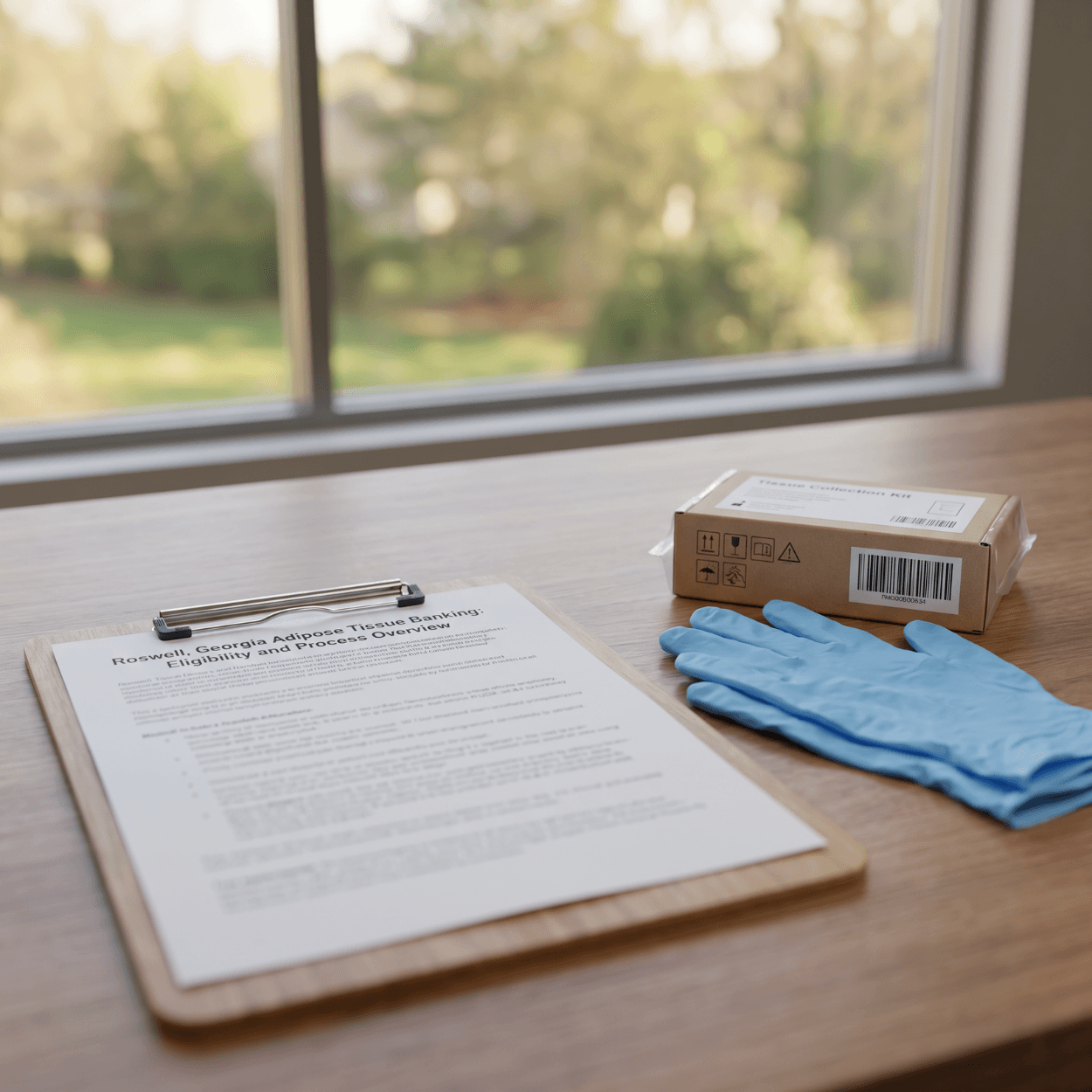
What Paperwork a Roswell Patient Completes
The paperwork splits by step. Banking involves the collection procedure’s own clinical consent plus the laboratory’s records and labels. The written consent required by Georgia’s law attaches to a later step, since it must be signed before a clinician performs a human stem cell therapy the FDA has not approved.
Georgia has no standalone tissue bank statute and instead uses clinical laboratory certification. The Georgia laboratory rules extend that definition to tissue banks that procure, store, or process human tissues for medical purposes. The tissue bank quality rule adds documented informed consent, unique lot identification, and records kept for not less than seven years after distribution. Adipose tissue is not named in those rules.
Frequently Asked Questions
Do I have to live in Roswell to bank tissue?
There is no residency test. Eligibility is a clinical decision by the physician performing the collection, made inside the federal framework described above.
Does age or health status affect eligibility?
Age and health shape the clinical side, not the regulatory side. The autologous exception turns on how tissue will be used, not on a patient’s age or diagnosis, so candidacy is the treating physician’s call.
Is any adipose-derived product FDA approved?
No adipose-derived product is FDA approved for any disease. Such material remains investigational and early stage, and patients should speak with a licensed provider before acting on what they read.
Can a relative use tissue I bank?
Federal criteria contemplate autologous use and, separately, allogeneic use in a first-degree or second-degree blood relative, though tissue stored for autologous use carries the “FOR AUTOLOGOUS USE ONLY” label. Our guide to family eligibility explains it.
Key Takeaways
Adipose banking in Roswell is a storage decision governed mostly by federal rules. Eligibility has a clinical gate, decided by the collecting physician, and a federal gate in 21 CFR Part 1271. Because stored tissue is autologous, the exception at 1271.90 swaps donor screening for required labeling. Georgia’s HB 1275 governs licensed clinicians, not banking, and creates no access to any therapy. No adipose-derived product is FDA approved for any disease, and banking guarantees nothing later.
Save My Fat connects patients and providers with a U.S.-based tissue bank. It is not a tissue bank, a laboratory, a medical practice, or a treatment provider. Stem cell and regenerative medicine regulations vary by state, including specific informed-consent and disclosure requirements in Florida, Utah, California, Georgia, and Tennessee governing tissue and stem cell services. Banking adipose tissue does not connect patients to any treatment pathway, and any future use depends on FDA regulatory status, physician guidance, and the availability of approved or investigational pathways at that time.
Roswell readers weighing adipose tissue banking for potential future use can compare current pricing or ask a question through the contact page.
Save My Fat works with a U.S.-based tissue bank for laboratory processing and storage.
This article is for educational purposes only and does not constitute medical or legal advice. Please consult your own licensed healthcare provider before making any decisions about adipose tissue banking or research participation.
About the author: Oscar Tellez is the founder and CEO of Save My Fat. He holds a Bachelor of Science in Exercise Science and Health Promotion from Florida Atlantic University. He has spent a decade in the regenerative medicine industry across product distribution, laboratory and vendor relationships, and provider training. He is not a licensed clinician, and this article is educational, not medical advice.
Related guide: state stem cell laws.