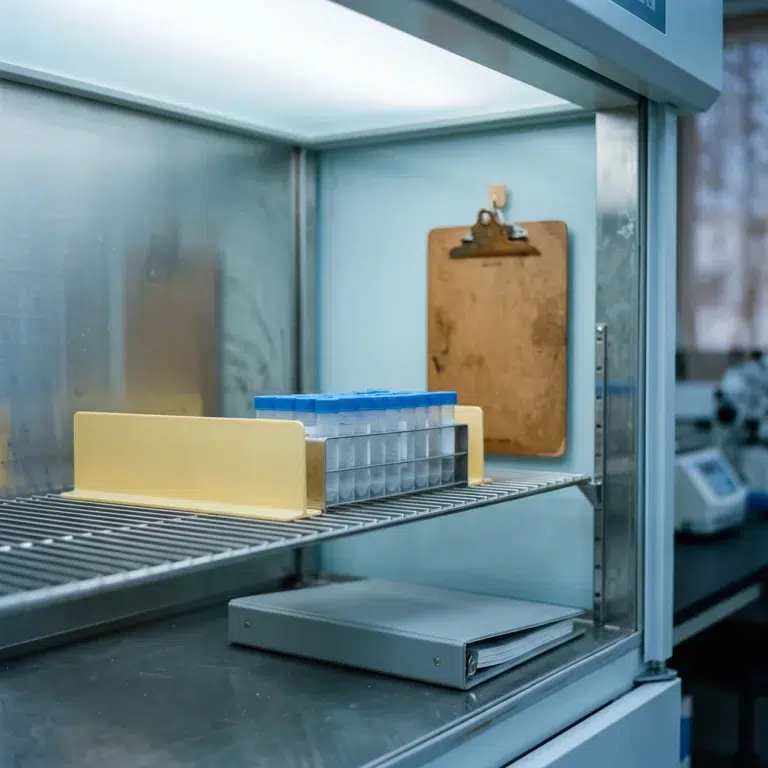

After a banking collection, a reasonable question is what actually happens to the tissue. This guide walks through the journey from the collection site to long-term storage at a U.S.-based tissue bank in plain language, so a patient understands each step. It describes the process for banking intact adipose tissue, which is what Save My Fat preserves, and it is transparent about what a patient should confirm before relying on any specific detail.
TLDR: After collection, intact adipose tissue is transported to the laboratory, where identity and chain-of-custody are confirmed, the tissue is processed and characterized, viability and sterility are assessed, and the tissue is cryoprotected, frozen, and moved to long-term cryogenic storage with continuous monitoring. Patients receive documentation of their banking. If tissue is ever needed for an FDA-regulated pathway, it is thawed and assessed before release. Save My Fat preserves intact tissue rather than isolating or expanding cells. Banking preserves a person’s own tissue for potential future use; it is not a treatment and does not guarantee eligibility, access, or clinical benefit.
Important Disclaimer: Save My Fat does not provide FDA-approved treatments or cures for any disease or condition. Banking adipose tissue today does not guarantee eligibility, access, or clinical benefit from any future therapy, clinical trial, or medical program. All content is for educational purposes only and does not constitute medical advice. Patients must consult their own licensed healthcare professionals regarding all medical decisions.
The process below reflects standard tissue banking practice and the way Save My Fat describes its service. Some specific operational details vary by laboratory and should be confirmed with a U.S.-based tissue bank, because a patient deserves accuracy rather than assumption.
From Harvest to the Lab: What Happens in the First 24 Hours
After the collection procedure, the adipose tissue is prepared for transport to the laboratory under conditions intended to preserve tissue integrity. On arrival, the laboratory confirms patient identity and documents chain-of-custody, which is the record that tracks the tissue from collection through every subsequent step.
This early stage matters because careful handling and accurate identification set the foundation for everything that follows. Unique patient identifiers are applied so that a patient’s tissue is tracked accurately throughout storage. The overview of your banking day describes the collection experience that precedes this step.
How Your Tissue Is Processed
A key point distinguishes this service from some others. Save My Fat preserves intact adipose tissue rather than enzymatically isolating or culture-expanding cells. In processing, the tissue is washed and prepared, and the intact adipose tissue is separated for preservation. This approach keeps the tissue intact rather than converting it into an isolated cell product.
This distinction has regulatory significance, because preserving intact tissue is handled differently from processing that isolates or expands cells. The overview of the tissue bank’s process provides the provider-facing detail. The processing is accompanied by characterization, including documentation of the tissue’s cellular content, performed under standard operating procedures.
Viability Testing: What It Is and Why It Matters
Viability testing assesses how many cells are alive and healthy, establishing a baseline for the sample before freezing. Sterility testing, using microbiological cultures, confirms the absence of contamination. Together these checks document the quality of the tissue at the time of banking.
Viability matters because it characterizes the sample, but it is important to understand what it does and does not mean. Published research shows that cryopreserved adipose tissue can retain viable cells after long-term storage, with results that vary by protocol, duration, and temperature. The overview of cryopreservation viability summarizes this research. High viability indicates that cells survived processing; it does not guarantee any specific clinical outcome or future use.
Cryopreservation: How Your Cells Are Frozen and Stored
Cryopreservation is a controlled process, not ordinary freezing. A cryoprotective agent is added to protect cells as they cool, and the tissue is frozen under a controlled cooling protocol designed to limit the ice-crystal damage that ordinary freezing causes. The tissue is then moved to long-term cryogenic storage.
Long-term storage is maintained at cryogenic temperatures, where biological activity effectively ceases, supporting long-term preservation. Quality storage facilities maintain continuous temperature monitoring, alarm systems, and backup systems to protect samples. The overview of how cryopreservation works explains the underlying science, and the broader overview of how banking works places storage in the full process. This handling is consistent with current good tissue practice standards under 21 CFR Part 1271, including Subpart D.
What Documentation You Receive After Banking
After banking, a patient should receive documentation confirming that the tissue was banked, along with records appropriate to the service. This documentation is part of the transparency a patient should expect, and it provides a record of what was collected and stored.
Chain-of-custody records and unique patient identifiers underpin this documentation, ensuring the tissue is tracked accurately. A patient who has questions about what records they will receive should ask before banking, and a transparent service will explain clearly. The service operates under 21 CFR Part 1271, the federal framework governing the handling and storage of human tissue.
What Happens to Your Tissue If You Want to Access It in the Future
Access to banked tissue occurs only in the context of an FDA-regulated clinical pathway, such as a clinical trial, expanded access, or a future approved therapy. When tissue is requested for such a use, the laboratory first confirms patient identity and chain-of-custody. The tissue is then thawed under a controlled protocol and assessed before release.
It is essential to be clear about what banking does and does not secure. Banking preserves tissue, but it does not guarantee access to any treatment, trial, or program, and any future use depends on FDA regulatory status and the science at that time. Consent is required for retrieval, and the realistic framing is that banking is preparedness, not a promise of any specific future use.
Frequently Asked Questions
Does the tissue bank isolate or grow my cells?
Save My Fat preserves intact adipose tissue rather than enzymatically isolating or culture-expanding cells. The tissue is washed, prepared, characterized, and cryopreserved as intact tissue. Specific processing steps should be confirmed with a U.S.-based tissue bank.
How is my tissue kept safe during storage?
Storage is maintained at cryogenic temperatures with continuous temperature monitoring, alarm systems, and backup systems, under chain-of-custody documentation and unique patient identifiers. Specific storage parameters should be confirmed with a U.S.-based tissue bank.
What does viability testing tell me?
Viability testing characterizes how many cells are alive and healthy and establishes a baseline before freezing. High viability means cells survived processing; it does not guarantee any specific clinical outcome or future use.
Can I access my tissue whenever I want?
Access occurs only in the context of an FDA-regulated clinical pathway, with identity and chain-of-custody confirmed and consent required. Banking preserves tissue but does not guarantee access to any treatment, trial, or program.
How is my banked tissue regulated?
Banked adipose tissue is handled under 21 CFR Part 1271, including current good tissue practice standards in Subpart D, which govern screening, processing, storage, and documentation of human tissue.
Key Takeaways
For patients who want to understand what happens after a collection, the process is defined and documented at every stage. Intact adipose tissue is transported to the laboratory, where identity and chain-of-custody are confirmed, the tissue is processed and characterized, viability and sterility are assessed, and the tissue is cryoprotected, frozen under a controlled protocol, and moved to monitored cryogenic storage. Save My Fat preserves intact tissue rather than isolating or expanding cells, which carries regulatory significance, and patients receive documentation of their banking. If tissue is ever needed, access occurs only within an FDA-regulated pathway, with thawing and assessment before release. Above all, banking adipose tissue is a preservation service for potential future use; it is not a treatment, and it does not guarantee eligibility, access, or clinical benefit.
Save My Fat connects patients and providers with a U.S.-based tissue bank. It is not a tissue bank, a laboratory, a medical practice, or a treatment provider. Stem cell and regenerative medicine regulations vary by state, including specific informed-consent and disclosure requirements in Florida, Utah, California, Georgia, and Tennessee governing tissue and stem cell services. Banking adipose tissue does not connect patients to any treatment pathway, and any future use depends on FDA regulatory status, physician guidance, and the availability of approved or investigational pathways at that time.
Patients who want to understand the process in more detail can review how banking works and contact the team with questions.
Save My Fat partners with a U.S.-based tissue bank for laboratory processing and storage.
This article is for educational purposes only and does not constitute medical or legal advice. Please consult your physician before making any decisions about banking, treatment, or research participation.
About the author: Oscar Tellez is the founder and CEO of Save My Fat. He holds a Bachelor of Science in Exercise Science and Health Promotion from Florida Atlantic University. He has spent a decade in the regenerative medicine industry across product distribution, laboratory and vendor relationships, and provider training. He is not a licensed clinician, and this article is educational, not medical advice.
Related guide: FDA adipose tissue regulation.