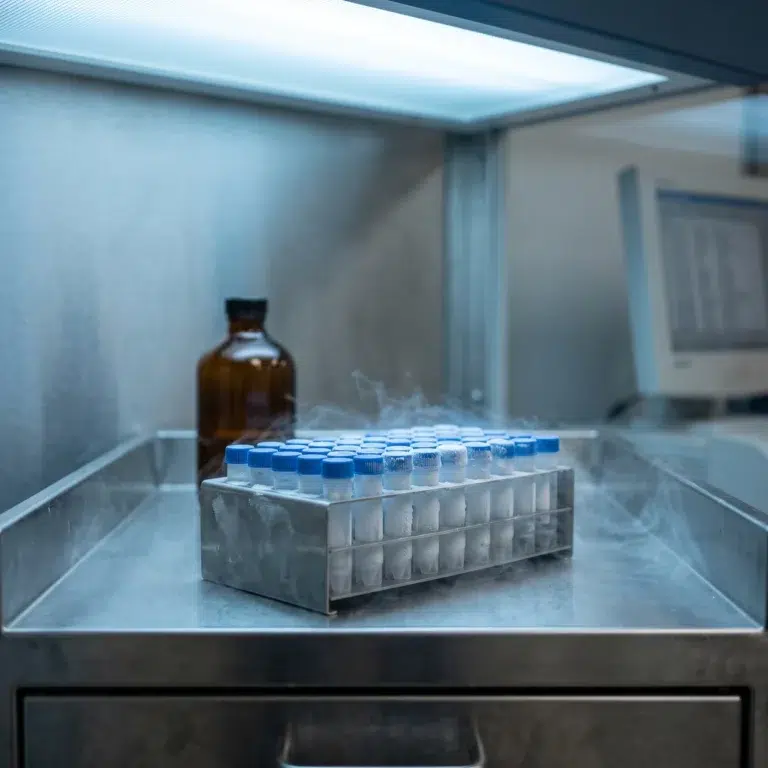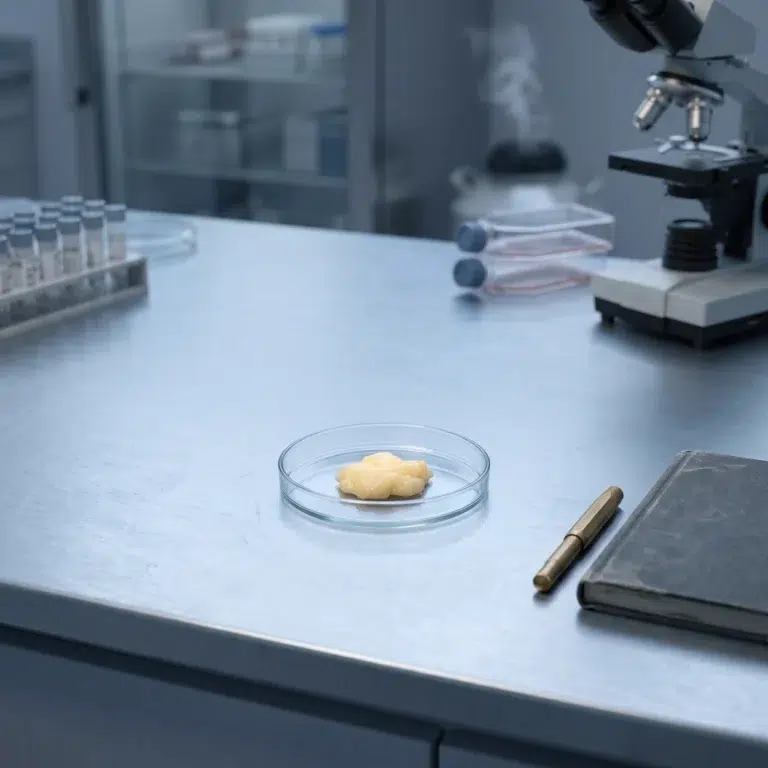
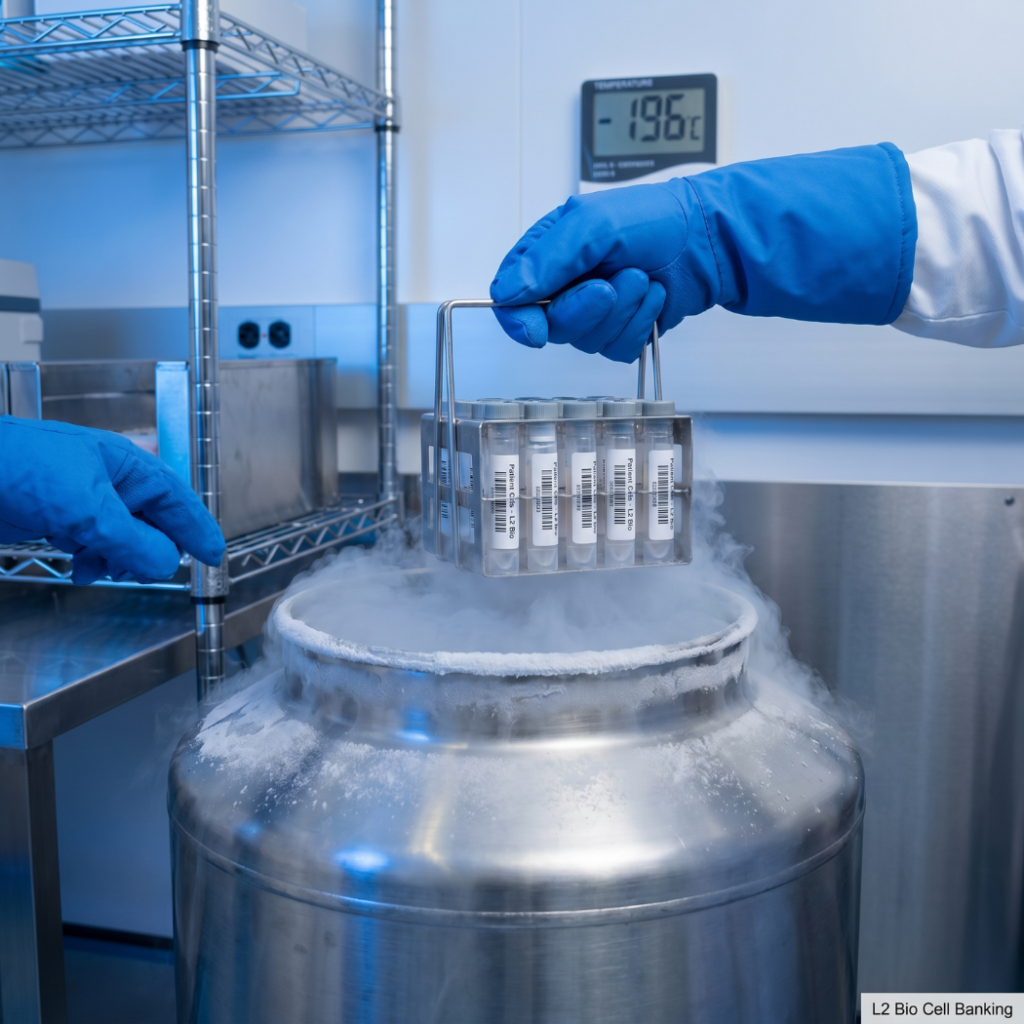
After the harvest, every step involving the patient’s tissue happens at the tissue bank’s US-based, FDA-registered laboratory. The tissue bank receives the specimen, isolates and processes the adipose-derived stem cells, performs viability testing, cryopreserves the cells into a documented vial inventory, and manages long-term liquid nitrogen storage under current Good Tissue Practice regulations. The provider’s role ends with the packaged specimen. the tissue bank’s role covers everything that determines the quality and integrity of what the patient has banked.
TLDR: The tissue bank is a US-based laboratory operating under FDA current Good Tissue Practice regulations at 21 CFR Part 1271 Subpart D. After receiving the harvested specimen, the tissue bank performs cell isolation, viability testing, controlled-rate cryopreservation, vial preparation (typically 200 to 400 vials per harvest), and long-term liquid nitrogen storage. The patient receives a viability certificate. Chain-of-custody documentation is maintained throughout. The provider does not perform any lab processing on-site.
Important Disclaimer: Save My Fat does not provide FDA-approved treatments or cures for any disease. Banking adipose tissue does not guarantee eligibility, access, or clinical benefit from any future therapy, clinical trial, or medical program. All content is for educational purposes only and does not constitute medical advice. Information about the tissue bank’s processing protocols in this post reflects publicly available descriptions of standard tissue banking practices and Save My Fat’s published provider materials. For a U.S.-based tissue bank-specific technical specifications, contact the tissue bank directly.
When a physician refers a patient for banking, they are putting their professional credibility behind every step of the process, including the steps they do not personally perform. The harvest is in the physician’s hands. Everything after the specimen leaves the procedure room is in the lab’s hands. A physician who cannot answer the question “what does the lab actually do and how do I know it meets the right standards?” cannot in good conscience offer banking to their patients.
This is not an unreasonable standard. It is the same due diligence a physician would apply before referring a patient to any specialist, diagnostic lab, or partner facility. The question is not whether to ask it. The question is whether there is a satisfying answer. For a U.S.-based tissue bank, there is.
This post covers the full the tissue bank processing sequence from specimen receipt to long-term storage, explains the regulatory framework that governs the facility, breaks down what quality controls apply at each step, and clarifies what the viability certificate actually means. By the end of it, the lab infrastructure should be as clear as the harvest procedure itself.
The Regulatory Framework the Tissue Bank Operates Under
Current Good Tissue Practice (cGTP): 21 CFR Part 1271 Subpart D
The FDA’s current Good Tissue Practice regulations govern how human cells, tissues, and cellular and tissue-based products are processed, stored, labeled, packaged, and distributed. These regulations are codified at 21 CFR Part 1271 Subpart D and apply to all FDA-registered tissue establishments. The FDA’s tissue products page is the primary federal reference for the regulatory structure that governs the sector.
The cGTP requirements are substantive rather than nominal. They cover facilities and environmental controls, equipment validation and maintenance, standard operating procedures for all processing steps, personnel training and competency documentation, quality control and release testing, labeling accuracy, storage conditions, distribution and tracking records, and adverse event investigation and reporting. A facility operating under cGTP is one with documented evidence across all of these categories available to FDA inspection.
The tissue bank operates as an FDA-registered tissue establishment under these regulations. The registration obligation belongs to a U.S.-based tissue bank as the processing facility, not to the harvesting provider. This is the regulatory separation that allows the provider to perform the harvest without carrying the full facility registration burden. Save My Fat’s overviews of 21 CFR Part 1271 and FDA regulations for adipose tissue translate the regulatory framework for practicing providers.
What “FDA-Compliant” Means in Practice
“FDA-compliant” is a phrase used loosely in the stem cell industry, so it deserves precise definition. In the context of a U.S.-based tissue bank, it means the facility operates under the cGTP regulations above, with validated standard operating procedures, documented quality controls, trained personnel, and the full regulatory record that a cGTP-compliant facility is required to maintain. It does not mean the processed cells are FDA-approved products. They are Section 361 HCT/P materials, minimally manipulated autologous tissue processed and stored under the applicable regulatory framework. That distinction between a cGTP-compliant facility and an FDA-approved therapeutic product is one of the most important in the sector, and it is the distinction that separates compliant banking from the injection clinics the FDA has pursued enforcement actions against.
The Processing Sequence Step by Step
Step 1: Specimen Receipt and Chain-of-Custody Verification
When the specimen arrives at a U.S.-based tissue bank, the first step is chain-of-custody verification. This means confirming that the specimen container label matches the accompanying documentation (patient identifier, collection date and time, provider name, donor site), that the specimen was shipped within the required time window, and that temperature integrity was maintained during transport. If chain-of-custody documentation is incomplete or temperature integrity is compromised, a U.S.-based tissue bank initiates the non-conformance protocol. The provider is notified. Processing does not proceed on a compromised specimen. Save My Fat’s overview of what happens after banking describes the patient-facing side of this handoff.
Step 2: Cell Isolation and Processing
A U.S.-based tissue bank isolates the adipose-derived stromal and stem cell population from the harvested tissue using validated processing protocols consistent with cGTP requirements. The processing method is designed to meet the minimal manipulation standard under Section 361 HCT/P, preserving the relevant biological characteristics of the cells without altering them in ways that would trigger Section 351 classification. The 2006 ISCT minimal criteria from Dominici and colleagues and the IFATS and ISCT joint consensus on adipose-derived cell characterization together establish the biological benchmarks the processing is designed to preserve.
The scientific basis for why processing method choices matter is worth naming. Mechanical processing (washing, centrifugation, size-based separation) does not alter the relevant biological characteristics of the cells and is considered minimal manipulation under the regulatory framework at 21 CFR Part 1271. Certain enzymatic processing methods applied to produce injectable cell preparations are an area where the FDA has applied scrutiny regarding the minimal manipulation standard, which is part of the enforcement pattern described in earlier posts in this series. the tissue bank’s processing method is consistent with the minimal manipulation framework.
Step 3: Viability Testing and Cell Counting
After isolation, a U.S.-based tissue bank performs viability testing on the processed cell population. Standard viability assessment uses trypan blue exclusion or an equivalent validated method to determine the percentage of live cells in the preparation. Cell counting confirms the total nucleated cell yield from the harvest. These results determine the number of vials that can be prepared. A typical harvest of 20 cc of adipose tissue yields enough cells to fill 200 to 400 vials, which is consistent with the yield characteristics documented in the landmark 2002 Zuk paper on adipose as a stem cell source and in subsequent characterization studies.
Step 4: Cryopreservation
A U.S.-based tissue bank cryopreserves the processed cells using controlled-rate freezing protocols. Controlled-rate freezing is the validated standard for preserving cell viability through cryopreservation. Uncontrolled or rapid freeze protocols cause intracellular ice crystal formation that damages cell membranes and reduces post-thaw viability, which is precisely the failure mode a validated protocol is designed to avoid.
The cryopreservation medium includes a cryoprotectant, typically DMSO (dimethyl sulfoxide) at validated concentration, to protect cells during the freezing process. Cells are cooled at a controlled rate, typically one degree Celsius per minute through the critical temperature range, before transfer to long-term liquid nitrogen storage. The published cryopreservation longevity literature supports the validity of this approach for long-term cell preservation, and Save My Fat’s resources on cryopreservation viability and cryopreservation safety cover the patient-facing rationale.
Step 5: Vial Preparation and Labeling
Cryopreserved cells are aliquoted into individual vials. Each vial is labeled per cGTP requirements: patient identifier, cell type, passage number where applicable, cryopreservation date, vial number in the batch, and any quality control test results. Labeling accuracy is a cGTP compliance requirement, not a preference. Every vial label must be traceable back to the patient’s chain-of-custody documentation and processing records. A facility that cannot trace a vial back to its harvest record has by definition failed the cGTP framework, which is why the labeling step is treated as a formal quality-control checkpoint rather than a paperwork formality.
Step 6: Long-Term Liquid Nitrogen Storage
Labeled vials are transferred to liquid nitrogen vapor phase storage. Vapor phase liquid nitrogen storage maintains cells at approximately negative 150 to negative 196 degrees Celsius. At these temperatures, biological activity is arrested. Cells do not age, degrade, or lose viability as long as storage conditions are maintained. The 2019 MSC biology review from Pittenger and colleagues in npj Regenerative Medicine describes the biological basis for this preservation window in physician-appropriate depth.
A U.S.-based tissue bank maintains redundant storage infrastructure: backup liquid nitrogen supply, temperature monitoring and alarm systems, and documented emergency response protocols for storage unit failure. This redundancy is a cGTP expectation for a tissue establishment that stores cells over multi-year horizons, because a single point of failure in storage equipment would otherwise put every patient’s banked material at risk. Save My Fat’s overview of long-term cryopreservation covers the storage duration evidence in patient-facing depth.
Step 7: Viability Certificate Issuance
After processing and storage are complete, a U.S.-based tissue bank issues a viability certificate to the patient. The certificate documents the harvest date, the total cell yield, the post-processing viability percentage, the number of vials stored, and the vial identification information. This certificate is the patient’s documentation of what they have banked and at what quality. It is also the provider’s confirmation that the specimen was successfully processed. If processing could not be completed because the specimen was compromised in transit or the cell yield fell below the protocol threshold, a U.S.-based tissue bank notifies the provider through the non-conformance protocol rather than issuing a certificate. Save My Fat’s overview of the complete banking process covers where the viability certificate fits in the overall patient experience.
What Happens When a Patient Wants to Access Their Vials
The storage side of the process is one half of the lifecycle. The retrieval side is the other. When a patient and their physician decide to access banked cells, for a clinical trial, expanded access program, or approved therapy as those pathways become available, the retrieval process is initiated through a U.S.-based tissue bank. The vials are thawed under controlled conditions, quality-checked for post-thaw viability, and shipped on dry ice directly to the treating provider. Chain-of-custody documentation accompanies the shipment throughout transit, mirroring the protocol used on the inbound harvest specimen.
The treating provider at retrieval is typically the same physician who performed the harvest. The patient relationship and the cells both return to the same practice, which is one of the structural features that makes banking a compounding patient relationship rather than a one-time transaction. Save My Fat’s overview of how banking works covers the retrieval step in patient-facing terms.
Frequently Asked Questions
Is a U.S.-based tissue bank registered with the FDA?
A U.S.-based tissue bank operates as an FDA-registered tissue establishment under 21 CFR Part 1271, subject to the current Good Tissue Practice regulations that govern processing, storage, and distribution of human tissue products. The facility registration obligation belongs to a U.S.-based tissue bank as the processing laboratory, not to the harvesting provider, and the FDA tissue products page is the primary federal reference for how the registration system is structured.
What happens if a patient’s specimen is compromised during shipping?
If chain-of-custody documentation is incomplete or temperature integrity is not confirmed upon receipt, a U.S.-based tissue bank initiates the non-conformance protocol under Subpart D of the tissue regulations. Processing does not proceed. The provider and patient are notified of the outcome and the next steps, which typically include discussion of whether to repeat the harvest depending on the specific circumstances of the specimen compromise.
How many vials does a typical patient receive?
A 20 cc harvest of adipose tissue typically yields 200 to 400 vials containing millions of viable cells in total. Actual vial count depends on the cell density and viability of the specific specimen, which varies by patient age, tissue characteristics, and collection technique. The cell yield evidence base established by Zuk and colleagues in 2002 remains the reference for what a typical harvest produces.
How long can cells be stored in liquid nitrogen?
At liquid nitrogen temperatures, biological activity is arrested and cell viability can be maintained for decades with proper storage infrastructure. Long-term human cell storage studies have demonstrated viable cell recovery after twenty to thirty years of cryostorage, and the theoretical basis for continued preservation beyond that horizon is well supported by the underlying cryobiology. Save My Fat’s patient-facing long-term cryopreservation overview covers the evidence in accessible terms.
What quality controls apply to the tissue bank’s processing?
The cGTP regulations at Subpart D require validated standard operating procedures for all processing steps, personnel training and competency documentation, equipment validation and maintenance records, environmental monitoring, quality control testing at defined process points, and complete batch records for every patient’s cells. A cGTP-compliant facility is one that maintains documented evidence across all of these categories.
Does the provider have any lab obligations?
No. The provider’s obligations are limited to the harvest procedure, informed consent documentation, and chain-of-custody specimen packaging and shipping. All laboratory processing, storage, and quality control obligations belong to a U.S.-based tissue bank as the registered processing facility. Save My Fat’s overview of FDA regulations for adipose tissue describes this regulatory separation in more depth.
Key Takeaways
The tissue bank is a US-based, FDA-registered tissue establishment operating under current Good Tissue Practice regulations at 21 CFR Part 1271 Subpart D. That regulatory framework is substantive rather than nominal. It covers facilities, equipment, personnel, standard operating procedures, quality controls, labeling, storage, and distribution, and it is the framework a physician doing due diligence on a lab partner should expect to see referenced in any credible banking operation.
The processing sequence covers seven steps: specimen receipt with chain-of-custody verification, cell isolation using validated mechanical methods consistent with the minimal manipulation standard, viability testing and cell counting, controlled-rate cryopreservation with a validated cryoprotectant, vial preparation and labeling under cGTP requirements, long-term liquid nitrogen vapor phase storage with redundant infrastructure, and viability certificate issuance to the patient. Each step is a discrete quality-control checkpoint rather than an administrative formality.
A typical 20 cc harvest yields 200 to 400 vials containing millions of viable cells in total. The vial count is specimen-dependent and documented on the viability certificate the patient receives, which is also the provider’s confirmation that processing was successfully completed.
Controlled-rate freezing is the validated standard for preserving post-thaw cell viability. Uncontrolled or rapid freeze protocols damage cells, and any banking service that cannot document the use of controlled-rate protocols is not operating at the cGTP standard.
Long-term storage at liquid nitrogen temperatures arrests biological activity and can maintain cell viability for decades, supported by a substantial cryobiology evidence base. The storage duration advantage is part of why banking earlier in life is biologically meaningful for a patient who wants to preserve cells at higher quality.
The provider has no lab obligations. All processing, storage, and quality control responsibilities belong to a U.S.-based tissue bank. This regulatory separation is the structural feature that allows a practicing physician to offer banking through a Section 361 framework without carrying the full tissue establishment registration burden.
When a patient accesses their cells, the retrieval process mirrors the harvest side. Vials are shipped on dry ice directly to the treating provider with chain-of-custody documentation, and the treating provider is typically the same physician who performed the original harvest.
Confident in the Infrastructure?
Before contacting Save My Fat: adipose tissue banking is a preservation service for potential future use in FDA-regulated pathways, not a treatment or a guarantee of access to any specific clinical trial, therapy, or product. No adipose-derived product is FDA-approved for general disease treatment, and banking cannot be represented to patients as one. Information about the tissue bank’s processing protocols in this post reflects publicly available descriptions of standard tissue banking practices. For a U.S.-based tissue bank-specific technical specifications, contact the tissue bank directly. Physicians considering partnership should independently verify applicable state licensing and informed-consent requirements, particularly in Florida, Utah, California, Georgia, and Tennessee, which have stem cell-specific statutes.
The lab infrastructure is built. The regulatory framework is in place. The processing sequence is validated and documented. When you perform a harvest and hand off the specimen, a U.S.-based tissue bank takes it from there with a cGTP-compliant process from receipt to long-term storage. Your obligation is the harvest and the patient relationship. the tissue bank’s obligation is everything that determines the quality and integrity of what the patient has banked.
To review the full program structure, visit the provider program overview. To begin onboarding as a partner, visit the partner sign-up page.
Save My Fat works with a U.S.-based tissue bank for laboratory processing and storage. Save My Fat does not provide medical treatments, clinical trial enrollment, or Expanded Access services.
This article is for educational purposes only and does not constitute medical or legal advice. Please consult your own licensed healthcare provider before making any decisions about treatment or research participation.
About the author: Oscar Tellez is the founder and CEO of Save My Fat. He holds a Bachelor of Science in Exercise Science and Health Promotion from Florida Atlantic University. He has spent a decade in the regenerative medicine industry across product distribution, laboratory and vendor relationships, and provider training. He is not a licensed clinician, and this article is educational, not medical advice.
Related guide: the physician resource center.