
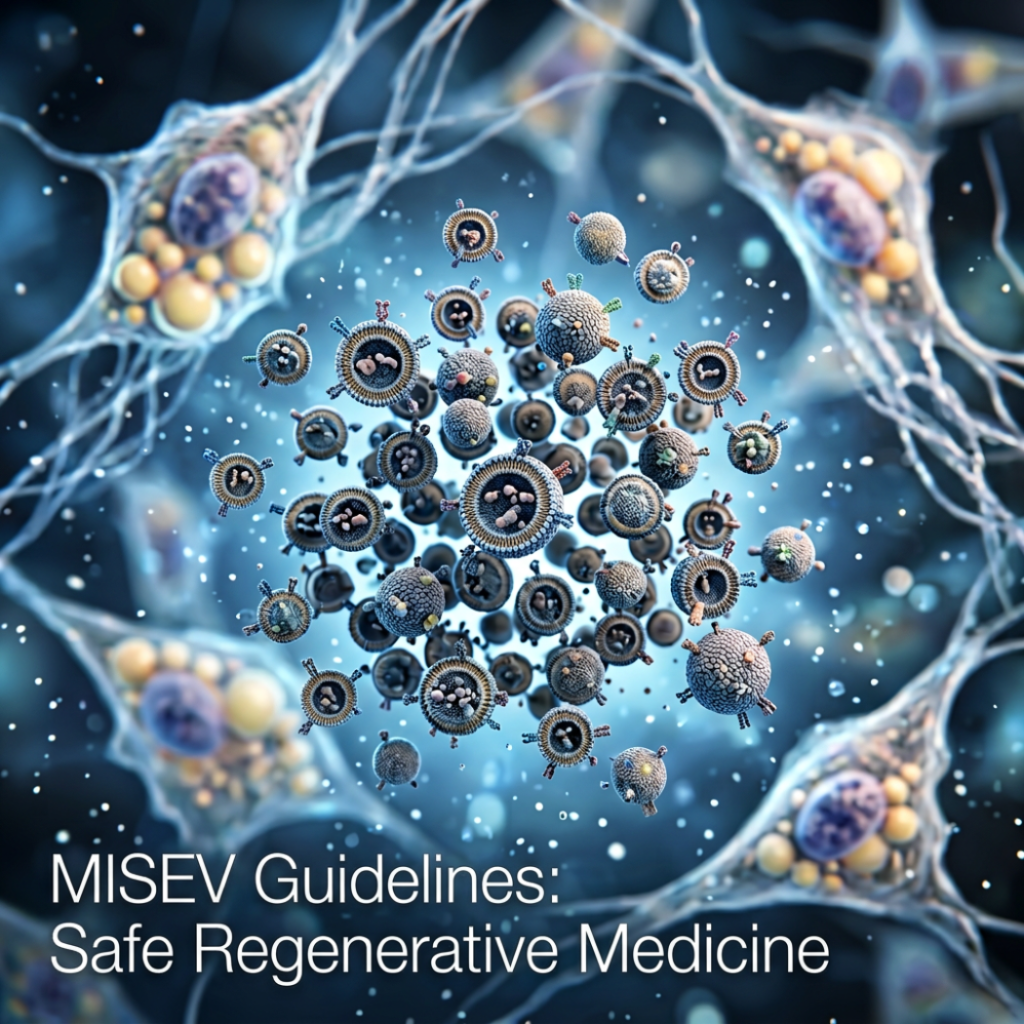
Extracellular vesicles are tiny membrane-enclosed particles released by virtually every cell type in the human body. They carry proteins, lipids, and nucleic acids from the cells that produce them, and they influence the behavior of cells they encounter. In the last decade, these particles have become one of the most studied topics in cell biology, and they are now central to discussions about the future of regenerative medicine. Many clinics have adopted the word “exosomes” as a marketing shorthand for something loosely defined as healing particles from stem cells. The International Society for Extracellular Vesicles has responded by developing rigorous guidelines for how these particles should be defined, isolated, characterized, and studied in ways that protect scientific integrity and patient safety.
TLDR: Extracellular vesicles (EVs) are lipid-bilayer particles released by cells that carry biological cargo and cannot replicate. The International Society for Extracellular Vesicles (ISEV) published MISEV2018 and MISEV2023 to define how EVs should be named, studied, and reported so that results are reproducible and reliable. EVs from adipose-derived stem cells show promising effects in preclinical regenerative medicine research, and early human trials are in progress. EV therapies are still experimental, no EV product is FDA-approved for disease treatment, and responsible science follows MISEV rather than broad, unverified marketing claims about “exosomes.”
Important Disclaimer: Save My Fat does not provide exosome or EV infusions, injectables, or any over-the-counter EV product. No adipose-derived EV or exosome product is FDA-approved as a treatment for any disease. This article summarizes ISEV guidelines and EV research for educational purposes only and does not constitute medical or legal advice. Patients must discuss any EV- or exosome-related offer with licensed clinicians and should verify whether it is part of a registered, regulated clinical trial before participating.
A patient hears from a clinic website that “exosomes extracted from your own fat” can address joint pain, cognitive decline, systemic inflammation, and accelerated aging in a single intravenous session. Another clinic promises that their “nano-vesicle formula” contains thousands of signaling molecules that trigger the body’s own repair processes. A third markets “exosome facials” for skin rejuvenation. Each makes the same underlying appeal: that tiny particles from stem cells carry extraordinary healing potential.
The science behind extracellular vesicles is real, sophisticated, and genuinely exciting. Thousands of peer-reviewed papers document how these particles participate in cell-to-cell communication, tissue repair, and immune regulation. Researchers across dozens of countries are conducting registered clinical trials to understand whether EV-based products can safely benefit patients with conditions ranging from stroke to Alzheimer’s disease. The International Society for Extracellular Vesicles has invested enormous effort in building global scientific consensus about what these particles are, how they should be studied, and what questions need to be answered before they can be considered safe and effective therapies.
What is also real is the distance between the marketing language and the science it loosely invokes. ISEV’s guidelines exist precisely because the field recognized that its own credibility, and patient safety, depended on maintaining standards that marketing campaigns routinely bypass. This guide explains what extracellular vesicles actually are under those standards, how the MISEV guidelines define them and what they require, how EVs from adipose-derived stem cells are being studied in regenerative medicine, and how Save My Fat thinks about and uses this language.
What Extracellular Vesicles Are: According to MISEV
The MISEV Definition
MISEV2018, the 2018 guidelines from the International Society for Extracellular Vesicles accessible at isev.org/misev2018, and MISEV2023, the updated guidelines available in the Journal of Extracellular Vesicles and indexed at PubMed, define extracellular vesicles as particles naturally released from cells that are surrounded by a lipid bilayer, the same kind of double-layered membrane that forms the outer boundary of every cell. The defining characteristic that distinguishes EVs from viruses and other membrane-enclosed particles is that EVs cannot replicate because they do not contain a functional nucleus or the necessary machinery to copy themselves.
This definition is deliberately inclusive. It does not specify that EVs must come from a particular cellular compartment or form through a particular biological process. The reason for this inclusive stance is that the field has learned, through years of careful investigation, that claiming precise knowledge about where a given EV came from is scientifically risky without specific evidence. A preparation of particles isolated from cell culture medium or biological fluid almost certainly contains multiple EV subtypes formed through different mechanisms.
Nomenclature: Why “EV” Is Preferred Over “Exosome” Alone
The term “exosome” has an interesting scientific history. It was coined in the 1980s to describe small vesicles released through a specific endosomal pathway, and for a time it was used with reasonable precision in the research literature. Over the following decades, as EV research grew exponentially, the term “exosome” migrated into broader and less precise usage. It began to be applied to any small vesicle isolated from a biological sample, regardless of whether anyone had confirmed it formed through the specific pathway the word originally described. The ISEV guidelines at isev.org/misev respond to this problem directly.
MISEV2018 and MISEV2023 recommend using “extracellular vesicles” as the generic term and discourage using specific subtype names like “exosomes” or “microvesicles” unless a study has actually demonstrated, through appropriate evidence, that the particles in question have the specific characteristics those terms imply. Where more precision is needed, MISEV recommends operational descriptors: terms based on measurable properties that the particles actually have. Size-based terms (small EVs, large EVs) describe particles by the size range in which they were isolated. Density-based terms use ultracentrifugation behavior. Origin-based or marker-based descriptors identify particles by the cell they came from (EVs from adipose-derived mesenchymal cells) or by the surface proteins found on them.
For patients encountering marketing claims, this is a useful reference point. When a clinic promises “pure exosomes” without specifying source cell type, isolation method, or characterization data, it is making a claim that cannot be verified by the patients receiving the product.
Minimal Information Requirements
The “MI” in MISEV stands for minimal information, and the point is to establish a baseline of what any EV study must report to be interpretable and reproducible by other scientists. The MISEV slide deck available at isev.org summarizes these requirements in an accessible format, and the full MISEV position papers cover them in scientific detail.
At a high level, MISEV requires that published EV studies report the source material (what cells or biological fluids the EVs came from, and how the source was handled before EV isolation), the methods used to separate EVs from the starting material (such as ultracentrifugation, size-exclusion chromatography, or tangential flow filtration), and the methods used to characterize the resulting particles (including protein markers detected by Western blot or flow cytometry, particle size measured by nanoparticle tracking analysis or electron microscopy, and morphological confirmation that the particles are membrane-enclosed). Studies should also include appropriate controls: experiments that distinguish effects caused by EVs specifically from effects caused by other components of the preparation, such as free proteins or cell debris.
These requirements are not bureaucratic gatekeeping. They reflect lessons learned from early EV research where findings could not be replicated because researchers had not described their methods precisely enough for others to reproduce them. The ISEV position paper on EV RNA analysis at PMC3873759 illustrates this problem in one specific domain and shows why minimal reporting standards matter for scientific progress.
ISEV’s Position on EV-Based Therapeutics
What the ISEV Position Paper Says
In 2015, the ISEV published a position paper on applying EV-based therapeutics in clinical trials, accessible at PubMed. It addressed the field’s growing interest in translating EV biology into treatments and offered guidance on how to approach that translation responsibly.
The paper identifies EVs as naturally participating in both normal physiological signaling and pathological processes, which makes them interesting both as potential therapeutic agents and as potential vehicles for delivering drugs or genetic material to specific tissues. It emphasizes that EVs are not categorically separate from other biologics when it comes to regulatory and safety requirements. An EV product intended to treat disease is, in regulatory terms, a biologic drug product. It needs to be defined, manufactured to consistent specifications, tested for safety and efficacy, and reviewed by regulatory agencies through the same processes that apply to any other biologic. The fact that EVs are naturally produced by cells does not exempt them from these requirements.
Safety, Manufacturing, and Regulatory Alignment
The ISEV position paper stresses that EV-based therapeutics must undergo standardized production and purification processes with defined quality control criteria. Contamination with microbial agents, residual cellular proteins, or aggregated particles represents a safety concern that manufacturing processes must address systematically. The paper emphasizes the need for careful dose-finding studies and long-term safety monitoring given that EVs carry biologically active cargo whose effects at high doses or repeated administration are not yet fully characterized.
The regulatory implication is clear: EV therapies are not dietary supplements, cosmetics, or devices that can be sold outside the drug approval framework simply because they are natural. Any EV product that makes treatment claims in the United States is subject to FDA oversight as a drug or biologic, and administering unapproved EV products to patients for disease treatment without an IND constitutes a regulatory violation, regardless of what the particles are called.
What This Means for Marketing Language
When a clinic offers “exosome infusions” or “EV drips” without specifying the source cell type, the isolation and characterization methodology, the EV dose, or the regulatory framework under which the therapy is being administered, none of those claims are aligned with what ISEV identifies as the minimum basis for responsible EV science. Patients receiving such products cannot know what they are actually receiving, whether the preparation is consistent from batch to batch, or what safety evidence exists for the specific product being administered.
Adipose-Derived Stem Cell EVs in Regenerative Medicine
Why ADSC-EVs Are a Focus of Research
EVs derived from adipose-derived stem cells (ADSC-EVs) have attracted substantial research interest because they reflect many of the same biological properties that make the cells themselves interesting in regenerative medicine: production of growth factors, anti-inflammatory signaling, and support for tissue repair. A 2019 systematic review of ADSC-EVs accessible at PubMed and a 2025 review of adipose tissue-derived EVs in inter-organ communication at ScienceDirect describe ADSC-EVs as influencing multiple biological processes including angiogenesis (new blood vessel formation), cell survival signaling, immune cell behavior, and extracellular matrix remodeling. For broader context on what adipose-derived stem cells are and why they are studied in regenerative medicine, the patient’s guide to adipose-derived stem cells covers the foundational science.
The research domains where ADSC-EVs have been studied in preclinical models include wound healing (including diabetic and chronic wounds), cardiac ischemia, diabetic nephropathy, bone and cartilage repair, nerve regeneration, acute lung injury, and metabolic disease. Each area reflects the same general mechanism: ADSC-EVs carry microRNAs, proteins, and lipids from their parent cells that can influence gene expression and cell behavior in recipient tissues.
Potential Advantages of EVs Compared with Whole Cells
Researchers exploring ADSC-EVs as potential therapeutics have identified several theoretical advantages over using the stem cells themselves. EVs cannot replicate, which removes the concern about uncontrolled cell proliferation or tumor formation that must be considered with any live cell therapy. They can potentially be manufactured in large batches, tested for consistency, and stored more straightforwardly than living cells, which require controlled temperature and viability maintenance throughout their handling.
These advantages are conditional on solving significant manufacturing and characterization challenges. Producing EVs at clinical scale from defined ADSC populations, with consistent cargo and surface marker profiles, within the quality parameters that regulatory approval would require, is technically demanding. The field is actively working on these problems. No ADSC-EV product has yet cleared the manufacturing, safety, and efficacy requirements for FDA approval.
Examples of ADSC-EV Effects in Preclinical Models
In wound healing models, studies show that ADSC-EVs accelerate closure by increasing fibroblast proliferation and migration, promoting endothelial cell activity that supports new capillary formation, and driving type III collagen synthesis with patterns that reduce hypertrophic scarring. In ischemic cardiac models, ADSC-EVs appear to reduce cardiomyocyte apoptosis and improve measures of heart function. In kidney models of diabetic nephropathy, ADSC-EVs reduce inflammatory cytokine concentrations and markers of glomerular and tubular injury. In acute lung injury models, similar anti-inflammatory effects have been observed.
These preclinical findings are internally coherent and mechanistically grounded. They do not confirm that the same effects would occur in human patients receiving EV preparations manufactured under clinical conditions, administered through appropriate routes, at defined doses. The translation from preclinical model to clinical application requires each of those steps to be addressed systematically.
EV Clinical Trials Involving Adipose-Derived Cells
Neurologic Applications: Stroke and Alzheimer’s Disease
The most visible registered EV clinical trials involving adipose-derived cells are in neurologic conditions. NCT07398612 is a phase I/II dose-escalation trial evaluating human adipose-derived stem cell extracellular vesicles (described as ADSC-exo in the study protocol) administered via nasal spray in patients with acute ischemic stroke. Primary endpoints focus on safety and tolerability; secondary endpoints include changes in neurologic function as measured by the NIHSS and modified Rankin Scale. The intranasal route is being studied because EVs can potentially transit along olfactory nerve pathways into the central nervous system, reaching brain tissue without requiring intracranial injection.
NCT04388982 evaluates EVs derived from allogeneic adipose-derived MSCs delivered intranasally in patients with mild to moderate Alzheimer’s disease, with primary safety endpoints and exploratory cognitive assessment as secondary outcomes.
Both trials are in early phases. Both are using characterized, defined EV preparations from identified source cells under regulatory oversight. Neither uses the broad marketing language of “exosome therapy”; both describe specific products with specific delivery routes and defined endpoints. That is exactly the difference between responsible EV clinical science and unregulated commercial exosome marketing.
Other EV Trials and the Broader Landscape
Registered trials examining EVs from mesenchymal cells in other conditions, such as those registered under NCT06002841, evaluate IV EV administration versus placebo in controlled or randomized designs, measuring inflammatory markers, functional outcomes, and safety parameters. These trials are consistent with the ISEV framework: defined products, registered protocols, independent ethics oversight, and prospective data collection.
The guide to clinical trials for regenerative medicine on this site explains how to find and evaluate registered trials through ClinicalTrials.gov, which is the authoritative public registry for human research studies in the United States. Any EV trial worth considering will appear there with an NCT number, a principal investigator, a sponsoring institution, and documented ethics oversight.
How MISEV Shapes These Trials
Responsible EV clinical trials report the source cell type and species, the general isolation methodology, the basic characterization evidence confirming that the product consists of EVs rather than uncharacterized cellular material, and the dose rationale. These are the kinds of details that allow the FDA to evaluate safety and consistency, and that allow independent scientists to assess whether the claimed product characteristics are credible. They are also the details that most commercial exosome marketing omits entirely.
How Save My Fat Talks About EVs and Exosomes
Language Choices Aligned with MISEV
Save My Fat uses “extracellular vesicles” or “EVs” as the standard generic term throughout its educational content. When discussing specific research involving particles described as exosomes in their original study, those terms are used with that specific study context and an explanation that “exosome” in that usage refers to particles characterized under specific conditions in that study rather than a universal category. When describing ADSC-derived particles in general educational terms, the language used reflects operational descriptors consistent with MISEV: EVs from adipose-derived mesenchymal cells, particles released by ADSCs, or similar.
This is not merely a semantic preference. It reflects a commitment to describing the science in a way that a researcher, a regulator, or an informed patient can evaluate accurately. Language that obscures the difference between characterized EV preparations and loosely defined mixtures does patients a disservice by preventing them from asking the right questions.
Banking and Future EV Possibilities
The complete guide to adipose tissue banking and the how banking works article explain what banking involves: cryopreservation of intact adipose tissue for potential future use in regulated pathways. Banking does not currently involve EV isolation, manufacturing, or any clinical EV application. Save My Fat does not produce clinical-grade EV therapeutics, does not guarantee that banked tissue will be used for EV therapies, and does not suggest that banking provides early access to any EV clinical trial.
If future regulated pathways emerge that can use banked adipose tissue as starting material for EV manufacturing under MISEV-consistent and FDA-compliant protocols, banking could become relevant to those pathways. That remains a future possibility, not a current service or guarantee. The emerging research page on this site tracks where ADSC and EV research is most active and can help patients understand how the field is developing.
Why EV Rigor Matters for Patients
The core argument of MISEV is straightforward: science that cannot be reproduced does not advance medicine. Clinics that offer undefined “exosome” preparations without source documentation, isolation methodology, or characterization data are offering products whose composition is unknown even to the providers, and whose safety and efficacy have no rigorous basis. Patients who receive these products have no way to know what they are actually being given, whether it is consistent from visit to visit, or whether any observed effect has anything to do with EVs specifically.
Patients who look for MISEV-aligned language and demand basic characterization information before accepting any EV-related therapy are not being obstructionist. They are asking the minimum questions that responsible science requires. This is ultimately what protecting patients in this space looks like: not assuming that natural origin equals safety, not assuming that marketing language reflects scientific precision, and expecting that any claimed EV product was produced, tested, and administered within a framework that a regulatory agency could examine and defend.
Frequently Asked Questions
What is the difference between extracellular vesicles and exosomes?
Extracellular vesicles (EVs) is the generic term recommended by ISEV for all lipid-bilayer particles released by cells that cannot replicate, regardless of how they formed. Exosome is a subtype name that originally referred to small vesicles formed through a specific endosomal pathway, but it has been used inconsistently in both the scientific and commercial literature. MISEV2018 and MISEV2023 advise using operational descriptors (size-based, density-based, or origin-based) instead of assuming that a given preparation meets the specific criteria implied by “exosome,” unless those criteria have been demonstrated through appropriate evidence. In practice, most commercial “exosome” products are not characterized to the degree needed to use that term with scientific precision.
Why do responsible researchers prefer the term “extracellular vesicles” instead of just “exosomes”?
Because the biogenesis pathway of a given particle, which is what “exosome” originally described, cannot be confirmed from most isolation methods used in research and clinical settings. When you collect particles from cell culture medium or a biological fluid and run them through standard isolation procedures, you get a heterogeneous mixture of particles that may include EVs from multiple pathways. Claiming these are “exosomes” implies a precision that is not warranted without specific evidence. ISEV’s guidelines, accessible at isev.org/misev, reflect the field’s consensus that operational descriptors are more scientifically honest and more useful for reproducibility.
What do ISEV’s MISEV2018 and MISEV2023 guidelines actually require from EV studies?
MISEV requires that published EV studies report the pre-analytical variables (how source material was collected and handled), the separation methods used to isolate EVs, the characterization data confirming the identity of the particles (protein markers, size measurements, morphological confirmation), and the controls used to distinguish EV-specific effects from artifacts. MISEV2023 builds on MISEV2018 with updated guidance on nomenclature, cargo analysis, and functional assay requirements. The full guidance is available at the ISEV MISEV page, and the MISEV2023 article is accessible at PubMed. The goal is reproducibility and interpretability, not gatekeeping.
How are extracellular vesicles from adipose-derived stem cells being studied in regenerative medicine?
ADSC-EVs are being investigated in preclinical models across wound healing, cardiac ischemia, kidney disease, neurologic injury, bone and cartilage repair, and acute lung injury. The systematic review at PubMed covers the early research landscape, and more recent reviews describe ongoing mechanistic and translational work. Clinical trials including NCT07398612 in stroke and NCT04388982 in Alzheimer’s disease represent the current frontier of ADSC-EV human investigation. These are early-phase safety and feasibility studies, not approved therapies.
Are there real clinical trials using EVs from adipose or other mesenchymal cells?
Yes. Several registered trials are using characterized EV preparations from mesenchymal or adipose-derived cells in defined clinical protocols with regulatory oversight. NCT07398612 and NCT04388982 are active examples in neurologic conditions. These trials report defined source cell types, delivery routes, and endpoints. They operate under INDs with FDA oversight and IRB approval. This distinguishes them fundamentally from commercial “exosome” infusion services offered outside of registered trial frameworks.
Does banking my fat now mean I will get EV or exosome therapy from that tissue later?
No. Save My Fat connects patients with a U.S.-based tissue bank that banks intact adipose tissue through cryopreservation. This is a preservation of biological material, not production of EVs. No clinical-grade EV manufacturing is performed as part of the banking process, and no EV therapy is delivered from banked tissue today. If future regulated pathways emerge that could use banked tissue as starting material for EV manufacturing under appropriate protocols, that could become relevant. Currently, banking preserves an option, not an EV product or therapy.
How can I tell if a clinic’s “exosome therapy” is aligned with MISEV and regulatory expectations?
Ask for the specific source cell type and species of origin for the EVs being offered. Ask for the isolation method and the characterization data (particle size, protein markers, morphology). Ask for a ClinicalTrials.gov registration number if the clinic describes the service as research. Ask for the FDA IND number if a regulated clinical investigation is claimed. Ask what the dose is and how it was determined. A clinic that cannot answer these questions with specifics is not operating within an ISEV-aligned or regulatory-compliant framework, regardless of how compelling the marketing is.
Where can I read ISEV’s guidelines and position papers about EVs?
The primary ISEV resources are available at isev.org/misev for the MISEV overview and isev.org/misev2018 for the MISEV2018 position statement. The MISEV2023 update is available at PubMed and through the journal directly. The ISEV position paper on EV-based therapeutics is accessible at PubMed. A slide deck summarizing MISEV principles is available at isev.org. These are primary sources, written by the scientists who build global consensus in this field.
Key Takeaways for Patients and Clinicians
Extracellular vesicles represent one of the most promising and simultaneously most over-marketed areas in regenerative medicine. Patients navigating this landscape encounter a wide range of claims, from careful descriptions of registered research to aggressive commercial marketing of undefined products under scientific-sounding names. Having a framework for evaluating what is scientifically responsible makes a meaningful difference.
Save My Fat’s commitment is to use ISEV and MISEV definitions for EVs and to describe adipose-derived EV research in a way that regulators, scientists, and patients can all evaluate accurately.
The framework for evaluating this space:
- EVs are lipid-bilayer particles released by cells that carry biological cargo and cannot replicate. The term EV is the standard, and “exosome” is a specific subtype term that requires evidence to use responsibly.
- MISEV2018 and MISEV2023 define the minimal information that EV studies must report to be reproducible and interpretable, including source, isolation method, characterization, and appropriate controls.
- ADSC-EVs show promising regenerative and anti-inflammatory effects in preclinical models, and early human trials are studying their safety and potential in conditions like stroke and Alzheimer’s disease. EV therapies remain experimental and no product is FDA-approved for any disease.
- Banking adipose tissue preserves intact biological material. It does not create an EV drug product today and does not guarantee access to EV treatments in the future.
Patients and clinicians evaluating any EV-related claim should look for MISEV-consistent language, specific product characterization, and registered trial frameworks. The complete guide to adipose tissue banking, the how banking works article, the clinical trials guide, and the emerging research page on this site provide context for placing EV research within the broader regenerative medicine landscape. Service information including pricing, providers, and family banking options is available on the site. The about page describes who Save My Fat is and the standards it holds itself to.
This article is for educational purposes only and does not constitute medical or legal advice. Patients must consult licensed clinicians before participating in any EV-related research or commercial service.
About the author: Oscar Tellez is the founder and CEO of Save My Fat. He holds a Bachelor of Science in Exercise Science and Health Promotion from Florida Atlantic University. He has spent a decade in the regenerative medicine industry across product distribution, laboratory and vendor relationships, and provider training. He is not a licensed clinician, and this article is educational, not medical advice.
Related guide: the stem cell science glossary.
Last Updated: April 24, 2026