
If you have banked your adipose tissue or are considering doing so, one of the biggest questions on your mind is probably, “What happens next?” This guide walks you through the full post-banking journey, from how your tissue is stored and monitored to how retrieval works, who owns your tissue, and what future access might realistically look like.
TLDR: After collection, your adipose tissue is processed, labeled with unique identifiers, and placed in cryogenic storage with continuous monitoring and backup systems. You retain ownership under the terms of your storage contract and can request retrieval or transfer, subject to verification, fees, and coordination with a qualified receiving facility. Banking creates a preserved biological resource, but it does not guarantee access, eligibility, or benefit from any future therapy or program. Read on for details about storage conditions, ownership rights, and future access scenarios.
Important Disclaimer: Save My Fat does not provide FDA-approved treatments or cures for any disease. Banking adipose tissue does not guarantee eligibility, access, or clinical benefit from any future therapy, clinical trial, or medical program. All content is for educational purposes only and does not constitute medical or legal advice. Patients must consult licensed healthcare professionals for medical decisions and qualified legal counsel for contract or ownership questions.
You made a significant decision when you chose to bank your adipose tissue. Whether you have already gone through collection or are still weighing the option, you deserve detailed answers about how your tissue is handled, monitored, and protected. You also deserve honesty about what banking can and cannot do.
This guide covers every stage: processing and freezing on day one, long-term storage conditions, your ownership rights, the retrieval and transfer process, what happens if a company changes hands, and realistic pathways through which banked tissue might be used. Where there are limitations, we will be upfront about them.
From Banking Day to Long-Term Storage
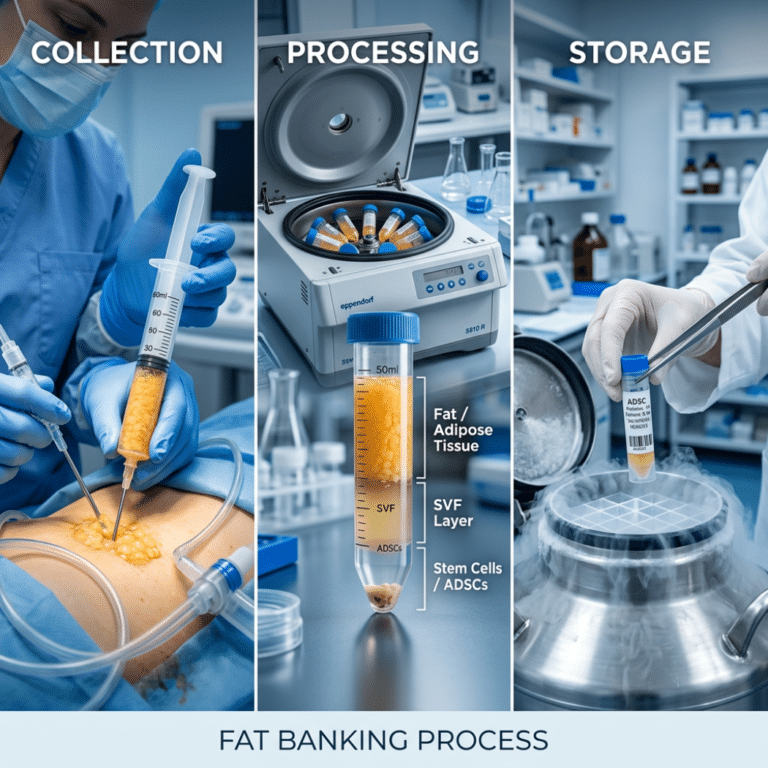
After your adipose tissue is collected, it is transported to the processing laboratory under controlled conditions. The lab team confirms labeling, verifies the sample against your patient record, and checks tissue volume. Processing includes gentle washing and preparation for cryopreservation. A cryoprotectant solution is added to protect cells during freezing, and the tissue is transferred into labeled cryovials or cryobags, each assigned a unique barcode tied to your file. For a closer look at the freezing science, see how cryopreservation works.
The sample then enters a controlled-rate freezing protocol before moving into long-term cryogenic storage. Every step is documented and time-stamped. Your sample is tied to your individual record and never pooled with tissue from other patients. Once stored, the tissue remains under defined conditions until you request retrieval, transfer, or the contract term expires.
Storage Facilities, Temperature Control, and Monitoring
Long-term storage typically uses liquid nitrogen systems maintaining temperatures between approximately negative 140 degrees Celsius and negative 196 degrees Celsius. These ultra-cold conditions preserve tissue viability over many years. For more on storage duration, visit how long adipose tissue can be stored.
Continuous monitoring is a core element of responsible tissue banking. Facilities use electronic temperature sensors, automated data logging, and alarm networks that trigger alerts if conditions drift. Backup systems, including secondary tanks and emergency generators, add additional protection. The FDA requires tissue banking establishments to follow Current Good Tissue Practice (CGTP) under 21 CFR Part 1271, covering storage conditions, facility controls, staff training, and documentation. Physical access to storage areas is restricted, and environmental controls protect tissue around the clock.
Monitoring preserves tissue quality. It does not guarantee any specific future medical use.
Labeling, Ownership, and Documentation
Each stored unit carries a unique identifier rather than your name, protecting privacy while ensuring traceability. Chain-of-custody records track every movement from collection through storage to retrieval.
Under a typical storage agreement, you are the legal owner of your banked tissue. The banking company serves as custodian, not owner, unless the contract states otherwise. Your consent and storage agreement should explain how long tissue is stored while fees are paid, what happens if payments lapse or you cannot be contacted, and when tissue could be discarded after proper notice.
Review your contract carefully before signing. Ask about ownership, rights, and various scenarios. If anything is unclear, consult a qualified attorney. You can also review Save My Fat’s terms and conditions and privacy policy.
Retrieval, Transfer, and How You Access Your Tissue
When you need your tissue, you or your authorized representative contacts the banking service with a written request. The team verifies your identity, confirms ownership, and reviews authorization documents, including power of attorney or estate credentials if applicable.
The receiving facility must be accredited, prepared to accept the tissue, and in compliance with all applicable regulatory and protocol requirements. Shipping uses validated dry shippers maintaining cryogenic temperatures, accompanied by chain-of-custody documentation. Retrieval and shipping fees may apply as outlined in your agreement.
Expect timelines of days to weeks, not hours. The receiving facility must confirm readiness, and regulatory requirements at the destination must be satisfied before shipment.
The banking company does not decide whether you are eligible for any clinical trial, Expanded Access program, or therapy. Eligibility is determined by trial investigators, treating physicians, sponsors, and regulators. Having banked tissue available does not guarantee that any program will agree to use it.
What If the Company Changes or Closes?
If ownership changes, storage contracts and patient rights typically transfer to the new entity. Your tissue should remain under equivalent conditions, and you should be notified with updated terms. You retain the right to request retrieval or transfer at that point.
If a company closes, reputable banking services plan for contingencies. Possible outcomes include transferring stored tissues to another accredited facility, a court-appointed custodian overseeing the process, and attempts to notify patients. These scenarios are governed by contract language and applicable law.
Before banking, ask: “What is your contingency plan if the company shuts down or changes ownership?” Transparency on this question is an important marker of a trustworthy provider. Keep your contact information updated and retain copies of all contracts and notices.
Future Use Pathways and What Cannot Be Guaranteed
Clinical trials on ClinicalTrials.gov may use adipose-derived products under IND protocols. Participation depends on inclusion criteria, sponsor decisions, and investigator judgment. Expanded Access allows patients with serious or life-threatening conditions to access investigational products when no alternatives exist, but requires agreement from a physician, sponsor, FDA, and institutional review board. The Reagan-Udall Foundation Navigator provides patient-friendly guidance on this process. Right to Try is a separate federal pathway for life-threatening diseases, requiring physician and sponsor participation and a product that has completed Phase 1 trials. Future FDA-approved therapies may create new options, but some therapies under investigation today may never receive approval.
Banking does not automatically connect patients to any of these pathways. Eligibility, access, and benefit depend on the state of science, FDA decisions, individual medical circumstances, physician recommendations, and program availability. Banked tissue is a resource that can be considered if legitimate opportunities arise. It is not a ticket, pass, or guarantee.
Questions to Ask Before You Bank
Use this as a checklist: ask your tissue bank how tissue is stored and monitored, who owns the tissue and what happens if you stop paying, how retrieval and transfer work and what the fees are, and what the contingency plan is if the company changes ownership or closes. Banking is one part of long-term health planning, not a substitute for conventional care. All medical decisions should involve qualified healthcare professionals, and contract questions should be reviewed with an attorney. For more about what adipose tissue banking involves, explore Save My Fat’s resources.
Frequently Asked Questions
Q: Can I get my tissue back whenever I want? A: You can request retrieval at any time, but the process requires identity verification, a qualified receiving facility, validated cryogenic shipping, and chain-of-custody documentation. It typically takes days to weeks and may involve fees specified in your storage agreement.
Q: Who decides how my tissue is used in the future? A: You control whether to request retrieval or transfer. However, if the tissue is intended for a clinical trial, Expanded Access program, or therapy, eligibility is determined by physicians, investigators, sponsors, and regulators, not the tissue bank.
Q: What happens to my tissue if I move or if I die? A: Tissue can generally be shipped to qualified facilities in other states. International transfers may involve additional regulatory requirements. If you pass away, your storage agreement should specify how next-of-kin or estate representatives can make decisions. Review this section of your contract and inform your family and attorney of your wishes.
Q: How long can tissue stay in storage? A: Properly stored tissue at cryogenic temperatures can remain viable for many years. Storage duration is also tied to your contract terms and continued fee payment.
Q: Does banking guarantee I will get into a clinical trial? A: No. Banking preserves tissue so it is available if opportunities arise, but eligibility for trials and programs is determined independently by investigators, sponsors, and regulators.
Key Takeaways
Processing and storage are tightly controlled. Every step from collection to cryogenic placement is documented with chain-of-custody records and unique identifiers tied to your patient file.
You own your tissue under the terms of your contract. The banking company is a custodian. Your agreement defines your rights, fees, and what happens in various scenarios.
Retrieval is possible but requires coordination. Expect verification, a qualified receiving facility, validated shipping, possible fees, and a timeline of days to weeks.
Responsible banks plan for contingencies. Ask about plans for ownership changes or closure before signing. Transparency on this topic signals trustworthiness.
Banking creates a resource, not a guarantee. Banked tissue may be considered if legitimate FDA-regulated opportunities arise, but access, eligibility, and benefit depend on factors outside any tissue bank’s control.
Ready to Learn More?
Use this guide as a checklist for the questions you want answered before banking, or as a reference for understanding the rights and processes that protect your tissue. To ask specific questions about storage, monitoring, retrieval, and transfers, contact our team directly. All medical decisions should be discussed with qualified healthcare professionals. Contract and ownership questions should be reviewed with qualified legal counsel.
Save My Fat Save My Fat provides adipose tissue collection, processing, cryopreservation, and long-term storage services for potential future use in FDA-regulated clinical research, Expanded Access programs, Right to Try pathways, or approved therapies, with no guarantee of access or benefit. This article is educational only and does not constitute medical or legal advice.