If you have been researching adipose tissue banking, you have probably come across terms like “intact tissue,” “minimal manipulation,” and “SVF” used in ways that sound important but are never quite explained. These are not just technical phrases. They describe a regulatory distinction with direct legal consequences under federal law, and the choice a banking service makes about how to process your tissue determines which regulatory pathway applies to that service. This guide explains what intact adipose tissue is, how the FDA classifies different types of adipose processing, and why the difference between intact tissue banking and SVF isolation matters under the law. By the end, you will have the vocabulary and context to ask the right questions before choosing a banking service.
TLDR: “Intact adipose tissue” means fat that is collected and cryopreserved without enzymatic digestion that would break apart its cellular structure. The FDA classifies adipose tissue as structural tissue and has determined that enzymatic processing to isolate SVF constitutes more than minimal manipulation under 21 CFR Part 1271. Three federal circuit courts ruled between 2014 and 2024 that enzymatically derived SVF is a drug requiring FDA approval, and in 2025 the Supreme Court declined to hear a challenge to the most recent ruling. Banking intact tissue is designed to qualify under the less restrictive Section 361 pathway and preserves future processing options. Read on to understand exactly what that means in practice.
Important Disclaimer: Save My Fat does not provide FDA-approved treatments or cures for any disease or medical condition. Adipose tissue banking is a preservation service for potential future opportunities, not a therapeutic product. Banking adipose tissue today does not guarantee eligibility, access, or clinical benefit from any future therapy, clinical trial, or medical program. All content here is for educational and informational purposes only and does not constitute medical advice or legal advice. Patients and providers should consult their own licensed healthcare professionals and qualified regulatory counsel for guidance on specific situations. Regulatory classifications described in this article are provided for educational context only. Outcomes of any regenerative medicine research or future therapies are highly individual and cannot be predicted or guaranteed.
When patients choose an adipose tissue banking service, one of the most consequential questions they rarely think to ask is: how exactly will my tissue be processed? This is not a procedural detail. The answer determines which federal regulatory pathway applies to the banking service, whether that service is operating within a relatively lower-burden compliance framework or one that requires pre-market FDA approval before any clinical use can occur.
The FDA has been clear on this question, and three separate federal circuit courts have weighed in as well. The legal and regulatory landscape is now well established. The distinction between banking tissue in its intact state and processing it enzymatically into a different product called stromal vascular fraction (SVF) is the central axis around which all of this regulatory analysis turns. Understanding that distinction is not a matter of preference or technical curiosity. It is practical due diligence before making a decision that involves your own biological material.
This article walks through the complete picture in a logical sequence: what intact adipose tissue is and what it contains, what SVF is and how it differs, what the FDA’s minimal manipulation standard requires, what the four criteria for Section 361 HCTP status are, what three court rulings have established, how intact tissue banking preserves future options without guaranteeing any specific outcome, and what questions patients should ask before committing to any banking service.
What “Intact Adipose Tissue” Means
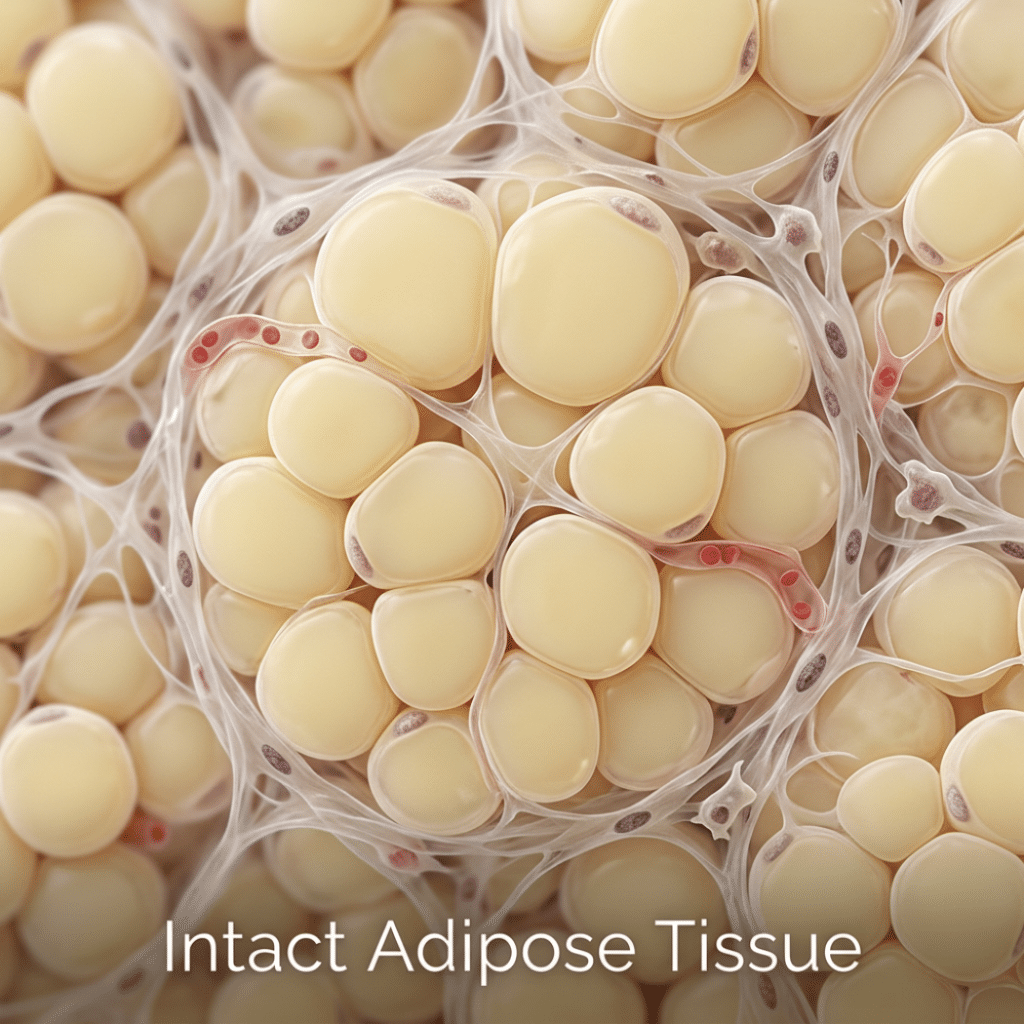
Adipose tissue is fat. When a physician performs a mini-liposuction procedure to collect tissue for banking, the result is a material called lipoaspirate: a mixture containing intact fat cells (adipocytes), the surrounding cellular matrix including adipose-derived mesenchymal stromal cells (ADSCs) and other stromal vascular fraction cells, connective tissue and extracellular matrix proteins, and small amounts of blood and fluid from the procedure.
“Intact” describes what that tissue is after it has been processed by the banking facility but before it has been enzymatically altered. The tissue is washed to remove blood and procedural fluids, centrifuged to separate it into distinct layers by density, and the middle adipose layer is retained. What that middle layer contains is the full cellular ecosystem of the original fat tissue: adipocytes, ADSCs, pericytes, endothelial cells, immune cells, and the extracellular matrix (ECM) that holds them all in their original structural relationship.
What “intact” does not mean is zero processing. Washing, centrifugation, and layer separation are standard steps in banking protocols. These clean and concentrate the tissue. They do not enzymatically break it down, they do not alter the fundamental cellular composition, and they do not separate the structural components from each other.
| Component | What It Is | Status in Intact Banking |
|---|---|---|
| Adipocytes | Mature fat cells that store energy as lipid droplets; the majority of adipose tissue by volume | Present and preserved in the intact middle layer |
| ADSCs | Multipotent mesenchymal stromal cells residing within the stromal vascular fraction | Present; not isolated; remain embedded within intact tissue |
| Pericytes | Cells surrounding blood vessel walls; considered a source of in situ ADSCs | Present |
| Endothelial cells | Cells lining blood vessels within adipose tissue | Present |
| Immune cells | Resident macrophages and lymphocytes that contribute to the tissue’s biological environment | Present |
| Extracellular matrix (ECM) | Structural scaffold of proteins and polysaccharides supporting tissue architecture | Present; preserved by avoiding enzymatic digestion |
| Free lipid oil | Lipid released from adipocytes damaged during collection | Discarded in the top layer during centrifugation |
The extracellular matrix deserves particular attention. The ECM is not passive scaffolding. It provides structural support and biochemical signaling that influences cell survival, behavior, and function. When enzymatic digestion is used to produce SVF, the ECM is broken down along with the process of separating cell types. Banking intact tissue preserves this full biological context. For more on what adipose-derived stem cells are and why researchers study them, the patient’s guide to adipose-derived stem cells covers the cell biology in plain language.
What SVF Is and How It Differs from Intact Tissue
What SVF Is
SVF stands for stromal vascular fraction. It is produced by enzymatically digesting adipose tissue to break down the extracellular matrix and mechanically separate the non-adipocyte cellular components from the lipid-filled adipocytes. The enzyme most commonly used is collagenase, which specifically cleaves collagen in the ECM. After enzymatic digestion and centrifugation, what remains in the pellet is SVF: a heterogeneous mixture of ADSCs, pericytes, endothelial cells, and immune cells, now separated from the adipocytes and the ECM they originally inhabited.
SVF contains a higher concentration of ADSCs per milliliter than intact tissue does, because the adipocytes, which make up the majority of the original tissue by volume, have been removed. That higher cellular concentration is sometimes presented as an advantage. The regulatory and biological consequences of the process that produces it are a different matter.
The Key Difference Between Intact Tissue and SVF
| Factor | Intact Adipose Tissue | SVF (Enzymatically Derived) |
|---|---|---|
| Cellular composition | Full ecosystem: adipocytes, ADSCs, ECM, pericytes, endothelial cells, and immune cells | Non-adipocyte fraction only: ADSCs, pericytes, endothelial cells, and immune cells; no adipocytes, no intact ECM |
| Processing method | Washing, centrifugation, and layer separation | Enzymatic digestion with collagenase, centrifugation, and pellet resuspension |
| ECM preserved? | Yes | No |
| FDA classification | May qualify as minimally manipulated structural tissue under 21 CFR Part 1271 | FDA has determined this is more than minimal manipulation; triggers Section 351 pathway |
| ADSC concentration | Lower per mL, diluted by adipocyte volume | Higher per mL, adipocytes removed |
| Requires IND for clinical research? | Not if all four Section 361 criteria are met | Yes, as a Section 351 biological product |
Can SVF Be Isolated from Banked Intact Tissue Later?
Yes, and this is an important practical point. Intact tissue stored under validated cryopreservation protocols can serve as source material for SVF isolation or ADSC extraction at a future date, if needed for a specific FDA-regulated clinical application. Published research by Devitt and colleagues in 2015 documented successful ADSC isolation from lipoaspirate that had been cryopreserved for up to 1,159 days across donor ages ranging from 8 to 82. That future isolation would need to occur under the applicable regulatory framework at that time, with any necessary IND or other approvals in place. Banking intact tissue preserves this option without requiring the banking service itself to operate under the Section 351 framework.
What “Minimal Manipulation” Means Under FDA Regulations
The Definition from 21 CFR Part 1271
The FDA’s definition of minimal manipulation for structural tissue is contained in 21 CFR 1271.3(f) and explained in plain terms in the FDA’s November 2017 guidance on Minimal Manipulation and Homologous Use: for structural tissue, minimal manipulation means processing that does not alter the original relevant characteristics of the tissue relating to its utility for reconstruction, repair, or replacement.
The first important point from that guidance is that the FDA explicitly classifies adipose tissue as structural tissue. This is not a contested or ambiguous point. It is a direct statement in federal guidance, and it establishes the starting framework for the entire analysis.
The second important point is what “alter the original relevant characteristics” means in practice. The FDA has stated that enzymatic processing of adipose tissue to isolate SVF is more than minimal manipulation, because removing the adipocytes and the structural ECM components fundamentally changes what the tissue is. Washing and centrifuging intact adipose tissue does not make that change. The guidance specifically notes that cryopreservation of intact tissue generally meets the minimal manipulation standard.
| Processing Step | FDA Classification | Reason |
|---|---|---|
| Washing with saline or physiological buffer | Minimal manipulation | Does not alter original structural characteristics |
| Centrifugation for layer separation | Minimal manipulation | Physical separation does not alter relevant characteristics |
| Cryopreservation using standard protocols | Minimal manipulation | Does not alter original relevant characteristics; guidance specifically addresses this |
| Enzymatic digestion with collagenase to isolate SVF | More than minimal manipulation | Removes adipocytes and ECM; alters original relevant structural characteristics |
| Cell culture and expansion | More than minimal manipulation | Clearly alters biological characteristics; confirmed in case law since 2014 |
| Genetic modification | More than minimal manipulation | Alters biological characteristics at the most fundamental level |
Why the Structural Tissue Classification Matters
The FDA classifies human cells, tissues, and cellular and tissue-based products (HCTPs) as either structural or non-structural, and the minimal manipulation standard is applied differently to each category. Adipose tissue is structural because its primary biological functions are cushioning, support, and insulation, functions that depend on the intact structural relationship between the tissue’s cellular components and its ECM. When the FDA asks whether processing altered the original relevant characteristics, the answer for intact adipose banking is no. For SVF production, the answer is yes.
The Four Criteria for Section 361 HCTP Status
To be regulated solely under Section 361 of the Public Health Service Act, the less restrictive pathway that requires FDA establishment registration and compliance with current good tissue practices (CGTP) but does not require pre-market approval, an HCTP must simultaneously satisfy all four criteria defined in 21 CFR Part 1271. Failing even one of the four triggers the Section 351 biological products pathway, which requires an Investigational New Drug application for clinical research and a Biologics License Application before any marketing.
| Criterion | Regulatory Reference | What It Requires | How Intact Adipose Banking Addresses It | How SVF Processing Fails It |
|---|---|---|---|---|
| Minimal Manipulation | 21 CFR 1271.10(a)(1) | Processing must not alter original relevant characteristics of structural tissue | Washing, centrifugation, and cryopreservation may qualify; no enzymatic digestion required | Enzymatic digestion is more than minimal manipulation per FDA November 2017 guidance |
| Homologous Use | 21 CFR 1271.10(a)(2) | Tissue must perform the same basic function in the recipient as in the donor | Using intact adipose tissue to replace or restore adipose volume may qualify; must be specified at time of use | Using SVF to treat arthritis, neurological conditions, or other non-structural indications is non-homologous |
| Not Combined with Non-HCTP Article | 21 CFR 1271.10(a)(3) | Cannot be combined with drugs, devices, or other biologics (except specific permitted exceptions) | Intact tissue combined only with approved cryoprotective agents such as DMSO may meet this standard | Combining SVF with growth factors, scaffolds, or other biologics violates this criterion |
| Systemic Effect or Autologous Use | 21 CFR 1271.10(a)(4) | Either no systemic effect and not dependent on living cells; or autologous, first-degree relative, or reproductive use | Autologous banking satisfies this criterion regardless of systemic effect | Allogeneic SVF for non-relatives must demonstrate no systemic effect, which is generally not achievable for cell-based therapies |
Save My Fat banks intact adipose tissue for autologous use and for potential use by first or second degree blood relatives under applicable regulations. This approach is designed to address the four criteria for Section 361 HCTP status. However, meeting these criteria is a regulatory determination that depends on all aspects of how tissue is processed and used. The explanations in this article are educational and do not constitute legal or regulatory advice. Patients and providers with specific questions about regulatory classification should consult qualified regulatory counsel and the FDA’s published guidance documents.
What Three Federal Court Rulings Established
The distinction between intact tissue and SVF is not only a matter of FDA administrative guidance. It has been litigated in three separate federal circuit courts over a decade, with each ruling affirming FDA authority and further defining the regulatory boundaries. In 2025, the Supreme Court declined to hear a challenge to the most recent ruling, leaving the legal landscape settled.
USA v. Regenerative Sciences (D.C. Circuit, 2014)
The D.C. Circuit Court ruling in USA v. Regenerative Sciences in 2014 was the first major appellate decision establishing FDA authority over ADSC-derived products. The court held that culture-expansion of MSCs, growing and multiplying cells in a laboratory to produce larger quantities, constitutes more than minimal manipulation, bringing the resulting product under the Section 351 biological products pathway. The court confirmed that the FDA has authority to regulate cultured cell products as drugs and biologics under both the Food, Drug, and Cosmetic Act and the Public Health Service Act. This ruling established the foundational legal principle: additional laboratory processing of adipose-derived cells changes their regulatory classification.
USA v. US Stem Cell Clinic (11th Circuit, 2021)
The 11th Circuit ruling in 2021 upheld a permanent injunction against a Florida clinic that was processing patients’ adipose tissue into SVF and injecting it as treatments for various conditions. The court affirmed that SVF products do not qualify for the Section 361 HCTP exception, because the enzymatic digestion process constitutes more than minimal manipulation and because the intended uses for joint conditions, neurological conditions, and other indications are non-homologous with the structural function of adipose tissue. The same clinic had been linked to documented cases in which patients suffered serious adverse outcomes, including vision loss, following unapproved SVF injections into or near the eye.
California Stem Cell Treatment Center (9th Circuit, September 2024)
The 9th Circuit’s ruling in 2024 addressed an argument that some clinics had used to assert FDA jurisdiction did not apply: the same surgical procedure exemption. Some clinics had argued that because SVF was processed and injected in the same surgical session in the same patient, it fell outside FDA’s authority as a same-day surgical procedure. The 9th Circuit rejected this argument unanimously. The court held that SVF is a drug under the FDCA, that the same surgical procedure exemption does not apply because the material removed (intact adipose tissue) is fundamentally different from the material reimplanted (SVF, a distinct and enzymatically derived cellular product), and that FDA has authority to regulate SVF regardless of same-day administration. In 2025, the United States Supreme Court declined to hear a challenge to this ruling, leaving it in place as binding precedent across the 9th Circuit, which covers California, Washington, Oregon, Nevada, Arizona, and other western states.
| Case | Court | Year | Key Holding | Impact |
|---|---|---|---|---|
| USA v. Regenerative Sciences | D.C. Circuit Court of Appeals | 2014 | Culture-expansion of MSCs is more than minimal manipulation; FDA authority over cultured cell products confirmed | Foundational precedent; established that laboratory expansion triggers Section 351 |
| USA v. US Stem Cell Clinic | 11th Circuit Court of Appeals | 2021 | SVF products do not qualify for any HCTP exception; enzymatic processing is more than minimal manipulation | Permanent injunction; confirmed FDA authority over SVF products; same clinic involved in documented patient harm cases |
| California Stem Cell Treatment Center | 9th Circuit Court of Appeals | 2024 | SVF is a drug under FDCA; same surgical procedure exemption does not apply to enzymatically processed SVF | Closed the same-day loophole; Supreme Court declined to hear challenge in 2025; binding across the 9th Circuit |
Why Banking Intact Tissue Preserves Future Options
The practical significance of intact tissue banking for patients rests on three points that are worth understanding carefully, because they involve both what the approach provides and what it does not guarantee.
The first point is regulatory pathway preservation. Banking intact tissue avoids the regulatory classification that enzymatic SVF processing triggers. If and when a legitimate FDA-regulated clinical pathway emerges for a specific application, SVF isolation or ADSC extraction can be performed from the banked tissue at that future date under the regulatory framework applicable to that specific use. The banking service itself does not need to operate as a Section 351 biological product manufacturer to preserve this future flexibility. The intact tissue is the biological raw material; the regulatory framework that governs its future processing will be determined by the specific application, not by how it was stored.
The second point concerns the viability evidence. Published research by Devitt and colleagues in 2015 documented successful ADSC isolation from intact lipoaspirate cryopreserved for up to 1,159 days across a wide range of donor ages. Published research by Gonda and colleagues in 2019 reported an average 67 percent volume recovery from long-term biobanked intact lipoaspirate, with no relationship found between tissue recovery and patient age. This body of evidence supports the conclusion that the option to process cells from intact banked tissue is preserved over meaningful time horizons under proper cryopreservation conditions.
The third point is the critical limitation that must be stated plainly: banking intact tissue does not guarantee anything about future clinical use. It does not guarantee that any future clinical pathway will exist for a patient’s specific condition. It does not guarantee that the banked tissue will qualify for any trial or Expanded Access program. It does not guarantee that SVF or ADSC isolation from the banked tissue will meet the specifications of any future protocol. These outcomes depend on the regulatory landscape, clinical science, and individual patient circumstances at the time of intended use. For more context on what the research landscape looks like and what legitimate access pathways currently exist, the guide to Expanded Access programs and the complete guide to adipose tissue banking provide relevant background.
| Factor | What Intact Tissue Banking Provides | What It Does Not Provide |
|---|---|---|
| Regulatory posture | May qualify under Section 361 HCTP pathway for the banking service itself | Guarantee that any specific future use will be Section 361 compliant |
| Cellular preservation | Preserves intact cellular ecosystem including ADSCs, ECM, and all SVF components | Guarantee that isolated cells will meet any specific clinical protocol’s requirements |
| Future processing options | Preserves the option for future SVF isolation or ADSC extraction when and if a regulated pathway requires it | Guarantee that future clinical pathways will exist or that the patient will qualify |
| Long-term viability | Published data supports successful ADSC isolation after years of cryopreservation | Guarantee of specific viability percentage for any individual sample |
| FDA compliance posture at banking | Designed to meet minimal manipulation criteria for the banking process itself | FDA approval of any future therapy derived from banked tissue |
Questions to Ask a Banking Facility About Tissue Processing
Patients choosing a banking service have both the right and the practical need to ask specific, technical questions about how their tissue will be processed. The regulatory distinctions described in this article make these questions more than procedural.
- How is the tissue processed after collection? Is enzymatic digestion such as collagenase used at any stage, or is the tissue kept intact?
- What regulatory pathway does your banking service operate under? Are you registered with the FDA as an HCTP establishment under 21 CFR Part 1271, and can you provide your registration number?
- If tissue is processed to isolate SVF or cells, under what regulatory framework does that processing occur? Has an IND been filed with the FDA for that processing?
- Does your banking process qualify as minimal manipulation of structural tissue under the FDA’s November 2017 guidance? Can you provide documentation or reference the specific protocol steps?
- Is tissue stored as intact lipoaspirate, isolated SVF, or culture-expanded cells? Each has a distinct regulatory classification with different compliance requirements.
- If I want SVF isolated from my intact banked tissue in the future for a specific FDA-regulated clinical pathway, is that option available? What is your process for supporting that future request?
- What quality control standards govern your tissue processing and storage? What are your release criteria for post-thaw viability?
- Can you confirm whether you process tissue under a same-day protocol that involves enzymatic digestion? Following the 9th Circuit’s 2024 ruling, same-day SVF production does not qualify for any HCTP exception.
FDA establishment registration can be verified directly through the FDA’s HCTP establishment registration database.
Frequently Asked Questions
What does “intact adipose tissue” mean in plain language?
Intact adipose tissue means fat that has been collected and preserved without enzymatic processing that would break apart its cellular structure. After mini-liposuction collection, intact tissue is washed to remove blood and fluid, centrifuged to separate layers by density, and the adipose middle layer is retained. This layer still contains adipocytes, ADSCs, the extracellular matrix, pericytes, and endothelial cells in their original relationship. Washing and centrifugation do not alter this composition. Enzymatic digestion with collagenase, which is what produces SVF, does alter it fundamentally.
What is SVF and why is it different from intact adipose tissue?
SVF (stromal vascular fraction) is produced by treating adipose tissue with an enzyme called collagenase, which breaks down the extracellular matrix and separates the non-fat cellular components from the adipocytes. The result is a cell pellet containing ADSCs, pericytes, endothelial cells, and immune cells, with no intact ECM and no adipocytes. The FDA has determined that this enzymatic processing constitutes more than minimal manipulation under 21 CFR Part 1271, and three federal circuit courts have confirmed FDA authority to regulate enzymatically derived SVF as a drug requiring approval under Section 351.
Why does the FDA classify adipose tissue as structural tissue?
The FDA considers adipose tissue structural because its primary biological functions are cushioning, support, and insulation, functions that depend on the intact relationship between its cellular components and extracellular matrix. The November 2017 FDA guidance on Minimal Manipulation and Homologous Use explicitly identifies adipose as structural tissue and applies the structural tissue minimal manipulation analysis to it. This classification is the starting point for determining whether any processing step qualifies as minimal manipulation.
Does banking intact tissue mean my tissue will definitely qualify as a Section 361 HCTP?
Not automatically. Meeting the Section 361 criteria requires all four conditions to be satisfied simultaneously, and the determination depends on all aspects of how tissue is processed and used, not only the banking step. Intact tissue banking is designed to address these criteria, but regulatory classification is a fact-specific determination. This article is educational and does not constitute legal or regulatory advice. Patients and providers with questions about specific situations should consult qualified regulatory counsel and the FDA’s published guidance documents.
What is the practical difference between Section 361 and Section 351 for patients?
Section 361 HCTP status requires FDA establishment registration and compliance with current good tissue practice standards, but it does not require pre-market clinical trials or FDA approval before the banking service operates. Section 351 biological products pathway requires an Investigational New Drug application before any clinical investigation and a Biologics License Application before any marketing, with demonstrated safety and efficacy through clinical trials. Banking intact tissue for potential future autologous use is designed to qualify under Section 361. Enzymatically derived SVF products intended for treating disease require Section 351 compliance, which no SVF product currently has for any indication.
What did the three court rulings establish for patients evaluating banking services?
The D.C. Circuit in 2014, the 11th Circuit in 2021, and the 9th Circuit in 2024 each confirmed FDA authority to regulate enzymatically processed adipose-derived products as drugs requiring approval. The Supreme Court declined to hear a challenge to the 2024 ruling in 2025. This means banking or clinical services that process tissue into SVF without an IND are operating outside FDA compliance, regardless of which state they are in or whether SVF is used the same day. Patients should ask directly whether a facility uses enzymatic digestion and whether an IND is in place before choosing a service.
Can cells be isolated from my intact banked tissue later for a clinical trial or Expanded Access?
Yes, intact banked tissue can serve as source material for future SVF isolation or ADSC extraction if a legitimate FDA-regulated clinical pathway requires it. Published research supports successful cell isolation from tissue cryopreserved for years, across a wide range of donor ages. That future isolation would need to occur under the applicable regulatory framework at that time, with any necessary IND or approvals in place. Banking preserves this option. It does not guarantee that any future pathway will exist or that the patient will qualify for a specific program.
Does Save My Fat bank intact tissue or process it into SVF?
Save My Fat banks intact adipose tissue. Tissue is washed, centrifuged, and cryopreserved without enzymatic digestion. This approach is designed to qualify as minimal manipulation of structural tissue under 21 CFR Part 1271 and the FDA’s November 2017 guidance. SVF isolation is not performed as part of the banking service. Any future SVF isolation from banked tissue would occur under the regulatory framework applicable to the specific FDA-regulated use at that time.
Key Takeaways
“Intact” means the cellular ecosystem is preserved. Intact adipose tissue contains adipocytes, ADSCs, the extracellular matrix, pericytes, and endothelial cells in their original structural relationship. Washing and centrifugation do not alter this composition.
SVF is a fundamentally different product from intact tissue. Enzymatic digestion produces a new cellular mixture by removing adipocytes and breaking down the ECM. The FDA and three federal courts have consistently classified this as more than minimal manipulation with direct regulatory consequences.
The FDA explicitly classifies adipose as structural tissue. The November 2017 FDA guidance directly addresses this classification and its implications for the minimal manipulation analysis. This is not an ambiguous or contested point in the guidance.
Three federal courts have confirmed FDA authority, and the Supreme Court declined to hear a challenge. The rulings in 2014, 2021, and 2024 cover the D.C., 11th, and 9th Circuits. The legal framework is settled, and same-day SVF production does not qualify for any exemption following the 9th Circuit’s 2024 decision.
Intact tissue banking is designed to qualify under Section 361. This pathway requires establishment registration and CGTP compliance but not pre-market approval, unlike the Section 351 pathway that enzymatically processed SVF triggers.
Future isolation is preserved, not foreclosed. Published research supports successful ADSC isolation from intact tissue after years of cryopreservation. Banking preserves this future option without requiring the banking service to operate as a 351 biologic manufacturer.
Intact banking does not guarantee any treatment. No ADSC product is FDA-approved for any disease as of April 2026. Banking preserves tissue for potential future opportunities in regulated pathways, not for any current or guaranteed future therapy.
Ask specific questions before choosing a banking service. The most important question is whether enzymatic digestion is used at any stage, and whether an IND is in place for any processing that goes beyond washing and cryopreservation.
Medical and Regulatory Disclaimer
Save My Fat does not provide FDA-approved treatments or cures for any disease or medical condition. Nothing in this article describes, promotes, or constitutes a treatment, therapy, or medical intervention of any kind. Adipose tissue banking is a tissue preservation service for potential future opportunities that may arise as regenerative medicine science and FDA regulations evolve. It is not a therapeutic product.
Banking adipose tissue today does not guarantee eligibility, access, or clinical benefit from any future therapy, clinical trial, Expanded Access program, or Right to Try pathway. The regulatory classifications described in this article are provided for educational purposes only and do not constitute legal interpretation or regulatory advice. Patients and providers should consult the FDA’s published guidance documents and qualified regulatory counsel for guidance on specific product classifications and compliance questions.
All content in this article is for educational and informational purposes only. It does not constitute medical or legal advice, diagnosis, or treatment recommendations. Patients must consult their own licensed healthcare professionals regarding all decisions related to their health and medical care.
Learn More
For context on the cells that intact tissue banking preserves, the patient’s guide to adipose-derived stem cells explains the biology and why researchers study them. For a complete overview of the banking process from collection through long-term storage, the complete guide to adipose tissue banking covers each stage. For a step-by-step walkthrough of the procedure itself, how stem cell banking works is a concise resource. For patients researching what legitimate access pathways currently exist for investigational therapies, the guide to Expanded Access programs describes the compassionate use framework. The For Patients section provides an overview of what Save My Fat offers. For providers interested in how the banking service works and how to offer it to patients, the providers section covers the provider relationship.
This article is for educational purposes only and does not constitute medical or legal advice. Legal and medical review is required before publication. Please consult your licensed healthcare provider and qualified regulatory counsel regarding all relevant decisions.
Related guide: FDA regulation of adipose tissue and stem cells.
Last Updated: April 10, 2026