One of the most important questions patients ask about adipose tissue banking is whether their tissue will still be biologically useful after years or even decades in storage. That question deserves a serious, science-based answer rather than reassurances without evidence. This guide explains how cryopreservation works at the cellular level, walks through how viability is measured after thawing, and explains precisely what published viability numbers mean and, just as importantly, what they do not mean. By the end, you will have a realistic understanding of what the science supports and what questions to ask any banking facility you consider.
TLDR: Cryopreservation is a validated scientific process that uses cryoprotective agents and controlled cooling rates to preserve living cells through ultra-low temperature storage, and it is fundamentally different from putting tissue in a freezer. Published research reports 80 to 91 percent post-thaw viability using standard DMSO protocols, and decade-long studies show no significant differences from fresh tissue. High viability confirms that cells survived with basic biological properties intact, but it does not guarantee any clinical outcome. No adipose-derived stem cell product is FDA-approved to treat any disease. Read on for the full scientific picture.
Important Disclaimer: Save My Fat does not provide FDA-approved treatments or cures for any disease or medical condition. Adipose tissue banking is a preservation service for potential future opportunities, not a therapeutic product. Banking adipose tissue today does not guarantee eligibility, access, or clinical benefit from any future therapy, clinical trial, or medical program. All content here is for educational and informational purposes only and does not constitute medical advice. Patients must consult their own licensed healthcare professionals regarding all medical decisions. Outcomes of any regenerative medicine research or future therapies are highly individual and cannot be predicted or guaranteed.
When patients consider banking their adipose tissue, one question rises above almost all others: will my cells actually survive the process and still be useful years from now? This is the right question to ask, and the science of cryopreservation exists specifically to answer it. The published evidence is substantial enough to take seriously, and the answer is more nuanced than a simple yes.
Cryopreservation is not guesswork, and it is not the same as putting something in a deep freeze and hoping for the best. It is a branch of science called cryobiology with decades of research behind it, beginning with blood banking in the 1950s and extending through reproductive medicine, cord blood preservation, and tissue banking. The protocols used today for adipose tissue are built on that accumulated foundation, refined through peer-reviewed studies measuring exactly what happens to cells during each stage of the process.
This article walks through the complete picture in sequence: what cryopreservation is and how it differs from unprotected freezing, the specific biological threats that freezing creates and how protocols address each one, what cryoprotective agents are and how they work, why the cooling rate and storage temperature are not interchangeable choices, how viability is actually measured after thawing, what those published percentages tell you and what they cannot tell you, how patient age factors into all of this, and what questions you should ask any banking facility before committing to their service.
What Cryopreservation Is and What It Is Not
Cryopreservation is a controlled scientific process for cooling biological tissue to ultra-low temperatures at which all biological activity stops, preserving the cellular state indefinitely until the tissue is needed and thawed. The emphasis belongs on “controlled.” Every variable in the process, the type and concentration of cryoprotective agent used, the rate at which the temperature drops, the final storage temperature, and the speed of thawing, is deliberately chosen based on published cryobiology data. Change any of these variables without scientific justification and cell survival rates drop.
Cryopreservation has been used in clinical medicine since the 1950s. Human sperm, embryos, blood products, and cord blood stem cells are all routinely cryopreserved for clinical use. The same physical and chemical principles that protect a sperm cell or a hematopoietic stem cell during freeze storage protect adipose-derived mesenchymal stromal cells, though the specific protocols are tuned to the particular properties of adipose tissue. When you read about the biology of adipose-derived stem cells and the properties that make them scientifically interesting, cryopreservation is the mechanism that preserves those properties over time.
| Factor | Unprotected Freezing | Cryopreservation |
|---|---|---|
| Process control | None; freezing occurs at uncontrolled ambient rate | Precisely controlled: CPA addition, cooling rate, and storage temperature are all specified |
| Ice crystal formation | Large intracellular crystals form and physically destroy cell membranes | Prevented by cryoprotective agents and optimized cooling rate |
| Cell survival | Very low; widespread and irreversible cell death | 80 to 91 percent post-thaw viability in published research |
| Tissue utility after thawing | Biologically compromised; structural integrity lost | Cells retain phenotype, proliferation capacity, and differentiation potential |
| Examples | Freezer-burned food | Cord blood banking, reproductive medicine, adipose tissue banking |
The freezer-burned food analogy is more than illustrative. It describes the same physical process: uncontrolled freezing allows ice crystals to rupture cell walls, destroying the internal structure. The mushy texture of improperly frozen vegetables is the macroscopic result of microscopic cell damage that cryopreservation protocols are specifically designed to prevent.
The Four Biological Threats During Freezing
Understanding why cryopreservation protocols are designed the way they are requires understanding what freezing does to living cells in the absence of protection. There are four distinct threats, each operating through a different mechanism, and each addressed by a different element of the protocol.
Ice Crystal Formation
This is the most immediately destructive threat. When water freezes without cryoprotective agents, it does not simply solidify uniformly. It forms sharp crystalline structures. Ice that nucleates inside the cell, intracellular ice, grows into jagged formations that physically puncture the cell membrane from within and shear apart internal structures like the mitochondria, nucleus, and endoplasmic reticulum. Even a small amount of intracellular ice formation is usually lethal. Extracellular ice is somewhat less immediately destructive but creates its own problem: as ice structures grow outside the cell, they compress it from all directions, applying mechanical pressure that collapses the cell membrane.
Osmotic Stress
As the water outside the cell freezes, it transitions from liquid to solid and is no longer available as a solvent. The solutes that were dissolved in that water, salts, proteins, metabolic byproducts, become increasingly concentrated in the remaining liquid. This creates a powerful osmotic gradient pulling water out of the cell through the membrane to equalize the concentration. At slow, uncontrolled cooling rates, this dehydration becomes extreme: the cell loses most of its water content, concentrating its own internal solutes to levels that denature proteins and permanently damage their functional structure.
Cell Membrane Damage
The lipid bilayer membrane surrounding every cell is vulnerable to both the mechanical pressure of surrounding ice and the chemical stress of concentrated solutes. Cryopreservation research has identified that membrane integrity is a prerequisite for all other cell functions. Once the membrane is breached by ice or solute damage, the cell loses the ability to maintain its internal environment and cannot recover.
Recrystallization During Thawing
The fourth threat is less intuitive and occurs not during freezing but during warming. If thawing proceeds too slowly, small ice crystals that survived the controlled freezing process do not melt individually. Instead, they merge with neighboring small crystals into larger ones, a process called recrystallization. These enlarged crystals are far more mechanically destructive than the small crystals that preceded them. A 2025 systematic review by Bonomi and colleagues confirmed that rapid warming is not merely a convenience but a critical and scientifically validated component of effective cryopreservation protocols.
| Threat | When It Occurs | Mechanism | Prevention |
|---|---|---|---|
| Intracellular ice formation | During freezing | Water inside cells freezes into sharp crystals; ruptures membranes and internal structures | Cryoprotective agents replace intracellular water; controlled cooling rate allows water to exit before freezing |
| Osmotic stress | During freezing and thawing | Solute concentration imbalance dehydrates and denatures cell contents | CPAs stabilize osmotic environment; controlled cooling rate manages the gradient |
| Cell membrane damage | During freezing | Mechanical pressure from ice and chemical stress from concentrated solutes breach the lipid bilayer | CPAs stabilize membranes; controlled cooling rate reduces peak mechanical pressure |
| Recrystallization | During thawing | Small surviving ice crystals merge into larger, more destructive structures during slow warming | Rapid thawing in a 37 degrees Celsius water bath passes through the critical temperature zone quickly |
How Cryoprotective Agents Work
DMSO: The Standard
Dimethyl sulfoxide (DMSO) has been the primary cryoprotective agent (CPA) in stem cell preservation for decades. Understanding why requires understanding its particular molecular properties. DMSO is a small, amphiphilic molecule, meaning it has both water-attracting and lipid-attracting regions, which allows it to pass through cell membranes relatively easily. Once inside the cell, DMSO partially displaces intracellular water and lowers the freezing point of the cell’s interior environment, reducing the likelihood of ice nucleation within the cell. In this way it addresses the most lethal freezing threat directly, from the inside.
At a concentration of 10 percent, published research by Thirumala and colleagues in 2010 showed that DMSO produces 80 to 91 percent post-thaw viability in adipose-derived stromal cells, with no significant difference in outcomes between 5 and 10 percent concentrations. DMSO does have meaningful limitations: it is toxic to cells at temperatures above 4 degrees Celsius, which is why it must be added gradually at controlled cold temperatures and why it must be washed out through serial dilution steps before any future clinical application of stored cells. These are protocol requirements, not afterthoughts.
Emerging CPA Alternatives
The toxicity and the removal requirement of DMSO have motivated researchers to develop alternatives. Several have produced encouraging results in published studies.
| CPA | Mechanism | Published Findings | Development Stage |
|---|---|---|---|
| DMSO (10%) | Permeates cells; replaces intracellular water | 80 to 91 percent post-thaw viability (Thirumala et al., 2010) | Standard clinical protocol; most extensive published data |
| Trehalose | Non-permeating disaccharide; stabilizes membranes from outside | Better preservation than no CPA; non-toxic; no removal required | Emerging; promising but less data than DMSO |
| L-proline plus trehalose | Dual protection; L-proline may assist intracellular stabilization | Equivalent to DMSO after 90 days (Zanata et al., 2023) | Research stage; validated for short-term storage |
| Hydroxyethyl starch (HES) | Replaces extracellular water; reduces ice formation outside cell | Similar to fresh tissue in viability and histological structure at -80 degrees C (Yildirim et al., 2021) | Research stage |
| Xeno-free chemically defined media | No animal-derived components; chemically consistent formulation | Restored plating efficiency to unfrozen control levels; multipotency and chromosomal normality retained (Devireddy et al., 2016) | Validated in studies; relevant for clinical-grade manufacturing |
DMSO-based protocols remain the standard because they have the most extensive and long-term published viability data behind them. The alternatives represent an active and promising area of cryobiology research, but they have not yet accumulated the decades of evidence that DMSO has. For now, DMSO is the benchmark against which newer approaches are compared.
Controlled-Rate Cooling and Long-Term Storage
Why the Cooling Rate Is Critical
The physics of ice formation create a narrow window during which cells are at maximum risk, and the cooling rate determines whether cells pass through that window safely. Cooling too fast does not allow water to exit the cell through osmosis before the temperature drops below the point at which intracellular water freezes, meaning ice forms inside the cell. Cooling too slowly does the opposite problem: it gives the external solute concentration too long to rise to damaging levels, causing prolonged osmotic stress and protein denaturation.
Published cryobiology research by Shu and colleagues in 2015 established that the optimal cooling rate for adipose-derived stem cells is 1 to 2 degrees Celsius per minute. This rate is slow enough to allow water to leave the cell safely through osmosis while fast enough to minimize solute-induced damage. The 2025 systematic review by Bonomi and colleagues confirmed this as the most commonly applied and consistently effective protocol. Achieving this rate requires either a programmable controlled-rate freezer, which uses computer-managed liquid nitrogen injection to follow the target slope precisely, or a validated isopropanol-based passive cooling container that achieves the same rate through passive thermal conduction. Using an ordinary freezer does not achieve controlled-rate cooling.
The temperature range between -15 and -60 degrees Celsius is where ice nucleation risk is highest. Controlled cooling moves tissue through this zone at the validated rate before reaching -80 degrees Celsius as an intermediate hold point.
Long-Term Storage: Why -196 Degrees Celsius Is Different from -80 Degrees
This is one of the most practically important distinctions in adipose tissue banking, and it is one that patients frequently encounter without clear explanation. At -80 degrees Celsius, biological activity is dramatically slowed but not halted. Residual molecular motion continues at a very low rate, and over a period of months to years this produces gradual, cumulative degradation. Published data from Miyagi-Shiohira and colleagues in 2021 shows approximately 80 percent viability at 9 months at -80 degrees Celsius, which represents meaningful cell loss compared to liquid nitrogen storage at the same time point. Ultra-low freezers at -80 degrees Celsius are appropriate for short-term or transitional storage, not for banking tissue that may need to be viable for a decade or more.
At liquid nitrogen temperature, -196 degrees Celsius for direct contact or -150 to -180 degrees Celsius for vapor phase, a qualitatively different physical state is reached. At these temperatures, all enzymatic reactions stop completely. Thermal energy is insufficient to drive any molecular movement relevant to biological processes. The tissue is in what cryobiologists call biological suspended animation. Degradation mechanisms that operate at -80 degrees Celsius simply do not operate at -196 degrees Celsius.
Vapor-phase storage, in which tissue is held above the liquid nitrogen surface at -140 to -180 degrees Celsius rather than submerged in the liquid, is the preferred method for clinical-grade banking because it eliminates the risk of cross-contamination between samples that can occur when samples are submerged in shared liquid nitrogen. It maintains temperatures well below the biological activity threshold while removing that contamination risk.
| Temperature | Method | Biological Status | Practical Duration | Viability Notes |
|---|---|---|---|---|
| 4 degrees C | Refrigerator | Fully active, gradual degradation | Hours to days | Short-term only; not appropriate for banking |
| -80 degrees C | Ultra-low freezer | Greatly reduced but not halted; residual molecular activity | 9 to 18 months | Approximately 80 percent at 9 months (Miyagi-Shiohira et al., 2021) |
| -150 degrees C | Vapor-phase nitrogen | Effectively halted | 18-plus months validated | 85 percent at 18 months; 90 percent at 24 months in cryobag (Miyagi-Shiohira et al., 2021) |
| -196 degrees C | Liquid nitrogen | Completely halted; biological suspended animation | Theoretically indefinite | No significant difference from fresh tissue after 10-plus years (Tsekouras et al., 2018) |
How Viability Is Measured After Thawing
This section is the most practically important part of the article for understanding what published viability numbers mean. The percentage figures you see in banking literature and research papers come from specific laboratory assays, and understanding what each assay measures is essential to interpreting those numbers correctly.
Trypan Blue Exclusion
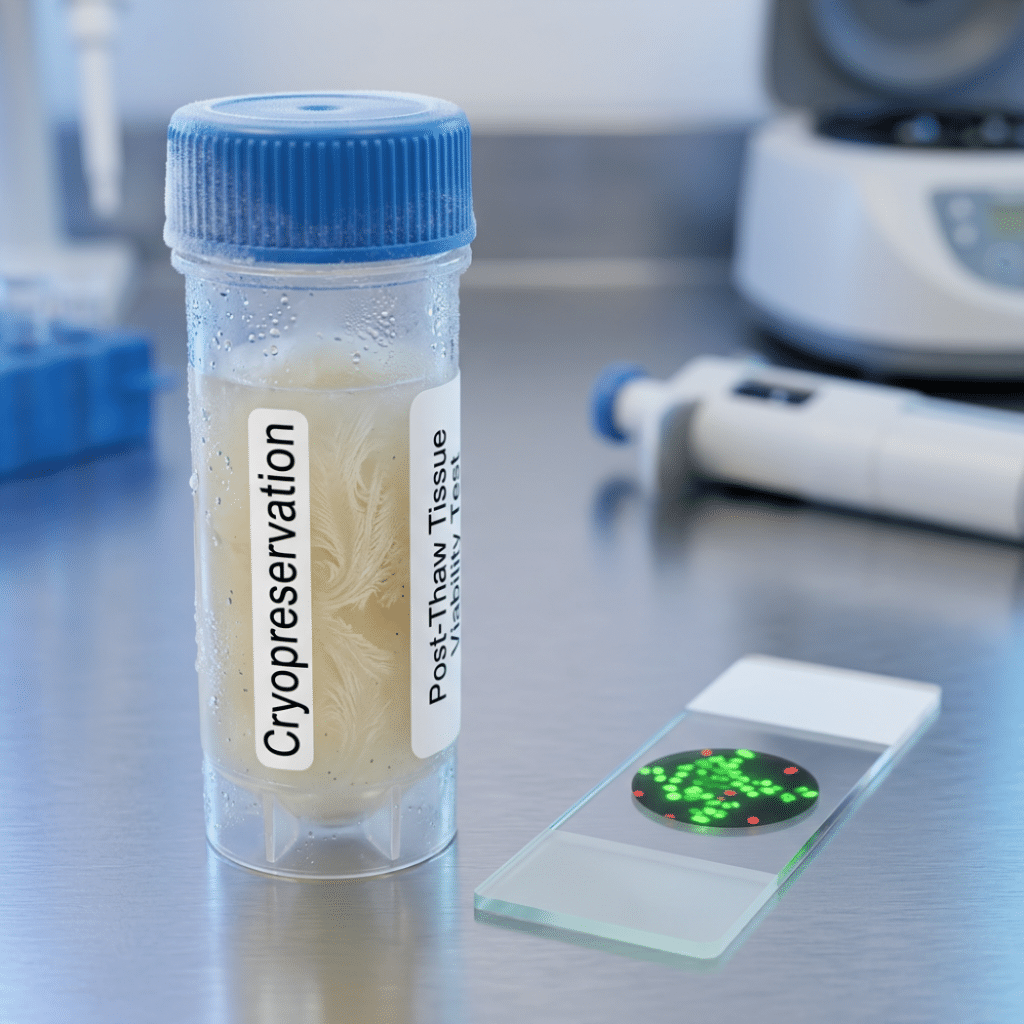
Trypan blue exclusion is the most common viability test used in both research publications and routine laboratory quality control. The principle is straightforward. Trypan blue is a dye that cannot pass through an intact, healthy cell membrane. When a cell suspension is mixed with trypan blue and examined under a microscope, living cells with intact membranes remain clear and unstained. Dead or damaged cells with compromised membranes absorb the dye and appear blue. A technician counts the proportion of clear cells to total cells, and that percentage is the viability figure.
This is where the “80 to 91 percent” figures in many published cryopreservation studies come from. The method’s limitation is important to understand: trypan blue exclusion measures only membrane integrity. A cell with an intact membrane counts as “live” by this test. It cannot tell you whether that cell is still capable of dividing, whether it still expresses the surface markers that identify it as a mesenchymal stromal cell, or whether it retains the functional properties that make it biologically interesting. It is necessary but not sufficient as a quality measure.
Flow Cytometry
Flow cytometry is more sophisticated, more informative, and more expensive. A cell suspension is passed through a laser beam at high speed, one cell at a time. Detectors measure multiple characteristics of each cell simultaneously: its physical size, its internal granularity, and the fluorescence emitted by labeled antibodies attached to specific surface proteins. In clinical-grade ADSC viability assessment, flow cytometry accomplishes two things at once.
First, it uses viability dyes such as 7-AAD or DAPI that penetrate compromised cell membranes, allowing the instrument to count live versus dead cells with higher accuracy than trypan blue. Second, it simultaneously confirms that surviving cells still express the correct surface marker profile for mesenchymal stromal cells: CD90, CD73, and CD105 must be positive at 95 percent or greater, and CD45, CD34, CD14, CD19, and HLA-DR must be negative at 2 percent or fewer. These are the ISCT (International Society for Cell and Gene Therapy) minimal criteria for mesenchymal stromal cells, established by Dominici and colleagues in 2006. Meeting these criteria after thawing confirms not just that cells survived but that they remained the correct cell type with the expected biological identity.
Proliferation and Differentiation Assays
The highest-level characterization goes beyond whether cells are alive and whether they look like MSCs to ask whether they can still perform the functions that define MSC biology. Proliferation assays measure whether thawed cells divide and multiply in culture at expected rates. Trilineage differentiation assays expose thawed cells to specific chemical conditions and confirm that they can still differentiate into fat cells (adipogenic), bone cells (osteogenic), and cartilage cells (chondrogenic). These three capacities are the defining functional criteria for mesenchymal stromal cell identity. Published research by Tsekouras and colleagues in 2018 confirmed that ADSCs stored for over a decade in liquid nitrogen retained all three differentiation capacities with no significant differences from freshly isolated cells.
| Method | What It Measures | Key Limitation | Context |
|---|---|---|---|
| Trypan blue exclusion | Membrane integrity: live versus dead count | Does not assess cell function, phenotype, or differentiation capacity | Routine lab use; source of most published viability percentages |
| Flow cytometry (viability dye) | Membrane integrity at the individual cell level, higher accuracy than trypan blue | More complex and costly; does not directly measure function | Clinical-grade quality control; research characterization |
| Flow cytometry (surface markers) | MSC phenotype: CD90/CD73/CD105 positive, CD45/CD34/HLA-DR negative | Confirms cell identity; does not measure functional capacity directly | ISCT criteria confirmation; quality release testing |
| Proliferation assay | Rate of cell division after thawing compared to fresh controls | Measures quantity of division; does not directly assess clinical potential | Research characterization panels |
| Trilineage differentiation assay | Capacity to become fat, bone, and cartilage cells in lab conditions | Laboratory induction may not reflect in vivo behavior | Highest-level confirmation of MSC functional identity |
What the 80 to 91 Percent Viability Range Means
The table below summarizes the key published data on post-thaw viability from peer-reviewed cryopreservation studies. Reading across the rows gives a picture of what the science actually shows at different time points, temperatures, and protocols.
| Reference | Storage Duration | Conditions | CPA | Post-Thaw Result | Key Finding |
|---|---|---|---|---|---|
| Thirumala et al., 2010 | 3 months | -196 degrees C | 10 percent DMSO | 80 to 91 percent viability | Establishes benchmark for standard protocol |
| Miyagi-Shiohira et al., 2021 | 9 months | -80 degrees C | No DMSO | 80 percent | Viable at -80 degrees C without DMSO at 9 months; -80 degrees C shown as suboptimal for long-term |
| Miyagi-Shiohira et al., 2021 | 18 months | -150 degrees C | DMSO/CP-1 | 85 percent | High-density vapor-phase storage validated |
| Miyagi-Shiohira et al., 2021 | 24 months | -150 degrees C | DMSO | 90 percent (cryobag format) | Large-scale storage protocol confirmed |
| Tsekouras et al., 2018 | Over 10 years | Liquid nitrogen | DMSO-based | No significant difference from fresh | Immunophenotype, proliferation, and differentiation all preserved |
| Zanata et al., 2023 | 90 days | -80 degrees C | L-proline and trehalose | Equivalent to DMSO | Non-toxic CPA alternative validated for short-term storage |
| Devitt et al., 2015 | Up to 1,159 days | Cryogenic | Standard | Viable cells successfully isolated | Donor ages 8 to 82; age not a significant factor in outcomes |
What Viability Does Not Tell You
This distinction is the most important compliance point in the entire article, and it deserves its own section rather than a footnote. High post-thaw viability means that cells survived the freeze-thaw cycle with their basic biological properties intact. The membrane is whole, the cell is metabolically active, and if flow cytometry was performed, the surface marker profile confirms the cells are still recognizable as mesenchymal stromal cells. That is meaningful and important information about the quality of a banking facility’s protocols.
What viability does not tell you is whether those cells will treat any disease, qualify for any clinical trial, or produce any specific health outcome. Clinical outcomes depend on entirely separate variables: whether an FDA-regulated product or protocol exists for the specific application, the design and eligibility criteria of that product or protocol, the individual patient’s clinical situation, and the state of the science and regulation at the future time of use. As of April 2026, no adipose-derived stem cell product is FDA-approved to treat any disease in the United States. Any future use of banked tissue would need to occur through an appropriate FDA-regulated pathway. For more context on what those pathways look like, the guide to Expanded Access programs describes the compassionate use framework, and the complete guide to adipose tissue banking covers the broader context of what banking preserves and why it may be relevant to future options.
Does Patient Age Affect Cryopreservation Success?
This is one of the most common anxieties patients have, and the published data addresses it directly. Research by Devitt and colleagues in 2015 documented successful ADSC isolation from cryopreserved tissue across donor ages ranging from 8 to 82 years. Across that entire range, patient age did not significantly impact post-thaw viability, cell isolation success, or cell growth rates after thawing. The cryopreservation process itself does not work less well in older donors.
The more nuanced consideration is the biological state of the cells at the moment of collection, which is a different question from whether the cryopreservation process itself is affected by age. Published research has documented age-related changes in ADSC properties that accumulate over the donor’s lifetime: gradual reductions in proliferative capacity, shifts in gene expression profiles, and increases in cellular senescence markers. These are changes in what the cells are at the time they are banked, not changes caused by the banking process. Cryopreservation halts biological time for whatever material it stores. It preserves cells at their current state, not at any idealized earlier state.
This distinction gives the scientific rationale for earlier banking a specific and honest foundation: banking younger preserves cells at a younger biological profile, not because cryopreservation works better in younger donors, but because the cells themselves may have different properties at different biological ages.
| Factor | Published Finding | Practical Implication |
|---|---|---|
| Donor age and post-thaw viability | Age did not significantly impact viability across ages 8 to 82 (Devitt et al., 2015) | Banking is biologically feasible across a wide range of adult ages |
| Donor age and cell isolation success | Age did not significantly impact ADSC isolation from cryopreserved tissue | Cells can be isolated from thawed tissue regardless of donor age |
| ADSC biological properties at collection | Age-related changes in proliferative capacity and gene expression documented separately | Earlier collection preserves cells at a younger biological profile |
| Cryopreservation and additional aging | Cryopreservation halts biological processes; does not cause further aging of stored tissue | Storage does not age the cells beyond the state at collection |
What to Ask a Banking Facility About Their Viability Protocols
Not all banking facilities operate at the same standard, and patients are entitled to ask specific, technical questions before committing to any service. The following questions are grounded in the science covered in this article.
- What cryoprotective agent is used, and at what concentration? The answer should specify DMSO at 5 to 10 percent, or a validated alternative with published data.
- What is the controlled-rate freezing protocol, and is it validated with published data? The rate should be 1 to 2 degrees Celsius per minute through the critical zone.
- At what temperature is tissue stored long-term? The answer should be liquid nitrogen or vapor-phase nitrogen. A facility storing tissue at -80 degrees Celsius long-term is not following best-practice protocols.
- What continuous temperature monitoring and backup systems are in place? Automated alarms and redundant nitrogen supply are infrastructure requirements, not premium features.
- What viability testing is performed before freezing and after thawing, and what are the release criteria? Quality facilities typically require 85 percent or higher post-thaw viability before a sample is accepted.
- What sterility testing is performed?
- Is flow cytometry performed to confirm MSC surface marker identity (CD90, CD73, CD105 positive; CD45, CD34, HLA-DR negative)?
- What is the chain-of-custody documentation process?
- Is the facility in compliance with current good tissue practice (CGTP) standards under 21 CFR Part 1271?
- Is the facility registered with the FDA as a human cells, tissues, and cellular and tissue-based products (HCT/P) establishment? FDA registration is a legal requirement, not a differentiating feature. It can be verified through the FDA’s HCTP establishment registration database.
Frequently Asked Questions
What is cryopreservation, and how is it different from regular freezing?
Cryopreservation is a controlled scientific process that uses cryoprotective agents and precisely managed cooling rates to preserve living cells at ultra-low temperatures. The key distinction from regular freezing is that every variable is deliberately controlled based on published cryobiology research: the type and concentration of protective agent, the rate of temperature decrease through each zone, the final storage temperature, and the speed of thawing. Regular freezing allows ice crystals to form in and around cells, destroying them. Cryopreservation prevents that damage. The same principles that make cord blood banking clinically viable for decades have been adapted for adipose tissue banking.
What are the 80 to 91 percent viability numbers I keep seeing, and where do they come from?
They come primarily from trypan blue exclusion assays, in which cells that have an intact membrane after thawing are counted as viable. Published research by Thirumala and colleagues in 2010 established this range using standard 10 percent DMSO protocols at -196 degrees Celsius storage. It represents the proportion of cells that survived the freeze-thaw cycle with their membrane intact. It does not measure whether those cells retained all functional properties, and it does not predict any clinical outcome. No ADSC product is FDA-approved to treat any disease.
How is viability actually tested in a lab?
The most common method is trypan blue exclusion, which identifies cells with intact membranes. More sophisticated quality control uses flow cytometry to simultaneously measure viability and confirm that surviving cells still express the surface markers that identify them as mesenchymal stromal cells (CD90, CD73, and CD105 positive; CD45, CD34, and HLA-DR negative). The most comprehensive characterization adds proliferation assays, which confirm cells still divide at expected rates, and trilineage differentiation assays, which confirm cells can still become fat, bone, and cartilage cells under appropriate lab conditions.
Does 80 to 91 percent viability mean 10 to 20 percent of my cells will be useless?
That is one way to interpret it, but the context matters. Published research consistently shows that post-thaw cells at 80 to 91 percent viability retain their MSC phenotype and functional properties. The 10 to 20 percent that does not survive the freeze-thaw process is typical for any cryopreservation procedure across all cell types and applications, not a failure specific to adipose tissue. The cells that do survive are biologically intact and characterizable. That said, viability tells you about biological survival, not about any future therapeutic outcome. No ADSC product is FDA-approved to treat any disease.
How long can adipose tissue be stored and still be viable?
The published data is encouraging for long-term storage. Published research by Tsekouras and colleagues in 2018 found no significant differences in immunophenotype, proliferation, or differentiation capacity between ADSCs stored for over 10 years in liquid nitrogen and freshly isolated cells. At -150 degrees Celsius vapor-phase storage, published research by Miyagi-Shiohira and colleagues in 2021 shows 85 percent viability at 18 months and 90 percent at 24 months. The key variable is storage temperature: liquid nitrogen temperatures halt all biological degradation mechanisms entirely, which is why they are the standard for long-term banking.
Does my age affect whether my tissue can be cryopreserved successfully?
Not significantly, based on published data. Research by Devitt and colleagues in 2015 documented successful cryopreservation across donor ages from 8 to 82 years, with age not significantly affecting post-thaw viability, cell isolation success, or growth rates after thawing. The separate consideration is the biological state of the cells at the time of collection: age-related changes in ADSC proliferative capacity and gene expression accumulate over a person’s lifetime, and cryopreservation preserves whatever state the cells are in at the moment of banking. Banking does not accelerate or cause age-related cellular changes; it freezes the current biological profile in place.
What is DMSO and why does it need to be removed before clinical use?
DMSO (dimethyl sulfoxide) is the standard cryoprotective agent in stem cell and tissue banking, with decades of published use in cord blood, bone marrow, and now adipose tissue preservation. It works by permeating cell membranes and partially replacing intracellular water, lowering the freezing point inside the cell and reducing ice nucleation. At physiological temperatures, however, DMSO can be toxic to cells and cause adverse effects in patients. For these reasons, any future clinical application of stored cells would require DMSO removal through serial dilution washing steps before the cells could be used. This is a standard protocol requirement that does not compromise the cells’ viability or properties.
Does high viability mean my banked tissue will work for a future treatment?
No, and understanding this distinction is critical. High post-thaw viability confirms that cells survived the freeze-thaw process with their basic biological properties intact. It does not mean those cells will treat any disease, qualify for any specific clinical trial, or produce any health benefit. Whether banked tissue is useful in a future medical context depends on whether FDA-regulated pathways exist for that specific application at that time, the design and eligibility criteria of those pathways, and the patient’s individual clinical situation. As of April 2026, no adipose-derived stem cell product is FDA-approved to treat any disease in the United States. Banking preserves a biological option for a future that remains scientifically and regulatorily uncertain. For context on the research landscape, the emerging research overview describes where adipose-derived cell science is currently most active.
Key Takeaways
Cryopreservation is a distinct scientific process, not freezing. It uses controlled cooling rates, cryoprotective agents, and ultra-low temperature storage to prevent the biological threats that destroy cells during unprotected freezing.
Four distinct biological threats must each be addressed by protocol. Intracellular ice formation, osmotic stress, cell membrane damage, and recrystallization during thawing are each prevented by a specific element of the validated cryopreservation protocol.
DMSO is the standard CPA with promising alternatives emerging. Ten percent DMSO achieves 80 to 91 percent post-thaw viability in published research. Trehalose, L-proline combinations, and xeno-free chemically defined media are showing equivalent results in shorter-term studies.
The cooling rate and storage temperature are both critical, and not interchangeable. One to 2 degrees Celsius per minute is the validated optimal cooling rate for ADSCs. Liquid nitrogen temperatures completely halt all biological activity; -80 degrees Celsius does not, making it unsuitable for long-term banking.
Viability is measured by specific scientific methods with distinct limitations. Trypan blue exclusion counts live versus dead cells based on membrane integrity. Flow cytometry adds MSC phenotype confirmation. Proliferation and differentiation assays provide the most comprehensive functional confirmation.
Published data supports decade-long storage without significant loss. The 80 to 91 percent range with standard protocols at short-term is consistent across studies; no significant differences from fresh tissue have been documented after 10-plus years of liquid nitrogen storage (Tsekouras et al., 2018).
Viability does not equal clinical outcome. High viability means cells survived with their biological properties intact. It does not guarantee access to any future treatment, clinical trial eligibility, or any health benefit. These determinations depend on regulatory, clinical, and scientific factors that are separate from the banking process.
Age does not prevent successful cryopreservation. Published research shows viable cells across donor ages 8 to 82. Banking earlier preserves cells at their current biological profile, not because the process works better in younger donors.
Medical and Regulatory Disclaimer
Save My Fat does not provide FDA-approved treatments or cures for any disease or medical condition. Nothing in this article describes, promotes, or constitutes a treatment, therapy, or medical intervention of any kind. Adipose tissue banking is a tissue preservation service for potential future opportunities that may arise as regenerative medicine science and FDA regulations evolve. It is not a therapeutic product and does not provide clinical benefit.
Banking adipose tissue today does not guarantee eligibility, access, or clinical benefit from any future therapy, clinical trial, Expanded Access program, or Right to Try pathway. Any future use of banked tissue depends entirely on the regulatory status of products or procedures at that time, the patient’s clinical situation and physician guidance, and the availability of FDA-regulated pathways that may accept previously banked autologous material.
All content in this article is for educational and informational purposes only. It does not constitute medical advice, diagnosis, or treatment recommendations. Patients must consult their own licensed healthcare professionals regarding all decisions related to their health, medical care, and participation in any research program.
Learn More
For context on the cells that cryopreservation preserves and why their biological properties matter, the patient’s guide to adipose-derived stem cells explains the science clearly. For a complete overview of the banking process from collection through storage, the complete guide to adipose tissue banking walks through each stage. For a more condensed step-by-step walkthrough, the overview of how stem cell banking works is the starting point. For patients who want to understand what the broader research landscape looks like, the emerging research section covers where adipose-derived cell science is most active. For those exploring what a future regulated pathway might look like, the guide to Expanded Access programs describes the compassionate use framework in plain language. The For Patients section provides a starting point for the overall banking conversation.
This article is for educational purposes only and does not constitute medical advice. Legal and medical review is required before publication. Please consult your licensed healthcare provider regarding all medical decisions.
Related guide: the stem cell science glossary.
Last Updated: April 9, 2026