
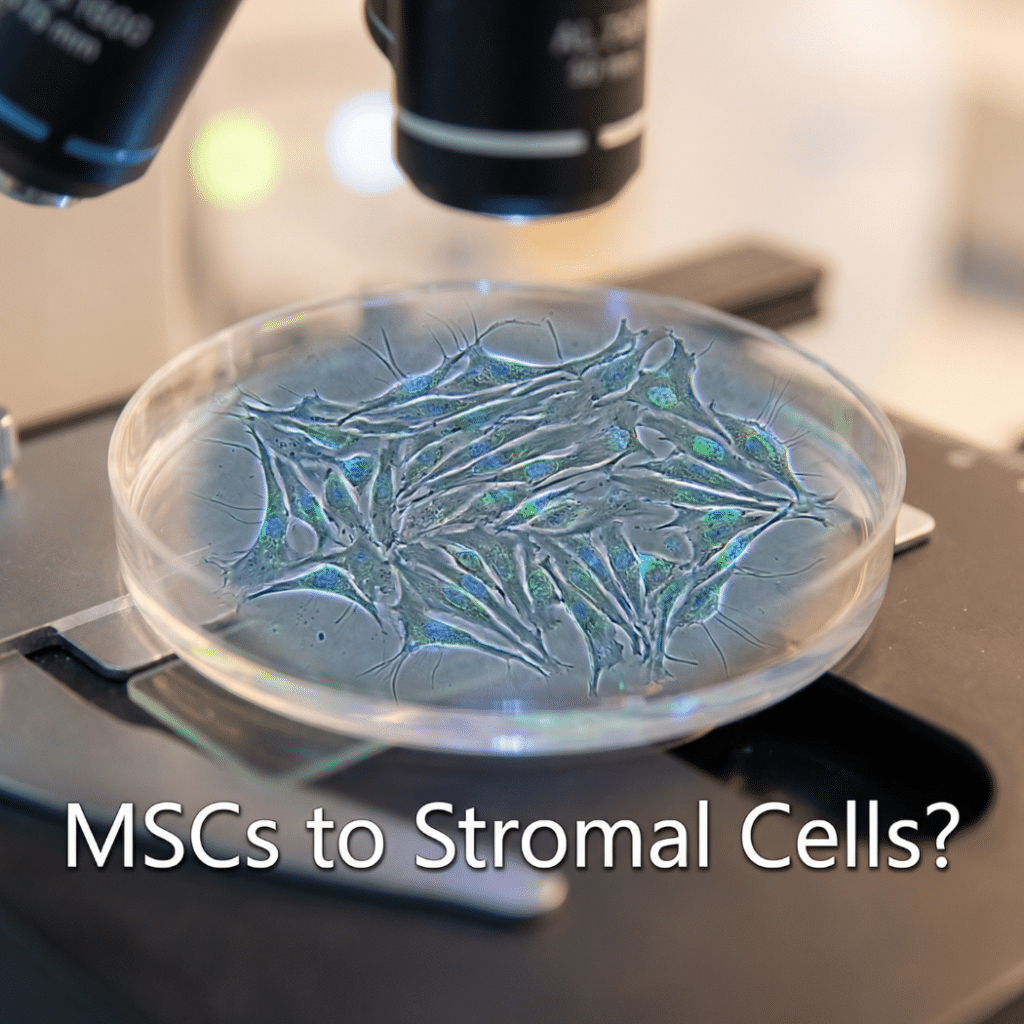
If you have spent any time researching regenerative medicine or adipose tissue banking, you have almost certainly encountered two terms used interchangeably: “mesenchymal stem cells” and “mesenchymal stromal cells.” You may have also seen “Medicinal Signaling Cells” thrown into the mix. These terms look similar, are often abbreviated the same way, and can appear in the same sentence in scientific literature, clinical trial listings, and clinic marketing materials alike. The confusion is not your fault. The scientific community has been actively debating and updating this terminology for over two decades, and the reasons behind that debate have real consequences for patients. This article explains where the terms came from, why they were changed, what the current scientific standards are, and how all of it applies to adipose-derived cells specifically.
TLDR: The term “mesenchymal stem cells” was coined by Arnold Caplan in 1991 and became the dominant label for a class of bone marrow progenitor cells. The International Society for Cell and Gene Therapy officially challenged the term in 2005, recommending “mesenchymal stromal cells” instead because true “stemness” has not been conclusively proven. Caplan himself publicly retracted the original name in 2017 and 2019. All three terms share the abbreviation MSC, which creates real confusion in both research and clinic marketing. Read on to understand exactly what distinguishes them and why the distinction matters.
Important Disclaimer: Save My Fat does not provide FDA-approved treatments or cures for any disease or medical condition. Adipose tissue banking is a preservation service for potential future opportunities, not a therapeutic product. Banking adipose tissue today does not guarantee eligibility, access, or clinical benefit from any future therapy, clinical trial, or medical program. All content here is for educational and informational purposes only and does not constitute medical advice. Patients must consult their own licensed healthcare professionals regarding all medical decisions. Outcomes of any regenerative medicine research or future therapies are highly individual and cannot be predicted or guaranteed.
Search for information about regenerative medicine and you will quickly encounter a terminology problem. The same abbreviation, MSC, can stand for “mesenchymal stem cells,” “mesenchymal stromal cells,” or “Medicinal Signaling Cells” depending on who is writing and when. All three refer to overlapping concepts built around the same underlying cell type, but they carry meaningfully different implications about what those cells do and how they work.
This matters to patients for a specific reason. The “stem cell” label carries enormous cultural weight. It implies the ability to regenerate, to replace, to cure. When clinics use “stem cell” language in marketing materials, they are activating a set of expectations that the underlying science often does not support for the products they are selling. Understanding the naming debate gives you a way to evaluate those claims more critically: if a clinic uses “mesenchymal stem cells” without specifying what they mean by the term, what criteria the cells meet, or whether their product is subject to FDA regulatory oversight, that imprecision is itself a red flag.
By the end of this guide, you will know who first discovered these cells and what he actually called them, why Arnold Caplan coined “mesenchymal stem cells” in 1991, what led the scientific community to challenge that label, what the formal criteria for identifying these cells are, and how adipose-derived cells fit into the current nomenclature framework. You will also understand what the first-ever FDA approval of an MSC product in December 2024 means for the field, and what it does not mean for adipose-derived cell research specifically.
Where the Term “Mesenchymal Stem Cell” Came From
Friedenstein and the Discovery of Bone Marrow Progenitors
The story begins not with stem cells but with fibroblasts. In 1970, Russian scientist Alexander Friedenstein published a paper (Friedenstein et al., Cell and Tissue Kinetics, 1970; PMID 5523063) describing an unusual population of non-blood cells he had identified in bone marrow. These cells were capable of forming colonies in culture, meaning a single cell could divide and produce a visible cluster of daughter cells. He called them colony-forming unit fibroblasts (CFU-F) and described their role as supporting the bone marrow’s structural environment.
Two details about Friedenstein’s work are worth holding onto. First, he did not call these cells stem cells. He used the term “stromal fibroblast progenitors,” which is a more descriptive and arguably more accurate label. Second, his primary observation was about their structural and supportive role in the marrow niche, not about any clinical potential. The work was foundational science about a cell type that had not been fully characterized yet.
Caplan Coins “Mesenchymal Stem Cells” in 1991
Two decades after Friedenstein’s observation, Arnold Caplan published a paper in the Journal of Orthopaedic Research (Caplan AI, 1991; PMID 1870029) that changed the field’s vocabulary overnight. Caplan proposed a model he called the “mesengenic process,” describing how a single progenitor cell in the marrow could differentiate into bone, cartilage, tendon, ligament, muscle, and other connective tissue types. He coined the term “mesenchymal stem cells” to capture what he saw as the cell’s remarkable potential to give rise to the entire mesenchymal tissue family.
The term caught on immediately and widely. It was memorable, it conveyed biological importance, and it fit a moment in science when stem cell research was generating enormous excitement. For nearly three decades, “mesenchymal stem cells” and its abbreviation MSC became the standard language in thousands of papers, clinical trials, and eventually clinic marketing materials. What neither Caplan nor his contemporaries fully anticipated was how much conceptual weight the “stem” label would come to carry, and how difficult it would later be to revise.
The Naming Problem Emerges
The timeline below shows how the terminology debate developed over fifty-plus years from first observation to current consensus.
| Year | Event | Significance |
|---|---|---|
| 1970 | Friedenstein identifies CFU-F in bone marrow | First observation of non-hematopoietic marrow progenitors; called “stromal fibroblast progenitors,” not stem cells |
| 1991 | Caplan coins “mesenchymal stem cells” | Term widely adopted; implies robust stemness and in vivo tissue replacement capacity |
| 2005 | ISCT position statement recommends “mesenchymal stromal cells” | First official scientific challenge to the stem cell label |
| 2006 | Dominici et al. publish ISCT minimal criteria | Defines MSC identity by three testable criteria; does not require stemness proof |
| 2017 | Caplan proposes “Medicinal Signaling Cells” | Original coiner argues the cells work by signaling, not tissue replacement |
| 2019 | Caplan states “I was wrong. I take back the name.” | Most explicit public retraction in the field’s history |
| 2019 | Viswanathan et al. ISCT nomenclature position statement | Current consensus: default to “mesenchymal stromal cells” with tissue source specified |
| 2024 | Ryoncil receives first-ever FDA approval for an MSC product | Field reaches regulatory milestone; product is bone marrow-derived, not adipose-derived |
What “Stemness” Means and Why It Is Disputed for MSCs
What Makes a Cell a Stem Cell?
In strict scientific terms, a cell qualifies as a stem cell if it demonstrates two specific properties. The first is self-renewal: the ability to divide indefinitely while maintaining its undifferentiated state. The second is in vivo multipotency: the ability to give rise to multiple specialized cell types inside a living organism, not just in a lab dish. Both properties need to be demonstrated in a living system, not just under controlled laboratory culture conditions.
The problem with calling MSCs “stem cells” is that the evidence for these properties in most MSC preparations is weaker than the label implies.
| Property | What It Means | Does the MSC Reliably Demonstrate This? |
|---|---|---|
| Self-renewal (indefinite) | Can divide repeatedly without limit or specialization | Not conclusively proven for most MSC preparations; cells undergo senescence after limited passages in culture |
| Multipotency in vivo | Can become multiple cell types inside a living body | Demonstrated in lab conditions (in vitro); rarely confirmed through long-term engraftment and tissue replacement in living organisms |
| Colony formation (CFU-F) | Can generate new colonies in culture | Yes, demonstrated in standard assays |
| Plastic adherence | Grows attached to lab plastic surfaces | Yes, required by ISCT criteria |
| Trilineage differentiation (in vitro) | Can become bone, fat, and cartilage cells in culture | Yes, required by ISCT criteria |
The critical observation from modern research, articulated by Pittenger et al. in npj Regenerative Medicine (2019; PMID 31815001), is that MSCs injected into a living body rarely persist long-term or physically replace damaged tissue. Instead, most of their observed effects in preclinical and early clinical settings appear to come from paracrine signaling: the release of bioactive molecules that influence surrounding cells, reduce inflammation, and support the body’s own repair mechanisms. The cells behave like stem cells in the artificial environment of a lab dish, but their primary mode of action in a living system is more pharmacological than regenerative.
Why Researchers Care About This Distinction
This distinction between “stem cell” and “stromal cell” is not a matter of scientific nitpicking. It has direct consequences for what patients and physicians expect from these cells and for how products based on them can legally be marketed. The ISCT’s 2005 position statement (Horwitz et al., Cytotherapy, 2005; PMID 16236628) was explicit: the “mesenchymal stem cell” label should be reserved only for cells that can demonstrate self-renewal and in vivo multipotency, and “mesenchymal stromal cell” should be used for the broad clinical product category that has not met that higher bar. The authors were not dismissing the cells as uninteresting. They were arguing that using “stem” when “stromal” is more accurate creates misleading expectations that the science does not support.
The ISCT Minimal Criteria: Defining MSCs by What They Do, Not What They Are Called
The Three Criteria
In 2006, an ISCT working group led by Dominici et al. published a paper in Cytotherapy (PMID 16923606) that has since been cited more than 15,000 times. Its purpose was practical: to define a minimum floor of testable criteria that any cell population must meet before it can be classified as multipotent mesenchymal stromal cells. This was a response to the proliferation of papers making claims about “MSCs” derived from dozens of different tissue sources using dozens of different preparation methods, making comparisons across studies nearly impossible.
The three criteria are:
| Criterion | Technical Requirement | Plain Language Explanation |
|---|---|---|
| Plastic adherence | Cells must adhere to standard tissue culture plastic under standard conditions | The cells stick to the bottom of lab dishes and grow there, which distinguishes them from blood cells that float freely |
| Surface marker profile | At least 95% must express CD105, CD73, and CD90; no more than 2% may express CD45, CD34, CD14 or CD11b, CD79a or CD19, or HLA-DR | The cells carry specific identifying proteins on their surface; blood cell markers must be absent |
| Trilineage differentiation | Must be capable of forming osteoblasts (bone), adipocytes (fat), and chondroblasts (cartilage) under defined lab conditions | Under the right lab conditions, the cells can be directed to become three different cell types |
These criteria are a practical identification floor. They do not prove stemness in the strict biological sense. A cell that meets all three criteria is correctly classified as a mesenchymal stromal cell. Meeting these criteria does not mean the cell is safe or effective for any clinical use. A clinic presenting CD73/CD90/CD105 surface marker data is describing what cell type they isolated. It is not evidence of clinical benefit.
Additional Markers and Limitations
The Dominici criteria represent the minimum, not the complete picture of MSC characterization. The table below adds context about additional markers commonly reported in the literature.
| Marker Category | Examples | What They Tell You |
|---|---|---|
| ISCT core positive (required) | CD73, CD90, CD105 | Cell meets minimum classification criteria |
| ISCT core negative (required) | CD45, CD34, CD14/CD11b, CD79a/CD19, HLA-DR | Rules out hematopoietic (blood) cell contamination |
| Additional commonly reported | CD44, CD29, CD166 | Broadly expressed; provide supplemental characterization data |
| Stemness-associated candidates | STRO-1, CD146, CD271, SSEA-4 | May enrich for more potent subpopulations; not part of ISCT minimum; expression varies significantly by tissue source |
| Tissue source-distinguishing markers | CD36 (adipose), CD106 (bone marrow), Oct-4 (some birth tissue MSCs) | Help distinguish MSCs derived from different tissue origins |
One important limitation deserves clear explanation. Phenotypic convergence occurs when non-MSC cells are grown in standard culture conditions long enough to acquire an MSC-like surface marker profile. This means the ISCT marker panel alone is necessary but not sufficient for confirming a functionally competent MSC population. The markers tell you what the cells look like on their surface; they do not fully characterize what the cells can do.
Arnold Caplan Changes His Mind
The 2017 Retraction
In 2017, the scientist who coined the term “mesenchymal stem cells” published a paper in Stem Cells Translational Medicine titled “Mesenchymal Stem Cells: Time to Change the Name!” (Caplan AI, 2017; PMID 28452204). In it, Caplan argued that the cells he had named in 1991 do not primarily work by differentiating into replacement tissue. They work by releasing signaling molecules that influence the behavior of nearby cells, reduce inflammation, and support endogenous repair processes. He proposed renaming them “Medicinal Signaling Cells” to better reflect this paracrine biology.
Two years later, in a follow-up paper in Tissue Engineering Part B Reviews (Caplan AI, 2019; PMID 30887883) Caplan was even more direct: “I was wrong. I take back the name that I gave these hugely important cells.” This is one of the most explicit public self-corrections by a scientist about a term they personally coined.
What “Medicinal Signaling Cells” Means for Patients
The three competing terms now all share the same abbreviation, which is a genuine source of confusion that researchers and patients alike encounter regularly.
| Term | What It Implies About Mechanism | ISCT Adoption Status | Currently Used In |
|---|---|---|---|
| Mesenchymal stem cells | Cells primarily differentiate into new tissue to replace damaged cells | Not recommended except for confirmed stemness | Older literature and some clinical trial listings; still common in clinic marketing |
| Mesenchymal stromal cells | Cells are supportive, multipotent stromal progenitors; mechanism is primarily paracrine | ISCT preferred term (Viswanathan et al., 2019) | Current scientific literature, regulatory submissions, ISCT guidance |
| Medicinal Signaling Cells | Cells act primarily as signaling agents; pharmacological rather than tissue-regenerative role | Not adopted by ISCT; proposed by Caplan | Some academic discussions; not standard regulatory or clinical trial language |
The practical takeaway for patients is this: when you see “MSC” in a research paper, a trial listing, or clinic marketing, check which full term is being used and in what context. A clinic using “mesenchymal stem cells” is using a term that the scientific community itself has moved away from. Regulatory bodies including the FDA use “mesenchymal stromal cells” in their guidance documents for products meeting ISCT criteria.
Where Adipose-Derived Cells Fit In
AD-MSCs in the Nomenclature Framework
Adipose-derived cells that meet the Dominici et al. 2006 ISCT criteria are correctly called adipose-derived mesenchymal stromal cells (AD-MSCs). The ISCT/IFATS joint statement (Bourin et al., Cytotherapy, 2013; PMID 23570660) provides phenotyping criteria specific to adipose-derived cells, distinguishing between two distinct preparations that are often confused with each other.
SVF (stromal vascular fraction) is the mixed cell population isolated directly from fat tissue without culture expansion. According to the IFATS/ISCT joint statement, freshly isolated SVF cells are characterized by the surface marker profile CD45-negative, CD235a-negative, CD31-negative, and CD34-positive. This is a mixed population that includes progenitor cells, blood vessel cells, immune cells, and others. SVF is not pure MSCs.
Culture-expanded ADSCs, by contrast, have been selected through the plastic adherence process, grown in culture, and characterized by the standard ISCT marker profile: CD90-positive, CD73-positive, CD105-positive, CD44-positive, with CD45-negative and CD31-negative. These culture-expanded cells meet the Dominici criteria and can be accurately called AD-MSCs or ASCs.
The Viswanathan et al. 2019 ISCT nomenclature position statement recommends specifying the tissue source when using the MSC abbreviation. Adipose-derived cells are thus accurately called AD-MSCs, bone marrow-derived cells are BM-MSCs, and umbilical cord-derived cells are UC-MSCs.
| Term | Source | Processing Stage | Preferred Usage |
|---|---|---|---|
| SVF (Stromal Vascular Fraction) | Adipose tissue | Freshly isolated, not culture-expanded | When referring to the unprocessed mixed cell population from fat tissue |
| ADSCs / ASCs (Adipose-Derived Stem/Stromal Cells) | Adipose tissue | Culture-expanded; meet ISCT criteria | Widely used in published research; both terms appear in the literature |
| AD-MSCs (Adipose-Derived Mesenchymal Stromal Cells) | Adipose tissue | Culture-expanded; meet ISCT criteria | ISCT-preferred format per 2019 nomenclature statement |
| BM-MSCs | Bone marrow | Culture-expanded; meet ISCT criteria | ISCT-preferred format for bone marrow-sourced cells |
| UC-MSCs | Umbilical cord / Wharton’s jelly | Culture-expanded; meet ISCT criteria | ISCT-preferred format for umbilical cord-sourced cells |
Why Adipose Tissue Is Distinctive Among MSC Sources
Adipose tissue yields roughly 100 to 500 times more MSCs per gram of starting material than bone marrow (Bourin et al., 2013; PMID 23570660). This yield advantage is practically significant: clinical applications that require large numbers of cells are more feasible starting from adipose tissue than from bone marrow, where a painful aspiration procedure yields a much smaller raw cell count. The IFATS/ISCT joint statement also identifies CD36 as a marker that may help distinguish adipose-derived MSCs from bone marrow-derived MSCs, reflecting the fact that cells from different tissue sources, even when they meet the same ISCT criteria, are not biologically identical.
All adipose-derived MSC research is still investigational. No adipose-derived MSC product currently holds FDA marketing approval for any disease or condition. The patient’s guide to adipose-derived stem cells covers the science of these cells in more depth.
What Ryoncil Means for the Field
On December 18, 2024, the FDA approved Ryoncil (remestemcel-L-rknd) for steroid-refractory acute graft-versus-host disease (SR-aGvHD) in pediatric patients aged 2 months and older. This was the first-ever FDA approval of an MSC product in the United States. The approval is documented at the FDA Ryoncil page.
Several facts about Ryoncil need to be stated precisely to understand what the approval means.
Ryoncil is an allogeneic product: it is manufactured from bone marrow donated by unrelated donors, not from adipose tissue. It is approved only for one specific indication in one specific patient population: steroid-refractory acute GvHD in pediatric patients (aged 2 months and older). It is not approved for adults, for other forms of GvHD, or for any other condition. The Phase 3 trial supporting its approval (NCT02336230) reported a 70% overall response rate at Day 28, and the product received 7-year orphan drug exclusivity. This is a product manufactured by Mesoblast, a biopharmaceutical company with a regulated manufacturing process, potency assays, and a complete clinical development program.
| What the Ryoncil Approval Means | What It Does Not Mean |
|---|---|
| An MSC product can successfully complete the full FDA approval pathway | MSC therapies broadly are now approved or available outside clinical trials |
| A Phase 3 randomized controlled trial demonstrated a 70% overall response rate for the approved indication | Similar results will be seen for other MSC sources or other conditions |
| FDA has cleared a specific allogeneic BM-MSC product for one specific pediatric indication | Adipose-derived MSC products are approved for any indication |
| The field has reached a meaningful regulatory maturity milestone | Patients can access Ryoncil for indications outside SR-aGvHD in pediatric patients |
The significance of Ryoncil for the broader MSC field lies in what it demonstrates about the development pathway, not in any implication that other MSC products are now approved. It shows that with rigorous manufacturing controls, validated potency testing, and well-controlled Phase 3 trial data, an MSC product can navigate the complete FDA review process and receive a Biologics License Application approval. That precedent is relevant to how future MSC products, including potentially adipose-derived products, may be developed. It does not accelerate or guarantee any other approval.
For context on what legitimate clinical trial participation looks like for regenerative medicine products, see the introduction to clinical trials for regenerative medicine.
How the Naming Debate Affects Patients Practically
The naming debate is not academic. It plays out in clinical settings, in regulatory decisions, and most directly for patients, in how clinics market their products.
When a clinic uses “stem cells” language in marketing, it activates a very specific set of expectations: tissue regeneration, cell replacement, the possibility of cure. These expectations are not supported by the current evidence for most MSC preparations being offered outside of registered clinical trials. Understanding that the scientific community itself has moved away from the “stem” label, and understanding why, gives patients a meaningful tool for evaluating those claims.
The specific red flags created by imprecise terminology include: using “mesenchymal stem cells” without specifying the tissue source, the manufacturing method, or whether the cells meet ISCT criteria; claiming FDA approval based on Ryoncil’s approval while selling an adipose-derived, cord tissue, or other non-BM-MSC product; and offering culture-expanded MSC products for systemic injection without disclosing that such products are generally regulated as Section 351 biologics requiring an IND.
On that last point: the FDA distinguishes between products regulated under 21 CFR Part 1271 Section 361 (minimally manipulated, homologous use) and products regulated as biologics under Section 351 (more than minimally manipulated or used for non-homologous purposes). Culture-expanded MSCs intended for systemic injection or disease treatment generally fall under Section 351, requiring an Investigational New Drug application and, if a sponsor intends to market them, a Biologics License Application. This regulatory framework applies regardless of whether a clinic calls its product “stem cells” or “stromal cells.” The label does not change the regulation. For more on the FDA regulatory framework for adipose-derived products, the guide to FDA regulations for adipose tissue provides additional context.
Frequently Asked Questions
What does mesenchymal mean?
Mesenchymal refers to the mesenchyme, the embryonic connective tissue that gives rise to bone, cartilage, muscle, fat, blood vessels, and other structural tissues in the body. In adult biology, “mesenchymal” is used to describe stromal progenitor cells with the ability to differentiate into these connective tissue lineages under the right conditions. The term distinguishes these cells from hematopoietic cells, which give rise to blood cell lineages. When you see “mesenchymal” in a cell name, it tells you something about the cell’s lineage origin and what tissue types it has been observed to produce in laboratory settings.
What is the difference between a stem cell and a stromal cell?
A stem cell, in the strict scientific definition, must demonstrate self-renewal (the ability to divide indefinitely without specializing) and in vivo multipotency (the ability to become multiple cell types inside a living body). A stromal cell is a supportive cell in connective tissue that may have differentiation capacity but has not necessarily been proven to meet the strict self-renewal criterion. Most MSC preparations meet the criteria for stromal cells but have not been proven to meet the stricter definition of stem cells, which is why the ISCT recommends the “stromal” label. In practical terms, both labels are applied to the same cell populations in most clinical contexts, but the “stem” label carries implications of potency and curative capacity that the evidence does not uniformly support.
Why do some scientists say “stem cells” and others say “stromal cells”?
The use of “stem cells” reflects the legacy of the term Arnold Caplan coined in 1991, which became so embedded in the literature that it persists even after the ISCT’s official recommendation to shift to “stromal cells.” Older papers, some clinical trial listings, and most clinic marketing still use “mesenchymal stem cells” because it is the more familiar and commercially appealing term. Current scientific papers and regulatory submissions increasingly use “mesenchymal stromal cells” in line with the ISCT 2019 position statement. The transition is gradual, which is why both terms appear in active use simultaneously. Importantly, all three variants of “MSC” share the same abbreviation, adding to the confusion.
What are the ISCT minimal criteria and why do they matter?
The ISCT minimal criteria, established by Dominici et al. in 2006 (PMID 16923606), are three testable requirements any cell population must meet to be called a multipotent mesenchymal stromal cell: plastic adherence in culture, a specific surface marker profile (CD105, CD73, and CD90 positive at 95% or above; CD45, CD34, CD14/CD11b, CD79a/CD19, and HLA-DR negative at 2% or below), and the ability to differentiate into osteoblasts, adipocytes, and chondroblasts under defined conditions. They matter because they created a common language for comparing cells across different tissue sources and preparation methods, which was essential for making clinical research results interpretable. They also matter for patients because meeting these criteria identifies what the cells are, not what they can do clinically; the criteria are not evidence of safety or therapeutic effect.
Who coined the term mesenchymal stem cell and why?
Arnold Caplan coined the term in a 1991 paper in the Journal of Orthopaedic Research (PMID 1870029). He was building on Friedenstein’s 1970 observation of colony-forming progenitor cells in bone marrow and proposed a model called the “mesengenic process” describing how a single progenitor could give rise to multiple connective tissue types. The “stem cell” label was chosen to capture what seemed like a remarkable regenerative potential. The term was widely adopted and became standard vocabulary for over two decades before the ISCT began formally challenging it.
Why did Arnold Caplan say he was wrong about the name?
By 2017, accumulated research had made it clear that MSCs injected into a living body rarely engraft and replace damaged tissue in the way the “stem cell” label implies. Instead, their primary observed effects come from paracrine signaling: the release of molecules that influence nearby cells, reduce inflammation, and support tissue repair without direct cell replacement. Caplan published a paper in 2017 (PMID 28452204) arguing that the “stem” label misrepresents the biology and proposed “Medicinal Signaling Cells” as a more accurate alternative. In a 2019 follow-up (PMID 30887883), he stated directly: “I was wrong. I take back the name.”
What does “Medicinal Signaling Cells” mean?
“Medicinal Signaling Cells” is Arnold Caplan’s 2017 proposed replacement for “mesenchymal stem cells.” The name reflects his view that these cells act more like pharmacological agents, releasing paracrine signals that modulate immune responses and support repair, than like classic stem cells that differentiate and replace damaged tissue. The term has been discussed in academic contexts but has not been adopted as standard by the ISCT, which continues to prefer “mesenchymal stromal cells.” All three terms, mesenchymal stem cells, mesenchymal stromal cells, and Medicinal Signaling Cells, share the abbreviation MSC.
How does the naming debate affect patients?
The most direct effect is in how patients interpret clinic marketing. The “stem cell” label activates expectations of regeneration and cure that the current evidence does not uniformly support for most products being offered outside registered clinical trials. When a clinic uses “mesenchymal stem cells” without specifying the tissue source, the manufacturing method, ISCT criteria confirmation, or regulatory status, the imprecision itself is a warning sign. Patients who understand that the scientific community moved away from the “stem” label for reasons grounded in evidence are better positioned to ask the right questions before agreeing to any procedure.
Where do adipose-derived cells fit in this terminology framework?
Adipose-derived cells that meet the Dominici et al. 2006 ISCT criteria are correctly called adipose-derived mesenchymal stromal cells (AD-MSCs) or, more commonly in published research, ADSCs or ASCs. The ISCT/IFATS joint statement (Bourin et al., 2013; PMID 23570660) provides specific phenotyping criteria for both freshly isolated SVF cells and culture-expanded ADSCs. The 2019 ISCT nomenclature position statement recommends using source-specific prefixes, so “AD-MSC” is the formally preferred term. No adipose-derived MSC product currently holds FDA marketing approval for any condition. For more on what these cells are and how they are characterized, see the patient’s guide to adipose-derived stem cells.
What is Ryoncil and what does its FDA approval mean for the field?
Ryoncil (remestemcel-L-rknd) is an allogeneic bone marrow-derived MSC product manufactured by Mesoblast that received FDA approval on December 18, 2024, for steroid-refractory acute GvHD in pediatric patients aged 2 months and older. It is the first MSC product ever to receive FDA marketing approval in the United States. Its significance for the broader field is that it demonstrates a complete MSC development pathway from research through Phase 3 trials to FDA approval is achievable. It does not mean that other MSC products are approved, that adipose-derived cell products are approved for any indication, or that patients can access Ryoncil for conditions other than the specific approved pediatric GvHD indication. The approval is described in detail at the FDA Ryoncil page.
Key Takeaways
- Friedenstein identified the cells first, in 1970, and called them stromal progenitors, not stem cells. The “stem cell” label came later, from a different scientist, based on assumptions about the cells’ potential that have since been revised.
- Arnold Caplan coined “mesenchymal stem cells” in 1991 and publicly retracted the name in 2017 and 2019. He proposed “Medicinal Signaling Cells” to reflect the paracrine biology that research has since confirmed as the primary mechanism of action.
- The ISCT recommends “mesenchymal stromal cells” as the default term. The 2005 and 2019 ISCT position statements both argue that “stem” implies a level of in vivo self-renewal and differentiation that has not been conclusively demonstrated for most MSC preparations.
- The Dominici et al. 2006 ISCT minimal criteria define three testable requirements. Plastic adherence, a specific surface marker profile, and trilineage differentiation in vitro are necessary for classification. They are not evidence of clinical benefit.
- All three MSC term variants share the same abbreviation. Mesenchymal stem cells, mesenchymal stromal cells, and Medicinal Signaling Cells are all abbreviated MSC. Always check which full term is being used in context.
- Adipose-derived cells that meet ISCT criteria are correctly called AD-MSCs or ADSCs. SVF (freshly isolated) and culture-expanded ADSCs are distinct preparations with different marker profiles. No adipose-derived MSC product holds FDA approval for any condition.
- Ryoncil is the first FDA-approved MSC product, approved December 2024, for a specific pediatric GvHD indication. It is bone marrow-derived, not adipose-derived. Its approval demonstrates that a complete MSC regulatory pathway exists. It does not mean other MSC products or adipose-derived products are approved.
- The naming debate is a patient protection issue. Clinics that use imprecise “stem cell” language without specifying criteria, tissue source, or regulatory status are using marketing language the scientific community itself has rejected. Understanding the debate helps patients recognize those red flags.
Learn More
Save My Fat helps individuals preserve their own adipose tissue through validated cryopreservation protocols for potential future opportunities that may arise as regenerative medicine science and FDA regulations evolve. Banking tissue does not guarantee eligibility, access, or clinical benefit from any future therapy, clinical trial, or medical program. Save My Fat does not provide FDA-approved treatments or cures.
The following resources provide additional context for patients and providers exploring the regenerative medicine landscape.
- What Are Adipose-Derived Stem Cells? A Patient’s Guide explains what ADSCs are, where they come from, and how they are identified.
- Emerging Research covers the conditions and applications where adipose-derived cell research is most active.
- What Are Clinical Trials for Regenerative Medicine? explains how clinical trials work and what patient participation involves.
- Adipose Tissue Banking: A Complete Guide covers the full banking process, from collection through cryopreservation and storage.
- Expanded Access Programs: How Patients Can Legally Access Investigational Therapies describes the compassionate use framework for patients who cannot enroll in a formal trial.
- How Stem Cell Banking Works walks through the step-by-step banking process.
- For Patients provides an overview of what Save My Fat offers.
- For Providers covers how physicians can offer tissue banking to their patients.
The Reagan-Udall Expanded Access Navigator is a free, independent tool for patients and physicians navigating the expanded access process. It is not affiliated with Save My Fat.
This article is for educational purposes only and does not constitute medical advice. Please consult your licensed healthcare provider regarding all medical decisions.
About the author: Oscar Tellez is the founder and CEO of Save My Fat. He holds a Bachelor of Science in Exercise Science and Health Promotion from Florida Atlantic University. He has spent more than a decade in the regenerative medicine industry across product distribution, laboratory and vendor relationships, and provider training. He is not a licensed clinician, and this article is educational, not medical advice.
Related guide: the stem cell science glossary.
Last Updated: April 7, 2026