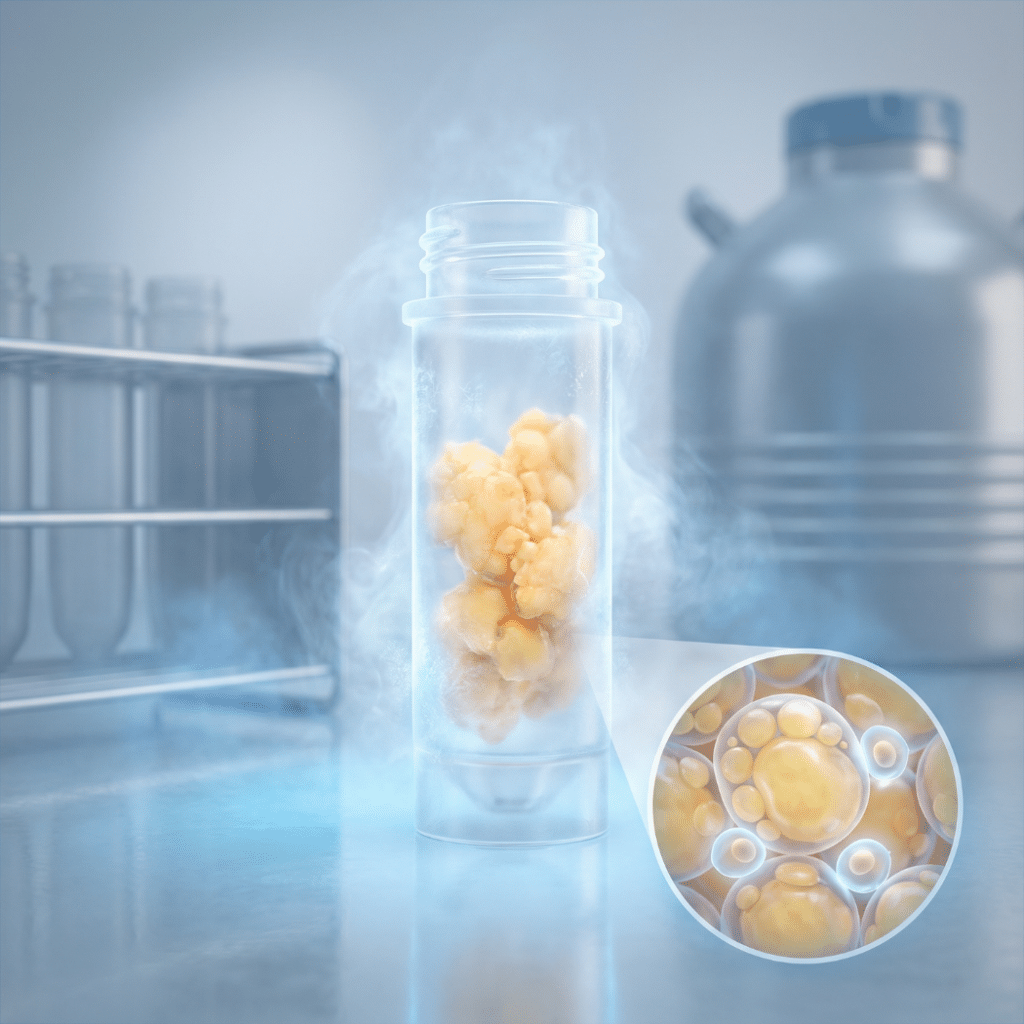
Cryopreservation is the scientific process that makes adipose tissue banking possible. Rather than simply freezing fat, cryopreservation uses protective agents and controlled cooling rates to preserve living cells for potential future use. This guide explains what happens at the cellular level during freezing, what protocols are used, what the published viability data shows, and what patients should understand before banking tissue.
TLDR: Cryopreservation is a validated scientific process that uses cryoprotective agents and controlled cooling rates to preserve adipose tissue and its stem cell populations for potential future use. Published research shows post-thaw viability rates of 80 to 91% using standard protocols, with some studies documenting viable cells after a decade of storage. Understanding the science helps patients evaluate tissue banking options with realistic expectations.
Important Disclaimer: Save My Fat does not provide FDA-approved treatments or cures for any disease. Banking adipose tissue does not guarantee eligibility, access, or clinical benefit from any future therapy, clinical trial, or medical program. All content is for educational purposes only and does not constitute medical advice. Patients must consult their own licensed healthcare professionals regarding all medical decisions.
What actually happens to tissue when it is frozen? Is it still alive in there? These are among the most common questions patients ask when considering adipose tissue banking. The answers lie in cryobiology, the science of preserving biological material at ultra-low temperatures. This guide walks through that science step by step.
What Is Cryopreservation?
Cryopreservation is a controlled scientific process for cooling and storing biological tissue at extremely low temperatures while maintaining cell viability. It is fundamentally different from simply putting tissue in a freezer.
Uncontrolled freezing destroys living tissue. Water inside and around cells forms large ice crystals that puncture cell membranes, rupture internal structures, and render the tissue biologically useless. Cryopreservation prevents this by using protective chemical agents and carefully controlled cooling rates to minimize ice crystal formation and preserve cellular integrity.
Cryopreservation has been used in medicine since the 1950s. Blood products, sperm, embryos, and cord blood are all routinely cryopreserved for clinical use. The same core principles now apply to the preservation of adipose tissue and its stem cell populations. For a detailed look at what adipose-derived stem cells are and why they are of scientific interest, see the companion guide: What Are Adipose-Derived Stem Cells?
The Cellular Challenge: Why Freezing Can Damage Tissue
To understand why cryopreservation protocols are so carefully controlled, it helps to understand what goes wrong during uncontrolled freezing. There are four main threats to cells during the freezing process.
Ice crystal formation is the most destructive. When water freezes without protection, it forms sharp crystals inside and outside cells. Intracellular ice (crystals forming inside the cell) is almost always lethal to the cell. Extracellular ice (crystals forming outside) can crush cells by compressing them between expanding ice structures.
Osmotic stress occurs because freezing concentrates salts and other solutes in the remaining liquid water. This creates a chemical imbalance that pulls water out of cells, causing severe dehydration.
Cell membrane damage results from both mechanical pressure (ice crystals) and chemical stress (concentrated solutes). Once the lipid bilayer membrane is breached, the cell cannot maintain its internal environment.
Dehydration from osmotic water loss can permanently alter protein structures and internal cell components.
Unprotected Freezing vs. Cryopreservation
| Factor | Unprotected Freezing | Cryopreservation |
|---|---|---|
| Ice crystal formation | Large intracellular crystals form | Minimized by CPAs and controlled cooling |
| Cell membrane integrity | Frequently ruptured | Largely preserved |
| Osmotic stress | Severe, uncontrolled | Managed through CPAs and cooling rate |
| Post-thaw viability | Very low | 80 to 91% (published data) |
| Stem cell function | Lost | Proliferation and differentiation retained |
| Practical utility | None | Potential future research and clinical use |
Sources: Shu et al., 2015; Tsekouras et al., 2018
Cryoprotective Agents: How Science Protects Your Cells
Cryoprotective agents (CPAs) are chemicals added to tissue before freezing to prevent ice crystal damage. They work through two main mechanisms: permeating CPAs enter the cell and partially replace intracellular water, reducing the amount of water available to form ice. Non-permeating CPAs remain outside the cell and stabilize the cell membrane.
DMSO: The Standard
Dimethyl sulfoxide (DMSO) is the most widely used CPA in stem cell cryopreservation. It permeates cell membranes and prevents intracellular ice formation. Published research shows that DMSO concentrations between 5% and 10% produce no significant differences in ADSC viability (Thirumala et al., 2010).
DMSO does have limitations. It can be toxic to cells at temperatures above 4 degrees Celsius, so it must be added and removed quickly at controlled temperatures. Before any clinical application, DMSO must be washed out of the cell preparation.
Alternatives to DMSO
Researchers are developing CPA alternatives that may avoid DMSO’s toxicity concerns:
- Trehalose, a non-toxic sugar, stabilizes cell membranes from the outside. Published research from as early as 2005 showed trehalose provided better long-term preservation than simple freezing without any CPA (Trehalose in adipose cryopreservation, 2005).
- L-proline combined with trehalose maintained ADSC viability equivalent to DMSO after 90 days in published research (Zanata et al., 2023).
- Hydroxyethyl starch (HES) produced results similar to fresh tissue in viability and tissue structure at -80 degrees Celsius in a murine model (Yildirim et al., 2021).
- Chemically defined, xeno-free media (containing no animal-derived components) restored plating efficiency to unfrozen control levels while retaining multipotency and chromosomal normality (Devireddy et al., 2016).
- TGM solution (a novel metformin-based approach published in 2025) showed reduced apoptosis and improved retention rates in early research (TGM cryopreservation, 2025). This is very early-stage research and requires further validation.
Cryoprotective Agent Comparison
| CPA | Mechanism | Effectiveness | Safety Profile | Status |
|---|---|---|---|---|
| DMSO (5-10%) | Permeates cell, prevents ice | 80-91% post-thaw viability | Toxic above 4 degrees C; requires removal | Standard protocol |
| Trehalose | Stabilizes membranes externally | Better than no CPA; comparable with optimization | Non-toxic, no removal required | Emerging |
| L-proline + trehalose | Dual protection mechanism | Equivalent to DMSO at 90 days | Non-toxic | Research stage |
| HES | Replaces extracellular water | Similar to fresh tissue at -80 degrees C | Non-toxic | Research stage |
| Xeno-free defined media | Chemically defined protection | Equivalent to unfrozen controls | Clinical-grade, no animal products | Validated in studies |
| TGM (metformin-based) | Anti-apoptotic, membrane protection | Reduced cell death, improved retention | Very early data | Early research |
Sources: Thirumala et al., 2010; Zanata et al., 2023; Yildirim et al., 2021; Devireddy et al., 2016
The Controlled-Rate Freezing Protocol
The cooling rate during freezing is as critical as the CPA used. Cooling too fast causes intracellular ice formation. Cooling too slowly causes excessive dehydration as water is drawn out of cells by the growing extracellular ice front.
The published optimal cooling rate for adipose-derived stem cells is 1 to 2 degrees Celsius per minute (Shu et al., 2015).
Step-by-Step Protocol
The standard controlled-rate freezing process follows these steps:
- Cell preparation: Cells are suspended in cryopreservation medium at a defined concentration (typically around 1 million cells per milliliter for isolated ADSCs, or as intact lipoaspirate for whole-tissue banking)
- CPA addition: The cryoprotective agent is added at controlled temperatures (at or below 4 degrees Celsius for DMSO)
- Transfer to storage vessels: Cells are loaded into cryovials (small tubes, typically 1 to 2 mL) or cryobags (for larger volumes up to 100 mL)
- Controlled cooling: Temperature drops at 1 to 2 degrees Celsius per minute, using either a programmable controlled-rate freezer or a passive cooling device (such as an isopropanol-based container placed in a -80 degrees Celsius freezer)
- Short-term hold at -80 degrees Celsius: Tissue can be held overnight or for short periods at this temperature
- Transfer to long-term storage: Tissue is moved to liquid nitrogen (-196 degrees Celsius) or vapor phase storage (-140 to -180 degrees Celsius) for long-term preservation
For information on how Save My Fat implements cryopreservation protocols, visit the how stem cell banking works page.
Storage: What Happens at -196 Degrees Celsius
Long-term tissue storage relies on bringing biological activity to a complete halt. At liquid nitrogen temperature (-196 degrees Celsius), all enzymatic reactions stop, no metabolic processes occur, and no degradation takes place. The tissue is, in effect, in biological suspended animation.
Two main storage methods are used:
Liquid phase storage submerges cryovials directly in liquid nitrogen at -196 degrees Celsius. This provides the most stable temperature but carries a small risk of cross-contamination between samples if vials are not hermetically sealed.
Vapor phase storage keeps cryovials in the nitrogen vapor above the liquid surface, typically at -140 to -180 degrees Celsius. This is the preferred method for clinical-grade storage because it eliminates cross-contamination risk while maintaining temperatures well below the critical threshold for biological activity.
Storage Temperature Comparison
| Storage Temperature | Method | Biological Activity | Practical Duration | Published Viability Data |
|---|---|---|---|---|
| 4 degrees C | Refrigerator | Active, slow degradation | Hours to days | Near-fresh, short-term only |
| -80 degrees C | Ultra-low freezer | Greatly reduced | Up to 9 to 18 months | >80% at 9 months (Miyagi-Shiohira et al.) |
| -150 degrees C | Ultra-low freezer | Effectively halted | 18+ months | >85% at 18 months (Miyagi-Shiohira et al.) |
| -196 degrees C | Liquid nitrogen | Completely halted | Theoretically indefinite | >90% at 24 months in cryobags; decade-long data published (Tsekouras et al.) |
Sources: Miyagi-Shiohira et al., 2021; Tsekouras et al., 2018
Quality tissue banking facilities maintain continuous temperature monitoring, alarm systems, and backup nitrogen supplies to protect stored samples.
Thawing: The Other Half of the Equation
The thawing protocol is as important as the freezing protocol. Poor thawing can destroy cells that survived freezing perfectly.
Rapid thawing is the standard. Cryovials are placed in a 37 degrees Celsius water bath and thawed quickly (typically in 1 to 2 minutes) to minimize the time cells spend in the temperature range where recrystallization (ice reforming into damaging large crystals) can occur.
After thawing, DMSO must be removed through a series of dilution and washing steps before cells can be used for any purpose. CPA alternatives like trehalose do not require this removal step, which is one reason researchers are interested in them.
An important practical point: banked tissue does not need to be thawed all at once. If tissue is stored across multiple cryovials, individual vials can be thawed as needed while the remainder stays in storage. This allows for staged use over time.
Published Viability Data: What the Research Shows
This section summarizes published research on post-thaw viability of cryopreserved adipose tissue and ADSCs.
| Study | Storage Duration | Storage Temp | CPA Used | Post-Thaw Viability | Key Finding |
|---|---|---|---|---|---|
| Standard DMSO protocol | 3 months | -196 degrees C | 10% DMSO | 80-91% | Viability maintained |
| Standard DMSO protocol | 1 year | -196 degrees C | 10% DMSO | ~90% | Reliable long-term |
| Miyagi-Shiohira et al. 2021 | 18 months | -150 degrees C | DMSO/CP-1 | >85% | High density optimal |
| Miyagi-Shiohira et al. 2021 | 24 months | -150 degrees C | DMSO | >90% (cryobag) | Large-scale storage validated |
| Miyagi-Shiohira et al. 2021 | 9 months | -80 degrees C | No DMSO | >80% | Suboptimal conditions still viable |
| Tsekouras et al. 2018 | 10+ years | -196 degrees C | DMSO | No significant difference from fresh | Immunophenotype, proliferation, differentiation preserved |
| Zanata et al. 2023 | 90 days | -80 degrees C | L-proline + trehalose | Equivalent to DMSO | Non-toxic alternative validated |
| Yildirim et al. 2021 | Variable | -80 degrees C | HES | Similar to fresh | Tissue structure preserved |
| Devireddy et al. 2016 | Variable | Variable | Xeno-free media | Equivalent to unfrozen controls | Multipotency and chromosomal normality retained |
| Shaik et al. 2019 | Up to 44 months | Cryogenic | Standard | Cellular components maintained | Intact lipoaspirate banking validated |
Sources: Tsekouras et al., 2018; Miyagi-Shiohira et al., 2021; Zanata et al., 2023; Yildirim et al., 2021; Devireddy et al., 2016; Shaik et al., 2019
The Tsekouras et al. (2018) study is particularly notable: ASCs stored frozen for over a decade showed no significant differences from fresh ASCs in immunophenotype, proliferation capacity, or differentiation potential. This is among the strongest published evidence for long-term cryopreservation viability.
Important context: High post-thaw viability means cells survive the freeze-thaw process with their basic biological properties intact. It does not guarantee that banked tissue will produce any specific clinical outcome, qualify for any particular clinical trial, or be suitable for any future therapeutic application. More long-term data continues to accumulate. Individual results may vary based on tissue quality, processing methods, and storage conditions.
Active Research Using Cryopreserved Adipose Tissue
Clinical trials are currently using cryopreserved adipose tissue in active research. For example, trial NCT06747715 is studying autologous fresh fat grafting followed by autologous cryopreserved fat grafting, using adipose tissue stored at -80 degrees Celsius. Published GMP-compliant protocols for cryopreserving native adipose tissue for direct clinical use have also been documented (GMP cryopreserved adipose tissue, 2024).
These examples demonstrate that cryopreserved adipose tissue is being used in real-world research settings. However, clinical trials are research studies, not treatment programs. Being listed on ClinicalTrials.gov does not mean a product is proven safe, effective, or FDA-approved. For more on the research landscape, visit the emerging research page.
What to Look for in a Tissue Banking Facility
Patients considering adipose tissue banking should ask potential facilities about their cryopreservation protocols. Key questions include:
- What cryoprotective agent is used, and at what concentration?
- What is the controlled-rate freezing protocol, and is it validated?
- At what temperature is tissue stored long-term? (Liquid nitrogen or vapor phase is the gold standard.)
- What monitoring and backup systems are in place for storage equipment?
- What are the facility’s published or internal viability data?
- Does the facility follow current Good Tissue Practice (cGTP) standards under 21 CFR Part 1271?
- What is the chain-of-custody documentation process?
The FDA regulates tissue banking under its HCT/P framework. Facilities handling human tissue must register with the FDA and comply with applicable regulations.
Learn more about Save My Fat’s approach on the about page and the how stem cell banking works page. For questions about pricing or to connect with a provider, visit the providers page.
Frequently Asked Questions
What is cryopreservation, and how is it different from regular freezing? Cryopreservation is a controlled process that uses protective chemical agents and carefully managed cooling rates to preserve living cells. Regular freezing allows large ice crystals to form, destroying cells. Cryopreservation is designed to prevent this damage.
What happens to my cells at the molecular level during freezing? As temperature drops, water inside and around cells begins to freeze. Without protection, ice crystals puncture cell membranes and cause fatal osmotic stress. Cryoprotective agents replace some intracellular water and stabilize membranes, allowing cells to survive the transition to ultra-low temperatures.
Is DMSO safe? DMSO is the most widely used cryoprotective agent in stem cell preservation and has decades of clinical track record. It can be toxic at temperatures above 4 degrees Celsius, so protocols require controlled addition and removal. It must be washed out before any clinical use. Alternatives like trehalose are being developed.
How long can adipose tissue be stored while maintaining viability? Published research shows viability rates of 80 to 91% with standard protocols at one year. At least one study has documented no significant differences between decade-frozen and fresh ADSCs (Tsekouras et al., 2018). At liquid nitrogen temperatures, biological activity ceases completely, supporting theoretically indefinite storage. Long-term data continues to accumulate.
What are the published viability rates after thawing? Published rates range from approximately 80% to over 90% depending on the CPA used, cooling rate, storage temperature, and duration. Individual results may vary based on tissue quality and processing methods.
Can tissue be refrozen after thawing? Refreezing previously thawed tissue is generally not recommended, as each freeze-thaw cycle damages cells. This is why tissue is typically stored in multiple small vials, allowing individual portions to be thawed as needed while the rest remains frozen.
Does the person’s age affect cryopreservation success? Published research, including studies with donors aged 8 to 82, shows that age does not significantly impact the ability to isolate viable ADSCs from cryopreserved tissue. However, banking earlier in adulthood preserves tissue at a younger biological age. Visit the wellness and healthy aging page for more context.
What is the difference between cryopreserving whole adipose tissue vs. isolated ADSCs? Whole tissue banking preserves the complete lipoaspirate (including ADSCs, other cell types, and the supporting matrix) without enzymatic processing. Isolated ADSC banking involves separating and culturing the stem cells before freezing. Both approaches have published viability data. Whole tissue banking may carry regulatory advantages because it avoids the “more than minimal manipulation” classification.
Can cryopreserved tissue still be used for research or clinical applications? Published research demonstrates that properly cryopreserved ADSCs retain their proliferation capacity, differentiation potential, and cell surface markers. Active clinical trials are using cryopreserved adipose tissue. However, cryopreservation does not guarantee eligibility for any specific trial or future therapy.
Can family members use my banked tissue? First-degree family members may potentially qualify to use banked cells under certain guidelines. Visit the family page for more information.
Key Takeaways
Cryopreservation Is Not the Same as Freezing
- Cryopreservation uses protective agents and controlled cooling to preserve living cells
- Uncontrolled freezing destroys cells through ice crystal formation
Published Viability Rates Support Long-Term Storage
- Standard protocols achieve 80 to 91% post-thaw viability
- At least one study shows no significant differences between decade-frozen and fresh ADSCs
Multiple Cryoprotective Options Exist
- DMSO is the standard, but trehalose, L-proline combinations, and xeno-free media show promise
- Research into non-toxic alternatives continues to advance
Cooling Rate and Storage Temperature Are Critical
- Optimal cooling rate: 1 to 2 degrees Celsius per minute
- Liquid nitrogen or vapor phase storage (-140 to -196 degrees Celsius) halts all biological activity
Viability Does Not Equal Guaranteed Outcomes
- High post-thaw viability means cells survived freezing with their properties intact
- It does not guarantee any specific therapeutic result, trial eligibility, or clinical benefit
Ask Questions Before Banking
- Evaluate facilities based on their protocols, viability data, storage methods, and regulatory compliance
Learn More About Adipose Tissue Banking
Before contacting Save My Fat: Adipose tissue banking is a preservation service for potential future opportunities, not a treatment or cure for any disease. Outcomes cannot be guaranteed. All medical decisions must be made with a licensed healthcare provider.
Visit the how stem cell banking works page for an overview of the process.
For the complete guide to adipose tissue banking, see What Is Adipose Tissue Banking?.
For information on the research areas being studied, visit the joint and orthopedic page.
Healthcare providers can visit the providers page.
Last updated: March 7, 2026
Related guide: the stem cell science glossary.