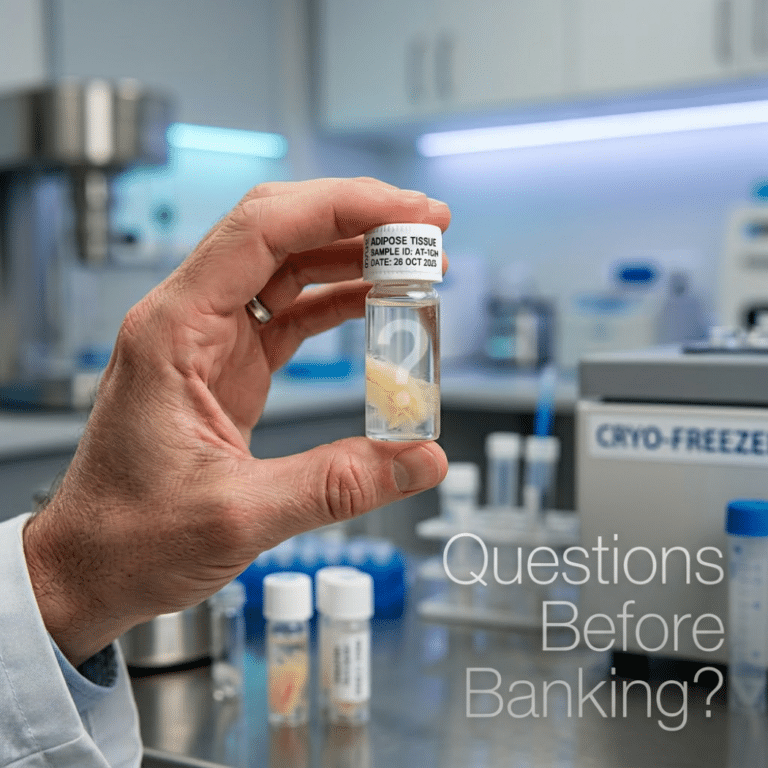
Choosing an adipose tissue banking service is a significant financial and medical decision, and not all services operate at the same level of regulatory compliance, scientific rigor, or transparency. This guide provides a practical checklist of the specific questions every patient should ask before committing to any tissue banking service, and explains what a strong, trustworthy answer looks like alongside what should raise concern. These questions apply to any service you are evaluating, including Save My Fat, and a legitimate service should welcome every one of them.
TLDR: Every tissue banking service should be able to answer clearly: whether it is FDA-registered, how tissue is processed and why that affects regulatory classification, what cryopreservation protocol and viability data it uses, what quality control and sterility testing it performs, what the complete financial commitment involves, and what banking does and does not guarantee. A legitimate service welcomes scrutiny. Red flags include inability to produce an FDA registration number, vague answers about processing, and any suggestion that banking guarantees future treatment access. Read on for the complete checklist with explanations.
Important Disclaimer: Save My Fat does not provide FDA-approved treatments or cures for any disease or medical condition. Adipose tissue banking is a preservation service for potential future opportunities, not a therapeutic product. Banking adipose tissue today does not guarantee eligibility, access, or clinical benefit from any future therapy, clinical trial, or medical program. All content here is for educational and informational purposes only and does not constitute medical advice. Patients must consult their own licensed healthcare professionals regarding all medical decisions. Outcomes of any regenerative medicine research or future therapies are highly individual and cannot be predicted or guaranteed.
Adipose tissue banking is not a casual purchase. It involves a minor surgical procedure, a relationship with a company that will hold your biological material potentially for decades, ongoing annual storage fees, and a set of expectations about what that stored tissue might one day make possible. A decision of that magnitude deserves the same careful evaluation you would apply to any significant long-term financial and health commitment.
The regenerative medicine space has attracted both legitimate, compliance-focused services and services that operate with insufficient regulatory rigor, make misleading marketing claims, or cannot answer basic questions about their own protocols. The same questions that identify a legitimate service reliably reveal the ones that should not be trusted. And here is the reassuring part: a trustworthy banking service will not only tolerate every question on this list. It will have clear, specific, well-documented answers to all of them.
This article organizes those questions into five categories: regulatory compliance and FDA registration, cryopreservation protocols and viability data, quality control and chain of custody, financial terms and long-term commitment, and realistic expectations. For each question, the article explains why it matters and what a strong answer looks like versus what should concern you.
Category 1: Regulatory Compliance and FDA Registration
These are the most fundamental questions, and no answer to them should be vague.
Question 1: Are you registered with the FDA as an HCTP establishment?
Under 21 CFR Part 1271, any establishment that recovers, processes, stores, or distributes human cells, tissues, or cellular and tissue-based products must register with the FDA. This is not optional, and it is not a formality. It is a legal requirement that creates accountability, mandates compliance with current good tissue practices (CGTP), and makes the facility subject to FDA inspection. The registration can be verified independently through the FDA's HCTP establishment database.
A strong answer provides the FDA establishment registration number and actively encourages you to verify it. A red flag is any response along the lines of “we comply with all regulations” without producing a registration number, or a claim that FDA registration is not required for their specific service.
Question 2: How is my tissue processed after collection, and does that processing affect your regulatory classification?
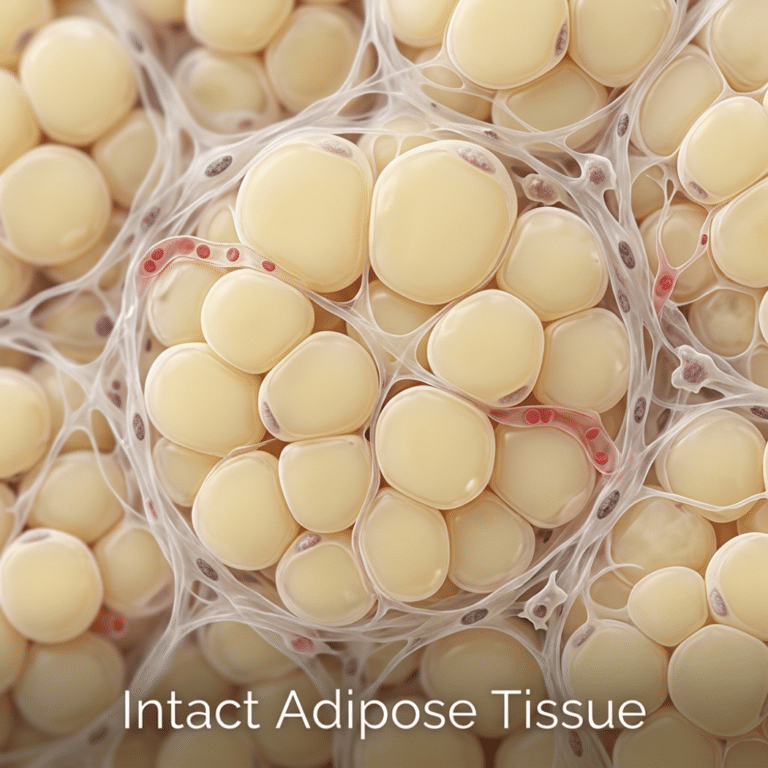
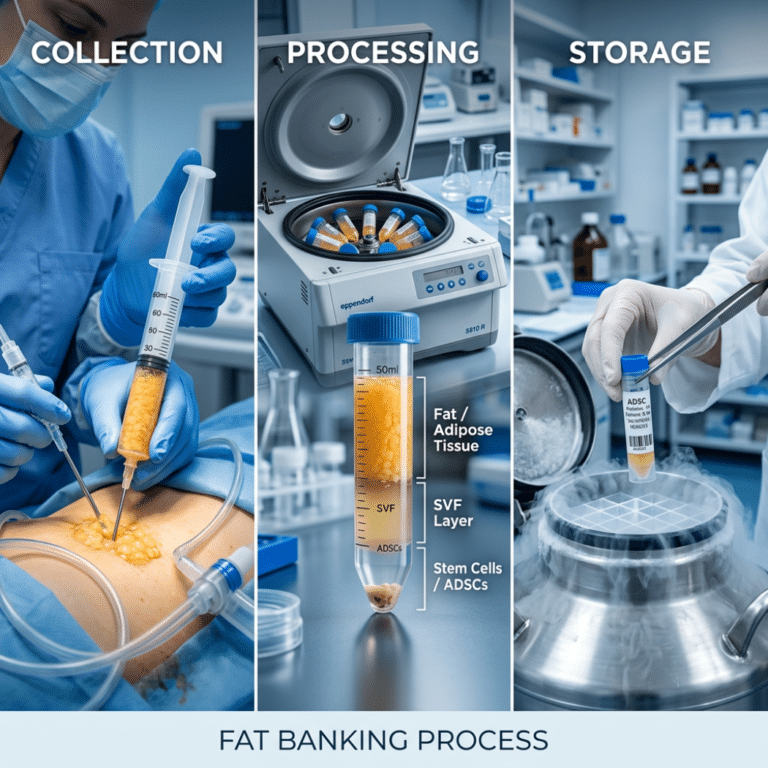
This is the single most important processing question, and the answer has direct legal consequences. The FDA’s November 2017 guidance on Minimal Manipulation and Homologous Use classifies adipose tissue as structural tissue and has determined that enzymatic digestion to isolate SVF (stromal vascular fraction) constitutes more than minimal manipulation, triggering the more restrictive Section 351 biologics pathway. Banking intact tissue through washing, centrifugation, and cryopreservation without enzymatic digestion may qualify under the less restrictive Section 361 HCTP pathway. Three federal circuit courts between 2014 and 2024 have confirmed FDA authority over enzymatically processed SVF products, and the Supreme Court declined to hear a challenge to the most recent ruling in 2025.
A strong answer describes the specific processing steps in detail, names the reagents used or explicitly not used (particularly whether collagenase or other enzymes are involved), and can explain which regulatory pathway the service operates under and why. A red flag is a claim that enzymatic SVF processing is legally equivalent to intact tissue banking because it uses the patient’s own cells, or an inability to name the exact processing steps.
Question 3: Has your facility received any FDA warning letters, and how can I verify that?
The FDA publishes its warning letters publicly and searchably. A service with unresolved warning letters for unapproved marketing claims, CGTP non-compliance, or processing violations deserves careful scrutiny. A strong answer gives you the legal entity name used for FDA filings and directs you to the FDA warning letter database. Defensiveness about this question, or discouraging independent verification, is itself informative.
| Question | What You Are Checking | Where to Verify |
|---|---|---|
| FDA establishment registration | Whether the facility is legally registered and subject to CGTP requirements | FDA HCTP establishment database |
| Processing method | Whether enzymatic digestion is used or intact tissue banking is the protocol | FDA November 2017 guidance document |
| Warning letter history | Whether the company has regulatory violations on public record | FDA warning letter database |
| Regulatory pathway | Whether the service operates under Section 361 HCTP or Section 351 biologics | Company documentation and FDA guidance |
Category 2: Cryopreservation Protocols and Viability Data
The science behind how your tissue is frozen and stored directly determines whether it will still be viable when you need it. Any banking service should be able to answer these questions with specifics, not generalities.
Question 4: What cryoprotective agent do you use, and at what concentration?
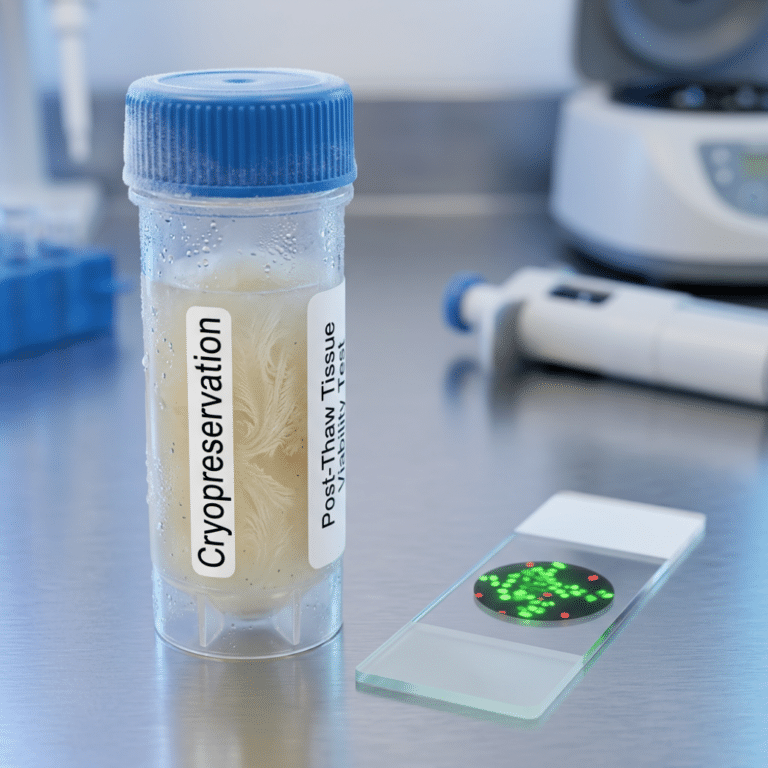
DMSO (dimethyl sulfoxide) at 5 to 10 percent is the most widely studied cryoprotective agent for adipose tissue, with published research by Thirumala and colleagues in 2010 documenting 80 to 91 percent post-thaw viability with standard protocols. Some services are developing DMSO-free alternatives using trehalose or other agents, and published research supports some of these as equivalent for shorter-term storage. DMSO must be removed through washing steps before any future clinical application. A strong answer specifies the agent, the concentration, and the published research supporting the protocol. A vague answer like “we use the best available technology” without specifying the agent is not acceptable.
Question 5: What cooling rate do you use for controlled-rate freezing, and what equipment achieves it?
The published optimal cooling rate for adipose-derived stem cells is 1 to 2 degrees Celsius per minute. Cooling too fast prevents water from leaving cells before it freezes, creating destructive intracellular ice crystals. Cooling too slowly causes damaging osmotic stress from concentrated solutes. Achieving the validated rate requires either a programmable controlled-rate freezer or a validated passive cooling container. A strong answer specifies the cooling rate and describes the equipment. A response that says “we freeze at the correct temperature” without mentioning the cooling rate is a gap worth pressing on.
Question 6: At what temperature is tissue stored long-term, and is vapor phase or liquid phase storage used?
Long-term storage requires liquid nitrogen temperatures, either -196 degrees Celsius (liquid phase) or -150 to -180 degrees Celsius (vapor phase), to halt all biological activity. Ultra-low freezers at -80 degrees Celsius slow biological degradation but do not halt it, making them suitable for short-term transit or staging but not for long-term banking of tissue intended to be viable years from now. Published research from Tsekouras and colleagues in 2018 found no significant differences from fresh tissue after over a decade of liquid nitrogen storage. Vapor phase storage is preferred for clinical-grade banking because it eliminates cross-contamination risk between samples.
Question 7: What post-thaw viability do you require before accepting a sample, and what happens if my sample does not meet that threshold?
Quality banking facilities require post-thaw viability of 85 percent or higher as part of their release criteria, consistent with published benchmarks for MSC banking. A strong answer specifies the viability threshold, names the measurement method (trypan blue exclusion or flow cytometry), and clearly describes what happens if the threshold is not met: typically, the patient is notified and recollection is discussed. No defined threshold, or no description of how viability is tested, is a meaningful gap.
| Question | What You Are Checking | Published Benchmark |
|---|---|---|
| Cryoprotective agent | Whether DMSO or a validated alternative is used at the correct concentration | Thirumala et al., 2010: 5 to 10 percent DMSO, 80 to 91 percent viability |
| Cooling rate | Whether the validated 1 to 2 degrees Celsius per minute rate is used | Shu et al., 2015 |
| Storage temperature | Whether liquid nitrogen or vapor phase is used for long-term banking | Tsekouras et al., 2018; Miyagi-Shiohira et al., 2021 |
| Post-thaw viability threshold | Whether samples must meet minimum viability before acceptance | Industry standard: 85 percent or higher |
Category 3: Quality Control, Sterility, and Chain of Custody
Quality control is where a banking service’s commitment to patient safety is either demonstrated or exposed.
Question 8: What sterility testing do you perform, and when?
Contaminated tissue cannot be used for any clinical purpose and poses serious safety risks. CGTP requirements under 21 CFR Part 1271 require sterility testing. The standard method is a 14-day culture following USP 71 protocols, conducted both pre-freeze and post-thaw. A strong answer specifies the method, the timing, and confirms that sterility is a condition for sample acceptance and release. A vague statement that samples are “tested” without specifying the method or timing is not sufficient.
Question 9: How does your chain of custody documentation work, and how is my sample identified throughout the process?
Chain of custody documentation protects against labeling errors, mix-ups, and loss of sample identity, all of which would be catastrophic in a long-term banking context. Each sample should carry a unique patient identifier through every stage from collection to cryogenic storage. A strong answer describes the specific identifier system, who has access to sample records, and how documentation is maintained and audited. An inability to describe this process in specific terms is a warning sign.
Question 10: Do you perform surface marker confirmation to verify banked cells are the correct cell type?
Flow cytometry confirms that surviving cells still express the correct surface markers for mesenchymal stromal cells: CD90, CD73, and CD105 must be positive at 95 percent or greater; CD45 must be negative at 2 percent or fewer. These are the ISCT minimal criteria established by Dominici and colleagues in 2006. This goes beyond simply counting live versus dead cells. It confirms the cells are the right type. A banking service that performs viability testing only, without phenotype confirmation, is missing an important quality layer.
Question 11: What continuous monitoring systems protect my sample, and what is your emergency protocol?
Liquid nitrogen storage requires continuous nitrogen replenishment to maintain temperature. Quality facilities maintain 24-hour automated alarm systems triggered by temperature deviation, backup nitrogen supplies (typically capable of maintaining temperature for multiple days without refill), and documented emergency response procedures. A specific description of the alarm infrastructure, the backup supply capacity, and the emergency response protocol is what a strong answer looks like.
Category 4: Financial Terms and Long-Term Commitment
Tissue banking is a long-term financial commitment, and the terms of that commitment should be entirely clear before you sign anything.
Question 12: What is the total cost, including collection, initial banking fee, and ongoing annual storage?
The all-in cost includes the collection procedure at the physician’s office (charged separately), the initial banking and processing fee, and ongoing annual storage fees that will accumulate over years or decades. Tissue banking is typically not covered by health insurance. A strong answer is a clear, itemized breakdown of all costs with no hidden fees. Reluctance to provide a full cost breakdown before commitment is a red flag.
Question 13: Who legally owns my banked tissue, and what are the exact retrieval terms?
Your tissue should remain your legal property throughout the banking relationship. The service agreement should clearly state that the facility is a custodian, not an owner, and should specify the exact regulatory conditions that must be met for release, the process for requesting retrieval, and the timeline. Ambiguous ownership language, or conditions on retrieval that are not clearly defined, creates legal vulnerability.
Question 14: What happens to my banked tissue if the company closes, is sold, or ceases operations?
This is the question most patients never ask, and it is among the most important. A legitimate service that is genuinely committed to being a long-term custodian of your biological material will have a documented continuity plan. That plan should specify where samples would be transferred, the timeline for patient notification, and what options patients would have. “That will never happen” is not an answer. No documented continuity plan is a serious gap.
Question 15: What are your policies on sample use by family members, and are those terms written into my agreement?
Under applicable FDA regulations, banked tissue may potentially be used by first or second degree blood relatives in certain circumstances. The terms governing this should be clearly defined in writing, not in verbal assurances. A strong answer provides written contractual language specifying which family members may potentially be eligible, under what conditions, and what regulatory pathway would govern any such use.
| Question | What You Are Checking | Why It Matters |
|---|---|---|
| Total cost breakdown | Full all-in cost with no hidden fees | Prevents surprise costs in an ongoing financial commitment |
| Tissue ownership | Whether tissue legally remains yours throughout the relationship | Protects retrieval rights |
| Company continuity plan | What happens to samples if the company closes | Protects long-term sample security |
| Family member terms | Whether any family access terms are in writing | Ensures verbal promises are enforceable |
Category 5: Realistic Expectations
Any banking service that promises more than tissue preservation is telling you what you want to hear, not what is true.
Question 16: Does banking my tissue guarantee access to any treatment, clinical trial, or medical program?
No. Banking preserves tissue. It does not guarantee that a future FDA-approved therapy will exist for your condition, that you will be eligible for any clinical trial, that your banked tissue will meet any future protocol’s specifications, or that any ADSC product will ever be approved for any disease. A strong answer is a direct “no,” followed by an honest explanation of what banking does provide: preserved tissue at its current biological state, preserved optionality, and the potential to participate in future FDA-regulated pathways if they become available and you qualify. Any response that implies banking creates an entitlement to future treatment is a red flag.
Question 17: What is the current FDA approval status of any ADSC-based therapy?
As of April 2026, no adipose-derived stem cell product is FDA-approved to treat any disease in the United States. A banking service that implies otherwise is making a factually false claim. A strong answer acknowledges this directly and explains that the research landscape continues to evolve. For context on the research currently under way, the emerging research and clinical trials landscape is a relevant resource.
Question 18: What do you see as the most realistic pathway through which my banked tissue might be used?
This question tests whether a service is honest about uncertainty. A legitimate answer acknowledges what is unknown, explains the legitimate pathways that currently exist (future FDA-approved therapies that may emerge from active clinical trials, participation in a trial for which you become eligible, or Expanded Access through a qualifying sponsor), and makes no timeline guarantees. For more detail on how legitimate access pathways work, the guide to Expanded Access programs is a useful companion resource.
| Claim | Legitimate or Red Flag |
|---|---|
| “Banking does not guarantee access to any treatment” | Legitimate: honest and accurate |
| “No ADSC product is FDA-approved for disease treatment as of April 2026” | Legitimate: factually accurate |
| “Your tissue will be available if legitimate opportunities arise” | Legitimate: accurately describes what banking provides |
| “Banking connects you to clinical trials” | Red flag: clinical trial eligibility depends on many factors separate from tissue storage |
| “FDA approval for ADSC therapies is imminent” | Red flag: regulatory timelines cannot be predicted |
| “Your banked tissue will treat [specific condition]” | Red flag: treatment claim for an unapproved product |
Red Flags: Signs a Service May Not Be Legitimate
Cannot provide an FDA establishment registration number. Registration is a legal requirement under 21 CFR Part 1271, not a selling point. A facility that cannot produce this number should not be trusted with your biological material.
Claims that enzymatically processed SVF banking is regulatory equivalent to intact tissue banking. The FDA and three federal courts have determined otherwise. This claim is either uninformed or misleading.
Makes disease treatment claims. No ADSC product is FDA-approved for any disease. Any service claiming its banking process treats, cures, or prevents disease is making an illegal marketing claim under FDA and FTC standards.
Vague or defensive answers about processing methods. A legitimate service can describe exactly what happens to your tissue at every step. Vagueness about processing is a meaningful gap.
No defined viability threshold or sterility testing protocol. Quality control is a non-negotiable baseline for a facility holding biological material over the long term.
No documented continuity plan for company closure. Legitimate long-term custodians plan for this scenario because the stakes for patients are high.
Pressure tactics. “Limited spots available,” prices increasing soon, or other urgency framing for a long-term banking commitment are consumer protection red flags under FTC guidance.
Testimonials claiming cures or disease reversal. Testimonials with medical efficacy claims for unapproved products violate FTC standards. The FTC Health Products Compliance Guidance explains these requirements in detail.
Cannot identify the specific regulatory pathway they operate under. Every HCTP banking facility should be able to explain clearly whether it operates under Section 361 or Section 351 and the specific reasoning.
Heavy reliance on marketing language instead of scientific specifics. A banking service’s value lies in its protocols, its compliance posture, and its quality controls, not its brand story.
How to Verify a Banking Service Independently
- Verify FDA establishment registration. Search the FDA’s HCTP establishment registration database by facility name. The facility should be listed as a registered establishment.
- Search for FDA warning letters. Use the FDA warning letter database to search by company name. Look for any letters related to unapproved marketing claims, CGTP violations, or processing non-compliance.
- Verify any ClinicalTrials.gov claims. If a service claims association with specific clinical trials, verify the registration independently at ClinicalTrials.gov. Confirm the trial is active, the sponsor is named, and the banking service’s role is accurately described.
- Read the service agreement before signing. The agreement should specify tissue ownership, retrieval terms, storage fees, the continuity plan, and family member access terms in writing. Verbal assurances are not enforceable.
- Consult your physician. Discuss the banking decision with your primary care physician or a specialist familiar with regenerative medicine before proceeding.
- Review the FDA consumer guidance. The FDA’s published information about unapproved regenerative medicine products is available at the FDA consumer alert on regenerative medicine products including stem cells and exosomes.
- Review FTC guidance on health product advertising. The FTC Health Products Compliance Guidance explains what health marketing claims are required to be substantiated and what practices are prohibited.
Frequently Asked Questions
Is adipose tissue banking regulated by the FDA?
Yes. Tissue banking in the United States is regulated under 21 CFR Part 1271. HCTP banking facilities must register with the FDA and comply with CGTP requirements. The specific regulatory pathway, Section 361 or Section 351, depends on how tissue is processed. Intact tissue banking may qualify under Section 361, while enzymatically processed SVF triggers the more restrictive Section 351 pathway requiring IND authorization for any clinical investigation.
What does FDA establishment registration mean and how do I verify it?
FDA establishment registration means the facility has formally notified the FDA of its operations, is subject to CGTP compliance requirements, and can be inspected. It does not mean the FDA has approved the banking service as a treatment. Patients can verify any facility’s registration independently through the FDA’s HCTP establishment database. A facility that cannot produce its registration number should not be trusted with your biological material.
Is tissue banking covered by insurance?
Tissue banking is typically not covered by health insurance. It is a preservation service for potential future use, not a treatment for a current condition, and insurance coverage generally applies to medically necessary current care. Patients should confirm directly with their insurance provider and plan for the complete out-of-pocket cost including the collection procedure, the initial banking fee, and ongoing annual storage fees.
What happens to my banked tissue if I die?
This is an important question to ask before signing any banking agreement. The answer depends on the specific service agreement. Patients should confirm that the agreement specifies next-of-kin or designated beneficiary rights, what happens if no designee is named, and whether first or second degree family members may be eligible to access the tissue under applicable regulations. These terms should be contractual, not verbal. Raise this question before signing.
Should I bank with a service that also offers SVF processing or direct stem cell injections?
Ask specifically whether those additional services operate under an IND. Services that offer enzymatically processed SVF or direct stem cell injections for disease treatment without an IND are not operating in compliance with FDA regulations. Ask whether the banking component and any treatment component are legally separated and what regulatory pathway each operates under. The FDA has issued a consumer alert specifically about unapproved SVF and stem cell products, and three federal courts have confirmed FDA authority to regulate and enjoin such services.
Does Save My Fat welcome these questions?
Yes. Save My Fat banks intact adipose tissue without enzymatic digestion, operates under 21 CFR Part 1271 CGTP requirements, does not offer treatments for any disease, and provides educational resources so patients can make fully informed decisions. Patients are encouraged to apply every question on this checklist to any banking service, including Save My Fat, and to verify answers independently. For details on the banking process, the complete guide to adipose tissue banking and the overview of how stem cell banking works provide specifics on what Save My Fat does at each stage.
Key Takeaways
FDA registration is not optional. Any HCTP banking facility must be registered with the FDA under 21 CFR Part 1271. Verify this independently before committing to any service.
Processing method has direct regulatory consequences. Enzymatic digestion triggers Section 351 and requires an IND for clinical investigation. Intact tissue banking may qualify under Section 361. Ask which applies and why.
Cryopreservation protocols should be specific and backed by published research. Ask for the exact cryoprotective agent, the cooling rate, the storage temperature, and the viability threshold. Vague answers are a warning sign.
The financial commitment is long-term and must be in writing. Get a complete cost breakdown, confirm tissue ownership in the agreement, and verify the documented continuity plan for company closure before signing.
No banking service can guarantee access to any future treatment. Any service implying otherwise is making a claim that is not scientifically or legally accurate. As of April 2026, no ADSC product is FDA-approved to treat any disease.
A legitimate service welcomes every question on this list. Transparency is the most reliable distinguishing feature of a trustworthy banking service. Defensiveness about these questions is itself informative.
Medical Disclaimer
Save My Fat does not provide FDA-approved treatments or cures for any disease or medical condition. Banking adipose tissue is a tissue preservation service for potential future opportunities that may arise as regenerative medicine science and FDA regulations evolve. It is not a therapeutic product and does not provide clinical benefit. Banking does not guarantee eligibility, access, or benefit from any future therapy, clinical trial, or medical program. All content in this article is for educational and informational purposes only and does not constitute medical advice. Patients must consult their own licensed healthcare professionals regarding all medical decisions.
Learn More
For a complete explanation of the banking process itself, the complete guide to adipose tissue banking and the detailed step-by-step overview of how adipose tissue banking works cover each stage from collection through long-term storage. For the patient-facing introduction, the For Patients section is the starting point. For providers considering offering banking to their patients, the For Providers section covers the service relationship. For background on the cells that banking preserves, the patient’s guide to adipose-derived stem cells covers the biology.
This article is for educational purposes only and does not constitute medical or legal advice. Legal review is recommended before publication. Please consult your licensed healthcare provider regarding all relevant decisions.
Last Updated: April 11, 2026