
You have probably seen the words “Phase 1” or “Phase 3” attached to a clinical trial and wondered what they actually tell you. The labels show up in news headlines, on ClinicalTrials.gov search results, and in marketing materials from clinics with very different motives. Understanding what each phase means, what it does not mean, and how phase status applies to regenerative medicine research can help you read the research landscape more honestly and make better decisions about your own health planning.
This guide walks through all four phases of clinical trial development in plain language, explains where adipose-derived stem cell (ADSC) research currently sits in that spectrum, and describes what phase status should and should not mean when you are thinking about tissue banking.
TLDR: Clinical trials are organized into four phases, each designed to answer a different scientific question. Phase 1 tests safety and dosing. Phase 2 looks for early signals of effectiveness. Phase 3 confirms results in large populations. Phase 4 monitors long-term outcomes after FDA approval. Most ADSC research is currently in Phase 1 or Phase 2, which means the science is still developing. Understanding these phases helps you evaluate research claims critically and protect yourself from misleading marketing.
Important Disclaimer: Save My Fat does not provide FDA-approved treatments or cures for any disease or medical condition. Adipose tissue banking is a preservation service for potential future opportunities, not a therapeutic product. Banking adipose tissue today does not guarantee eligibility, access, or clinical benefit from any future therapy, clinical trial, or medical program. Any future use depends on the regulatory status of products or procedures at that time, the patient’s clinical situation, physician guidance, and availability of FDA-regulated pathways. All content is for educational and informational purposes only and does not constitute medical advice, diagnosis, or treatment recommendations. Patients must consult their own licensed healthcare professionals regarding all medical decisions.
When you search ClinicalTrials.gov and find a study that looks promising, the phase designation is one of the first pieces of information you see. But the number sitting next to the word “Phase” means very specific things scientifically, and it is frequently misrepresented, both by clinics trying to appear more credible than they are and by patients who understandably want to believe that “Phase 1 approved” means something it does not.
The phased system was not designed to frustrate patients. It exists to protect them. Each phase answers a different question, builds on the evidence from the phase before it, and requires increasing levels of rigor before a product can advance. To learn the basics of how clinical trials function and what they are designed to accomplish, see the introduction to clinical trials for regenerative medicine on the Save My Fat resource library.
This article goes deeper. It is written for people who already know that clinical trials exist and are now asking what the phase numbers actually mean in practice, particularly in the context of adipose-derived cell research.
Why Clinical Trial Phases Exist
The Core Purpose: Answering Questions in Order
New medical products do not jump directly from a laboratory bench to a doctor’s office. The FDA requires that developers follow a structured sequence of studies, each one designed to answer a specific question before the next can begin. This staged approach exists because biological therapies interact with the human body in complex ways that cell cultures and animal models cannot fully predict.
The phased system protects patients from being exposed to therapies before basic safety questions are answered. It also protects the integrity of the science by ensuring that results are built on solid foundations before claims about effectiveness are made.
Preclinical Research Comes First
Before a therapy enters any human trial, it goes through preclinical research. This stage typically involves laboratory studies (in vitro, meaning in a dish or culture) and animal studies (in vivo). Preclinical research helps researchers understand how a product behaves at a cellular level, what dose range might be appropriate, and whether obvious safety signals exist.
Preclinical results do not prove a therapy works in humans, but they are required before the FDA will authorize an Investigational New Drug (IND) application, which is the formal permission to begin human trials. For a detailed overview of the regulatory pathways that govern these studies, see the emerging research section of this site.
The Four Phases at a Glance
| Phase | Primary Question | Typical Participants | Duration |
|---|---|---|---|
| Phase 1 | Is it safe? What dose is tolerable? | 20 to 100 | Months to 1 year |
| Phase 2 | Does it show early signs of working? | 100 to 300 | 1 to 3 years |
| Phase 3 | Does it confirm effectiveness at scale? | 300 to 3,000+ | 3 to 5 years |
| Phase 4 | What happens after approval? | Thousands (real-world) | Years to decades |
This overview captures the broad structure. Each phase is described in much greater detail in the sections that follow.
Phase 1 Trials: Is It Safe?
What Phase 1 Is Designed to Do
Phase 1 trials are first-in-human studies. Their primary purpose is to determine whether a treatment is safe enough to continue studying and to identify a tolerable dose range. They are not designed to prove that a treatment works. They are not designed to show that it beats a placebo. They are designed to ensure that researchers can keep studying the treatment without causing serious harm to participants.
Most Phase 1 trials enroll between 20 and 100 participants, though the number varies by product type. For oncology trials, participants are usually patients with the target disease who have exhausted other options. For regenerative medicine and cellular therapy trials, designs vary, and some enroll healthy volunteers. Participants are monitored closely for adverse events (unwanted medical effects), which are graded and reported to the FDA throughout the study.
Phase 1 trials also explore dose escalation: researchers start at a low dose and gradually increase it to find where the risk of harm becomes unacceptable. This is called the maximum tolerated dose, and it informs the dosing strategy for future phases.
A Real ADSC Phase 1 Example
One registered Phase 1 trial investigating adipose-derived stem cells in a neurological application is NCT05789394, available to review on ClinicalTrials.gov. This type of early study is consistent with where most adipose-derived cell research currently sits: in the early phase, testing safety before any effectiveness claims can responsibly be made.
For background on what adipose-derived stem cells are and why researchers are interested in them, see the patient’s guide to adipose-derived stem cells.
A Common Misconception About Phase 1
Many patients hear “Phase 1” and interpret it as a green light: the treatment passed its safety test, so it must be safe to use. This is a misunderstanding that bad actors in the industry are quick to exploit.
Phase 1 establishes early short-term safety signals in a small number of people over a limited time period. It does not establish long-term safety. It does not rule out rare but serious side effects that only appear in larger populations. It does not prove the treatment will be safe in someone with a different health profile, different age, or different combination of medications. Passing Phase 1 means the research can continue, not that the product is proven safe for general use.
What Phase 1 Does and Does Not Establish
| Phase 1 Establishes | Phase 1 Does NOT Establish |
|---|---|
| Short-term safety in a small group | Long-term safety |
| Tolerability and preliminary dose range | Effectiveness against the target condition |
| Early pharmacokinetic data (how the body processes the treatment) | Rare side effects not visible in small samples |
| Whether it is reasonable to proceed to Phase 2 | Any basis for marketing or treating patients outside a trial |
Phase 2 Trials: Does It Show Promise?
From Safety to Signal Detection
Once a Phase 1 trial confirms that a treatment appears safe enough to continue, Phase 2 trials begin. These studies enroll larger groups, typically between 100 and 300 participants, and shift the primary question from “is it safe?” to “does it show signs of working?”
Phase 2 is where researchers look for efficacy signals. They are not yet trying to prove with certainty that the treatment works, but they want to see whether there is enough of a signal to justify the very large and expensive Phase 3 trial that would come next. Safety monitoring continues throughout Phase 2 as well.
Phase 2a vs. Phase 2b
Researchers sometimes subdivide Phase 2 into 2a and 2b designations, though these are not formal FDA categories.
Phase 2a is the earlier, smaller exploration: a proof-of-concept stage asking whether any biological activity or preliminary effectiveness is visible. Phase 2b is more rigorous, with larger cohorts and better-controlled designs, typically aimed at identifying the optimal dose and gathering data that could guide Phase 3 design.
The distinction matters because a trial described only as “Phase 2” may be at either end of that spectrum. Early Phase 2a results are much less mature than late Phase 2b results with dose-response data.
Where ADSC Research Currently Sits
A substantial number of the ADSC trials currently registered on ClinicalTrials.gov are in Phase 1 or Phase 2. This is important context for anyone evaluating the field. It means that for most conditions being studied, researchers are still in the early stages of building evidence. They have identified areas of scientific interest, they are gathering preliminary data on safety and early signals, but they have not yet produced the large, rigorously controlled evidence base that FDA approval requires.
One example is NCT05951777, a Phase 2 ADSC neurological trial registered on ClinicalTrials.gov. Studies like this represent the current frontier of the research, not the end of it.
For an overview of the specific research areas where ADSC science is developing, see the stem cell research areas overview.
What Phase 2 Does and Does Not Establish
| Phase 2 Establishes | Phase 2 Does NOT Establish |
|---|---|
| Early signals of potential effectiveness in a larger group | Confirmed effectiveness requiring no further study |
| Continued safety data across more participants | Long-term outcomes |
| Dose-response information for Phase 3 design | A basis for claiming the treatment “works” |
| Whether proceeding to Phase 3 is scientifically justified | FDA approval or marketing authorization |
Phase 3 Trials: The High Bar
Why Phase 3 Is the Pivotal Moment
Phase 3 trials are where the scientific bar becomes very high. These studies typically enroll between 300 and 3,000 or more participants across multiple sites. They are randomized, meaning participants are assigned to treatment or control groups by chance rather than by choice, and they are typically blinded, meaning neither participants nor researchers know who received the treatment until the study concludes.
The primary goal of Phase 3 is to confirm that the treatment works in a large, diverse population and to compare it against either a placebo or the current standard of care. Phase 3 trials are also designed to detect rare but serious side effects that were too infrequent to appear in smaller Phase 1 and Phase 2 studies.
A successful Phase 3 trial does not automatically result in FDA approval, but it is required for a sponsor to submit a Biologics License Application (BLA) for biological products like cell therapies. The FDA then reviews all submitted data, which can take another year or more.
Where ADSC Research Stands at Phase 3
Very few adipose-derived cell therapy programs have advanced to Phase 3, and as of early 2026, none have resulted in FDA approval in the United States. This is not a sign that the science is failing, but it is an honest picture of where the field is. Some ADSC programs globally have reached Phase 3, including JointStem (NCT03990805), a program investigated for knee osteoarthritis with regulatory activity in South Korea. This illustrates that the science is maturing in some applications, but the path to FDA approval remains long and uncertain.
The absence of FDA-approved ADSC therapies is one reason that tissue banking is positioned as a preparatory step, not a treatment. Banking today preserves optionality for a future that has not yet arrived, and the timeline for that future depends entirely on whether current and future clinical programs succeed.
What Phase 3 Does and Does Not Establish
| Phase 3 Establishes | Phase 3 Does NOT Establish |
|---|---|
| Confirmed effectiveness in a large, diverse population | Automatic FDA approval |
| Direct comparison to placebo or standard of care | Efficacy in populations not studied in the trial |
| Detection of rare side effects invisible in smaller trials | Long-term (post-approval) safety profile |
| Data required for a BLA submission to the FDA | Guaranteed commercialization or patient access |
Phase 4 Trials: After Approval
Phase 4 trials, sometimes called post-market surveillance studies, only occur after the FDA has approved a product. They monitor how a therapy performs in the real world, across a far larger and more varied patient population than any clinical trial could capture.
In Phase 4, manufacturers and independent researchers track long-term outcomes, identify rare adverse events that were statistically unlikely to appear in trials, and sometimes study the treatment in patient subgroups or for new indications.
For adipose-derived cell therapies, Phase 4 has no current examples in the United States because no ADSC product has reached FDA approval. If and when that changes, Phase 4 monitoring would begin as a condition of that approval.
What Phase Status Means for Patients Considering Tissue Banking
The honest picture of ADSC research is this: the majority of registered trials are in Phase 1 or Phase 2. That is early. It means researchers are still gathering the foundational safety and signal data that would be required to even design the Phase 3 trials that could eventually support FDA approval. The science is real and the interest from researchers is genuine, but the timeline to any approved therapy is measured in years, not months, and no outcome is guaranteed.
Banking adipose tissue today does not change the pace of clinical development. It does not guarantee that any current trial will succeed. It does not guarantee that a therapy will ever receive FDA approval. What it does is preserve tissue at its current biological state for a future that may include FDA-regulated pathways that use a patient’s own stored material. That distinction matters.
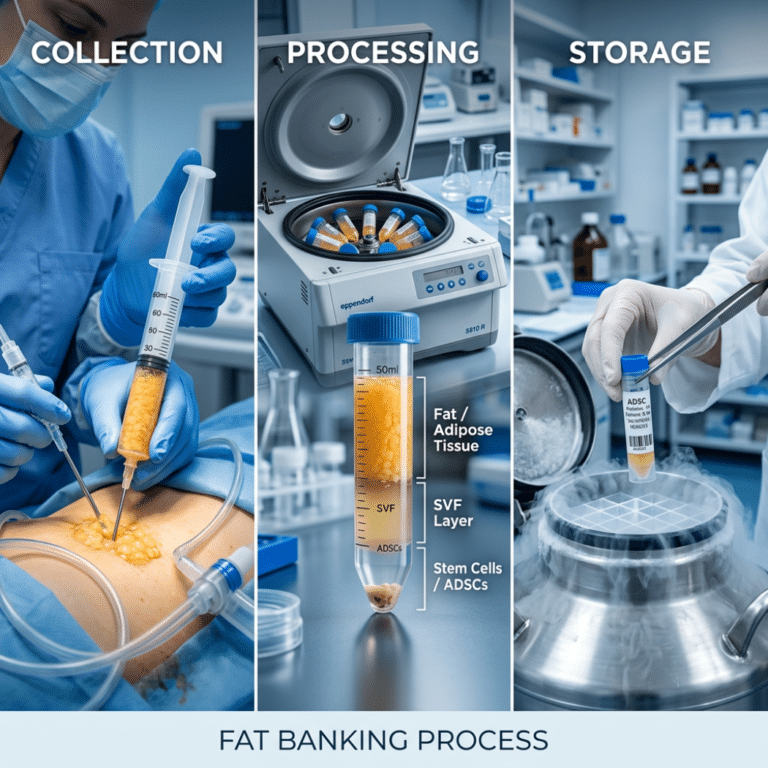
Save My Fat helps individuals preserve their own adipose tissue through validated cryopreservation protocols for potential future opportunities that may arise as regenerative medicine science and FDA regulations evolve. Banked tissue does not guarantee eligibility, access, or clinical benefit from any future therapy, clinical trial, or medical program. Any future use depends on the regulatory status of products or procedures at that time, the patient’s clinical situation, physician guidance, and availability of FDA-regulated pathways.
If you are researching expanded access pathways that currently exist for investigational therapies, see the article on expanded access programs and how patients can legally access investigational therapies. For information on how to find trials that are currently enrolling, see how to find legitimate clinical trials in 2026.
Most regenerative medicine products marketed directly to consumers are not FDA-approved to diagnose, treat, cure, or prevent any disease. Save My Fat does not provide FDA-approved treatments or cures.
Red Flags When Reading Trial Phase Claims
Understanding what each phase does and does not establish also helps you identify when someone is using phase language misleadingly. Here are specific red flags to watch for.
“Phase 1 proved it is safe, so we offer it at our clinic.” Phase 1 establishes short-term tolerability in a small number of people. It does not prove long-term safety and is explicitly not a basis for offering a product commercially outside a registered trial.
“We have Phase 3 results.” If this claim is made without a ClinicalTrials.gov registration number, a peer-reviewed publication, and a named institutional sponsor, it is not verifiable. Anyone can claim Phase 3 results. The question is whether those results exist in the public scientific record.
“FDA approved this after Phase 2.” The FDA does not approve therapies based on Phase 2 data alone under standard pathways. Accelerated approval or Breakthrough Therapy designations can expedite review, but they do not eliminate Phase 3 requirements for most biological products. A clinic claiming FDA approval from Phase 2 data should be treated with significant skepticism.
“Our treatment is registered on ClinicalTrials.gov.” Registration on ClinicalTrials.gov is not the same as FDA approval, endorsement, or proof of effectiveness. ClinicalTrials.gov is a registry, not a seal of quality. The FDA is clear that listing on the registry does not mean the FDA has reviewed or approved the study. See the FDA patient guidance on clinical trials for more on this distinction.
For a comprehensive checklist to evaluate whether a trial is legitimate before you consider participating, see the guide to finding legitimate clinical trials in 2026.
Frequently Asked Questions
What is a Phase 1 clinical trial and does it mean the treatment is safe?
A Phase 1 trial is the first stage of human testing for a new therapy. Its primary purpose is to determine whether a treatment is safe enough at a given dose to continue studying, not to prove that it works. Passing Phase 1 means researchers have observed acceptable short-term tolerability in a small group. It does not establish long-term safety, rule out rare side effects, or provide any basis for offering a product outside a research setting. A therapy that has completed Phase 1 has cleared one early hurdle in a very long process.
What is the difference between Phase 2 and Phase 3?
Phase 2 looks for early signals that a treatment might work in a moderately sized group, while continuing to gather safety data. Phase 3 confirms effectiveness in a large, randomized, typically blinded trial and is required before the FDA will consider approving a biological therapy. Phase 3 is significantly larger, more rigorous, more expensive, and more definitive than Phase 2. Many therapies that show promise in Phase 2 do not successfully complete Phase 3 trials.
What does Phase 4 mean and when does it happen?
Phase 4 refers to post-market surveillance studies that occur only after the FDA has approved a product. These studies track long-term safety and effectiveness in real-world populations far larger than any clinical trial. For ADSC therapies, Phase 4 does not yet apply in the United States because no ADSC product has received FDA approval.
Why do most stem cell and adipose-derived cell trials seem to be in Phase 1 or Phase 2?
Because the field is relatively young. Adipose-derived stem cell research has only gained momentum over the past two decades, and moving from preclinical work through Phase 1 and into Phase 2 takes years even under optimal conditions. The concentration of trials in these early phases reflects a field that is actively building its evidence base, not one that has stalled. To explore the conditions being actively studied, see the stem cell research areas overview.
What does it mean if a trial I am interested in is still in Phase 1?
It means the trial is in its earliest human stage, primarily focused on safety and dose-finding. There is no effectiveness data yet. Participating in a Phase 1 trial means contributing to the foundational safety record of a therapy, which is genuinely valuable, but it does not mean you will receive a treatment that has been proven to help your condition. Discuss Phase 1 participation carefully with your own physician before making any decisions.
Does a trial being listed on ClinicalTrials.gov mean it works?
No. ClinicalTrials.gov is a federally maintained registry where sponsors are required to register human studies, but listing does not mean the FDA has reviewed, endorsed, or approved the study or the product being tested. Registration is a transparency requirement, not a quality certification. The FDA patient guidance on clinical trials explains this distinction clearly.
Can I join a clinical trial if I have banked my adipose tissue?
Banking adipose tissue does not automatically qualify you for any clinical trial. Each trial has specific eligibility criteria set by the investigators, including age, diagnosis, health status, prior treatments, and often specific requirements about how tissue was collected and processed. Some future trials may be designed to use banked tissue as starting material, but this would require that the trial sponsor specifically designed the protocol around banked material. Your eligibility for any trial would be evaluated by the trial investigators, not by Save My Fat. For more detail on expanded access opportunities that exist outside of traditional trials, see the expanded access programs guide. The Reagan-Udall Expanded Access Navigator is also a useful resource.
How long does it take to go from Phase 1 to FDA approval?
The path from Phase 1 to FDA approval typically takes 10 to 15 years or longer when you account for all phases of development, the BLA review process, and the time required to manufacture at commercial scale. Not all therapies make it. Historical data from the FDA suggests that only about 10 to 15 percent of drugs and biologics that enter Phase 1 ultimately receive FDA approval. The timeline varies considerably by therapy type, indication, and regulatory designation. The NCI resource on how clinical trials work provides a helpful overview of general timelines.
What is a placebo and why do some trials use one?
A placebo is an inactive treatment given to one group in a clinical trial while the other group receives the actual therapy being studied. Placebos are used to measure the true effect of a treatment separately from the placebo effect, the well-documented phenomenon in which people feel better simply because they believe they are receiving a treatment. Blinded, placebo-controlled trials (where neither participants nor researchers know who received which) produce the strongest evidence. Some early-phase trials do not use placebos, but Phase 3 trials for most biologics are designed to include placebo or active comparator arms.
What should I ask a doctor before joining any trial?
Ask whether the trial is registered on ClinicalTrials.gov and what the NCT number is. Ask whether the trial has IRB (Institutional Review Board) oversight and whether it is being conducted under an IND. Ask whether you will be charged for the investigational product. Ask about the phase of the trial, its primary endpoint, and how long participation would last. Ask whether participating would affect your ability to receive other treatments. Ask your own physician whether the trial’s eligibility criteria match your current health status and whether participation makes sense in the context of your overall care. The FDA expanded access information page is also a valuable resource if you are considering pathways outside of traditional enrollment.
Key Takeaways
- Phase 1 is about safety, not effectiveness. A therapy that has completed Phase 1 has established short-term tolerability in a small group. It has not proven that it works and has not received any form of FDA endorsement.
- Phase 2 looks for early signals. These trials are larger and more controlled than Phase 1, but a positive Phase 2 result means that more study is warranted, not that the therapy is proven.
- Phase 3 is the definitive test. Large, randomized, blinded trials are required before a sponsor can submit a Biologics License Application. Passing Phase 3 is necessary for FDA approval under standard pathways but does not guarantee it.
- Phase 4 happens after approval. No ADSC therapy has reached this stage in the United States as of early 2026.
- Most ADSC research is Phase 1 or Phase 2. This reflects an actively developing field, not a proven one. Claims of proven effectiveness are not supported by the current clinical evidence base.
- ClinicalTrials.gov registration is not FDA approval. Registration is a transparency requirement. It provides important information about a study but does not signal that the FDA has endorsed the research or the product.
- Phase claims are frequently misused. Clinics that cite “Phase 1 safety” or unverifiable “Phase 3 results” to sell procedures outside registered trials are misrepresenting what the science supports.
- Banking and clinical trials are separate. Preserving adipose tissue keeps options open for a future that includes FDA-regulated pathways. It does not enroll you in any trial or guarantee access to any therapy.
Learn More About Adipose Tissue Banking
If you have been researching clinical trials for regenerative medicine, you already understand that the path from early research to an approved therapy is long and that the science is still building its evidence base. What tissue banking offers is a way to preserve your biological material at its current state so that you are not starting from zero if and when legitimate regulated pathways become available.
Save My Fat helps individuals preserve their own adipose tissue through validated cryopreservation protocols for potential future opportunities that may arise as regenerative medicine science and FDA regulations evolve.
What Save My Fat offers:
- Adipose tissue collection coordinated with qualified providers
- Validated cryopreservation and long-term storage protocols
- Educational resources about the regenerative medicine landscape
- Guidance on how to evaluate research claims and find legitimate trials
- Potential eligibility preservation for future FDA-regulated pathways
To learn more about the tissue banking process itself, visit savemyfat.com. For information tailored to patients, see the patients section. If you are a provider interested in offering tissue banking to your patients, visit the providers section.
Banking adipose tissue today does not guarantee eligibility, access, or clinical benefit from any future therapy, clinical trial, or medical program. Save My Fat does not provide FDA-approved treatments or cures for any disease or medical condition.
This article is for educational purposes only and does not constitute medical advice. Please consult your licensed healthcare provider regarding any medical decisions.
Last Updated: April 1, 2026