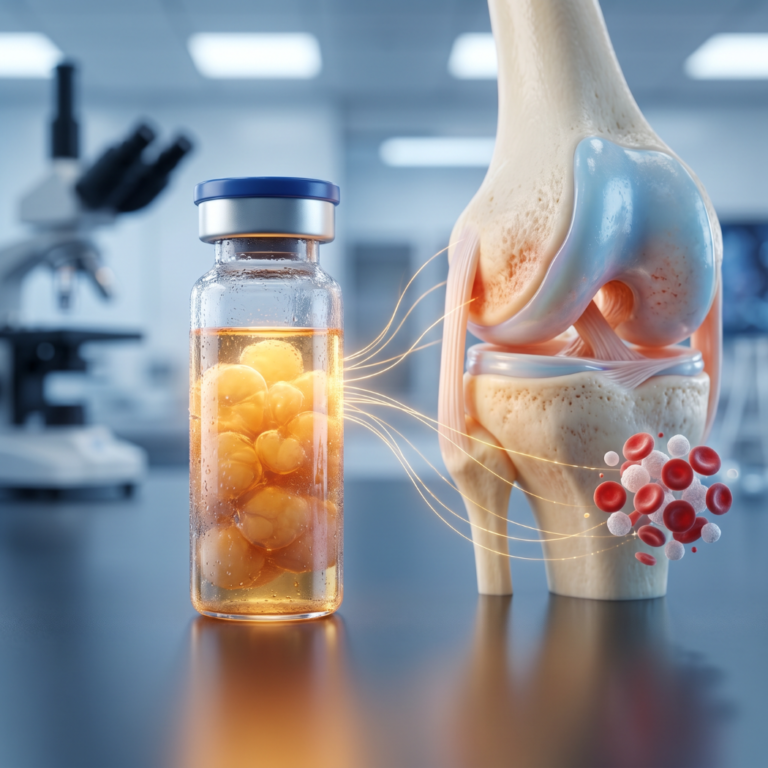
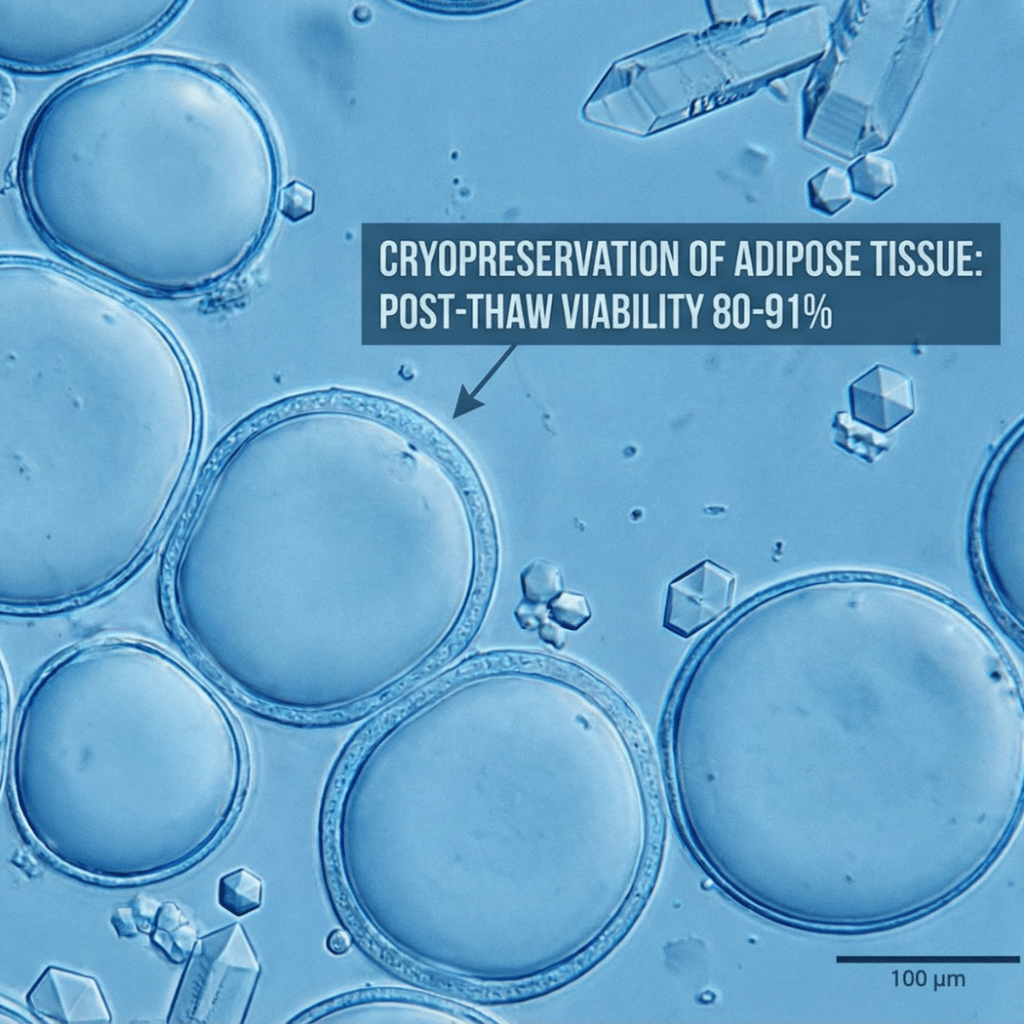
If you have been researching adipose tissue banking, you have probably come across viability percentages like “80–91% post-thaw survival” and wondered what those numbers actually mean for you. Those figures come from peer-reviewed studies measuring how many adipose-derived stem cells (ADSCs) survive the cryopreservation process, and they represent some of the most encouraging data in tissue preservation science. But what do they really tell you about the future usefulness of your banked tissue?
This guide breaks down the science of cryopreservation, explains why it is fundamentally different from simply freezing fat, walks through the published viability data, and clarifies what high post-thaw survival does (and does not) guarantee. By the end, you will understand the biological basis for adipose tissue banking and be better equipped to evaluate whether tissue preservation aligns with your health planning goals.
TLDR: Validated cryopreservation protocols consistently achieve 80–91% post-thaw cell viability in published studies, with decade-long storage data showing preserved cell properties. However, cryopreservation is a preservation service, not a treatment, and high viability does not guarantee eligibility for or benefit from any future therapy or clinical trial. Read on to understand what those numbers mean and why the distinction matters.
Important Disclaimer: Save My Fat does not provide FDA-approved treatments or cures for any disease. Banking adipose tissue today does not guarantee eligibility, access, or clinical benefit from any future therapy, clinical trial, or medical program. All content is for educational purposes only and does not constitute medical advice. Patients must consult their own licensed healthcare professionals regarding all medical decisions.
Why Freezing Tissue Is Hard on Cells
When biological tissue is frozen without protection, the results are destructive. The core problem is water. Human cells contain a large percentage of water, and when that water freezes, it forms ice crystals that expand, physically puncturing cell membranes and disrupting internal structures. This is the same process that makes frozen produce mushy after thawing: ice crystals rupture cell walls, and what you get back is structurally compromised.
Uncontrolled freezing also causes osmotic stress. As ice forms outside the cell, the remaining liquid becomes increasingly concentrated with salts and other solutes, pulling water out of the cell and causing it to shrink and deform. If freezing happens too quickly, intracellular ice forms before water can leave. If it happens too slowly without protection, prolonged solute exposure damages proteins and membranes.
The result is widespread cell death. For adipose tissue, which contains not only fat cells but also valuable supporting cell populations (including ADSCs, immune cells, and vascular cells), unprotected freezing effectively destroys the biological value of the tissue.
| Factor | Unprotected Freezing | True Cryopreservation |
|---|---|---|
| Ice crystal formation | Large, damaging crystals form inside and outside cells | Cryoprotectants limit crystal size and formation |
| Cell membrane integrity | Frequently ruptured by ice expansion and osmotic stress | Largely preserved through controlled dehydration |
| Post-thaw viability | Very low (most cells destroyed) | Approximately 80–91% in validated ADSC protocols |
| Practical utility | Tissue is biologically compromised | Cells retain phenotype, proliferation, and differentiation capacity |
This is why the term “cryopreservation” exists as a distinct concept from “freezing.” The difference is not marketing language. It is a fundamentally different process with fundamentally different outcomes.
What Cryopreservation Actually Does
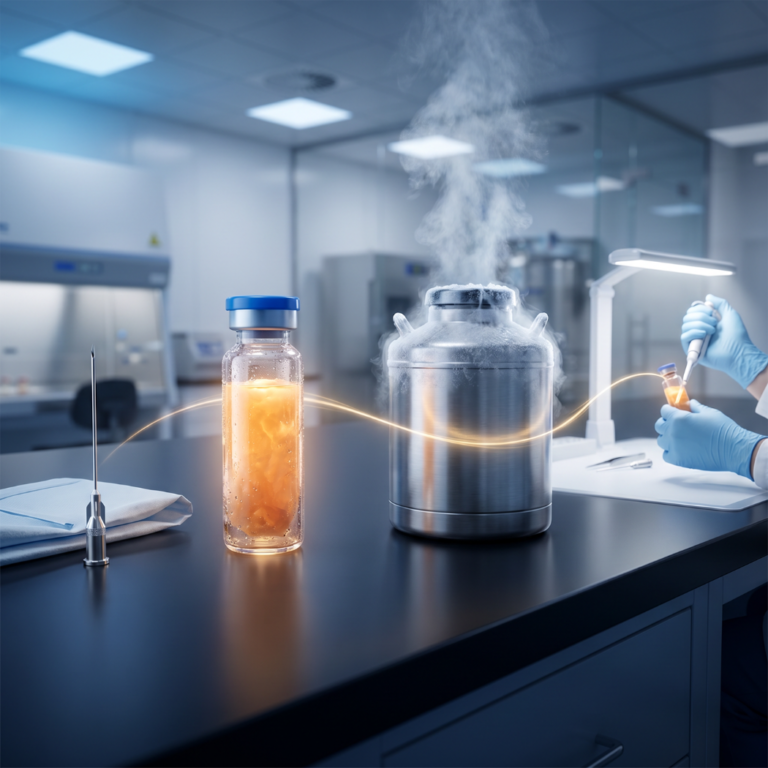
Cryopreservation is a controlled, multi-step process designed to bring living tissue to ultra-low temperatures while keeping cells structurally and functionally intact. Three elements work together to make this possible: cryoprotective agents, controlled-rate cooling, and appropriate long-term storage conditions.
Cryoprotective Agents
The most widely used cryoprotectant in adipose tissue and ADSC banking is dimethyl sulfoxide, commonly known as DMSO. DMSO is a small molecule that penetrates cell membranes and partially replaces intracellular water, lowering the freezing point inside the cell and reducing ice formation during cooling. The standard concentration is typically 10% DMSO, though some protocols use 5% DMSO combined with human serum albumin for additional protection.
DMSO is not without limitations. At higher concentrations or with prolonged exposure at room temperature, it can be toxic to cells. This is why DMSO is added gradually at cold temperatures (around 4°C), and why any future clinical use of cryopreserved cells would involve washing steps to remove the DMSO before application.
Researchers are also studying emerging alternatives, including trehalose (a natural sugar found in organisms that survive extreme dehydration) and combinations of L-proline with trehalose. These show promise in early studies, though DMSO-based protocols remain the standard with the most extensive published viability data.
Controlled-Rate Cooling
The second critical element is the rate at which tissue is cooled. The optimal cooling rate for ADSCs and adipose tissue is approximately 1–2°C per minute. This rate is slow enough to allow water to leave the cell gradually through osmosis (reducing intracellular ice formation) but fast enough to limit the time cells spend exposed to the damaging concentrated solute environment outside the cell.
Achieving this precise cooling rate requires specialized equipment, either a controlled-rate freezer with programmable temperature profiles or validated isopropanol-based cooling chambers that approximate the correct rate. The tissue is cooled to approximately negative 80°C as an intermediate step before transfer to long-term storage.
Long-Term Storage
Once tissue reaches negative 80°C, it is transferred to liquid nitrogen storage (negative 196°C) or vapor-phase nitrogen storage (approximately negative 150°C). At these temperatures, all biological activity, including enzymatic reactions, molecular movement, and cellular metabolism, is effectively halted.
Think of it this way: a cell at liquid nitrogen temperatures is in complete biological suspension. No energy is consumed, no waste accumulates, no aging processes continue. The chemistry of life simply stops. When the cell is properly thawed, those processes resume. This is what makes long-term storage at nitrogen temperatures fundamentally different from storage in a standard ultra-low freezer at negative 80°C.
What the 80–91% Viability Numbers Mean
The 80–91% post-thaw viability range reported in published research represents the percentage of ADSCs that survived the cryopreservation and thawing process with their basic biological functions intact. These numbers come from multiple independent studies using validated DMSO-based protocols and standard viability assays such as trypan blue exclusion and flow cytometry.
Here is a simplified summary of key findings from published research:
| Study | Storage Duration | Storage Conditions | Cryoprotectant | Approximate Post-Thaw Viability |
|---|---|---|---|---|
| Study A | 1–2 years | Liquid nitrogen / vapor phase | 10% DMSO | ~80–91% |
| Study B | 5+ years | Liquid nitrogen | 10% DMSO | ~85–90%, preserved phenotype |
| Study C | 8+ years (whole tissue) | Ultra-low / nitrogen | Whole tissue banking | ADSCs successfully isolated, stemness markers maintained |
| Study D | ~10 years | Liquid nitrogen | DMSO-based protocol | No significant difference from fresh ADSC controls |
These numbers tell us several important things.
First, the majority of cells survive the freeze-thaw cycle. An 80–91% viability rate means that for every 100 cells that go into storage, roughly 80 to 91 are alive and functional when thawed. The 10–20% loss is consistent across well-run laboratories and reflects the inherent biological stress of the cryopreservation process.
Second, surviving cells retain their key biological properties. Published studies confirm that cryopreserved ADSCs maintain their characteristic surface markers (such as CD29 and CD90 expression, with appropriate absence of CD45), their ability to proliferate in culture, and their capacity to differentiate into multiple cell types. In decade-long storage studies, frozen ADSCs were not significantly different from freshly harvested controls on these measures.
Third, these are laboratory measurements, not clinical guarantees. Viability testing confirms that cells survived and retained basic biological function in controlled conditions. Different laboratories using slightly different protocols will produce slightly different numbers within this general range. That variability is normal and expected.
What viability testing does not tell you is whether those cells will produce a specific therapeutic result in a specific patient. That determination depends on factors far beyond the storage process, including the regulatory status of future therapies, the design of clinical protocols, individual patient eligibility, and evolving scientific evidence.
Long-Term Storage and How Long Cells Can Last
One of the most common questions about adipose tissue banking is how long the tissue can remain in storage. At liquid nitrogen temperatures (negative 196°C) or vapor-phase nitrogen (negative 150°C), molecular movement is reduced to a near standstill. The thermodynamic conditions that drive biological degradation simply do not occur at these temperatures. There is no known expiration point for properly stored biological material at liquid nitrogen temperatures.
The practical data extends to roughly a decade of documented storage. Published studies have demonstrated that ADSCs stored for 8 to 10 or more years retain viability, phenotype, and differentiation capacity with no statistically significant decline compared to freshly isolated cells. As the field of regenerative medicine continues to mature, those documented time points will extend.
Why Negative 80°C Is Not Enough for Long-Term Banking
Standard ultra-low freezers maintain temperatures around negative 80°C. While this is cold enough to slow biological activity dramatically, it is not cold enough to halt it completely. At negative 80°C, residual molecular movement continues at a very slow rate, and over months to years, this can lead to gradual degradation of cellular structures and viability.
Published evidence shows that short-term storage at negative 80°C (days to weeks) is acceptable as a transitional step, but long-term banking relies on liquid nitrogen or vapor-phase nitrogen to maintain cellular integrity over years and decades.
Quality tissue banks address this through continuous temperature monitoring, alarmed storage systems that alert technicians to any temperature fluctuations, and redundant backup systems. These safeguards are part of the infrastructure required to comply with current good tissue practice (CGTP) standards under FDA regulations (21 CFR Part 1271).
Age, Adipose Tissue, and Viability
A common concern among people considering tissue banking is whether their age affects the quality of what can be preserved. Published research has successfully isolated viable ADSCs from cryopreserved tissue across donor ages ranging from 8 to 82 years. Patient age did not prevent successful cryopreservation, and stemness markers were maintained throughout storage regardless of donor age at the time of collection.
However, biological aging of the tissue itself does matter. Like all cells in the body, ADSCs are subject to age-related changes over time. Older tissue may show shifts in proliferative capacity and gene expression compared to younger tissue. This is the biological rationale behind banking adipose tissue earlier rather than later: tissue collected at a younger biological age preserves younger cells, and cryopreservation locks those cells at that biological age for the duration of storage.
This rationale is grounded in published data about age-related cellular changes. It is not a promise that younger banked cells will perform better in any specific future clinical application, because that depends on many additional factors beyond the storage process.
Viability Is Not the Same as Treatment
This distinction is critical. High post-thaw viability is a necessary condition for any potential future clinical use of banked tissue, but it is not a sufficient condition. Viability tells you that cells survived and retained their basic biological properties. It does not tell you that those cells will treat a disease, qualify for a clinical trial, or produce a specific health outcome.
Laboratory measures like viability, phenotype confirmation, proliferation assays, and differentiation testing measure what cells can do under controlled conditions. These tests confirm that the cells are biologically functional and express the expected markers of adipose-derived mesenchymal stromal cells.
Real-world clinical outcomes depend on entirely different variables: whether an FDA-regulated product or protocol exists that can use those cells, the design of that protocol (including dosing, delivery method, and target condition), individual patient factors such as health status and eligibility criteria, and evolving scientific evidence.
As of March 2026, no adipose-derived product is FDA-approved to treat any disease in the United States. The only FDA-approved stem cell products are cord blood-derived hematopoietic progenitor cells used for certain blood disorders. Any future use of banked adipose tissue would need to occur through appropriate FDA-regulated pathways, including clinical trials under an Investigational New Drug (IND) application, Expanded Access programs, or future approved therapies that complete the full regulatory approval process.
Save My Fat provides a preservation and banking service. It does not provide treatments, cures, or access to unapproved therapies.
How Adipose Tissue Banking Uses Cryopreservation
Understanding the tissue banking process helps clarify what cryopreservation looks like in practice. Here is a high-level overview of the steps involved.
Step 1: Tissue Collection. A small volume of adipose tissue (typically 100–200 mL) is collected through a mini-liposuction procedure. This is an outpatient procedure performed under local anesthesia, usually lasting 15–30 minutes with same-day discharge.
Step 2: Processing and Cryoprotectant Addition. The collected tissue is prepared for long-term storage. Cryoprotective agents (typically DMSO-based solutions) are added gradually at cold temperatures to protect cells during the freezing process.
Step 3: Controlled-Rate Freezing. The tissue is cooled at approximately 1–2°C per minute using validated equipment until it reaches approximately negative 80°C.
Step 4: Transfer to Long-Term Storage. The tissue is transferred to liquid nitrogen or vapor-phase nitrogen storage (negative 150°C to negative 196°C) for long-term preservation. Storage facilities maintain continuous temperature monitoring and alarmed backup systems.
An important clarification: Save My Fat preserves intact adipose tissue. This is different from clinics that market isolated cell products as immediate treatments for diseases. Intact tissue preservation maintains the full architecture and cell populations of adipose tissue in a minimally manipulated state, consistent with FDA regulatory frameworks for human cells, tissues, and cellular and tissue-based products (HCT/Ps).
Frequently Asked Questions
Does 80–91% viability mean my cells will definitely be usable in the future?
No. The 80–91% viability range describes how many cells survived the freeze-thaw process in laboratory testing. It confirms that the cells are alive and retain basic biological function. It does not guarantee that those cells will meet the specific requirements of any future therapy, clinical trial, or medical program. Usability depends on regulatory, clinical, and scientific factors that are separate from the storage process.
How long can my adipose tissue stay in storage?
At liquid nitrogen or vapor-phase nitrogen temperatures, there is no known biological expiration point. Published data confirms preserved viability and function after a decade of storage. Quality tissue banks maintain continuous monitoring and alarmed systems to ensure stable conditions.
Can my tissue be thawed in stages or partially?
Tissue is typically stored in multiple separate vials or containers. This means individual portions can be thawed as needed without disturbing the remaining stored tissue. You do not need to thaw everything at once.
Is DMSO safe, and is it removed before any future clinical use?
DMSO is the most widely studied and used cryoprotectant in cell banking. At the concentrations used in cryopreservation (typically 10%), it is effective and well-characterized. However, DMSO can be toxic to cells at higher concentrations or with prolonged exposure at warmer temperatures. Standard protocols for any future clinical application would include washing steps to remove DMSO before the cells are used.
Does my age affect cryopreservation success?
Published research has demonstrated successful ADSC isolation from cryopreserved tissue across donor ages ranging from 8 to 82 years. Your age does not prevent successful cryopreservation. However, cells collected at a younger biological age may carry different proliferative and functional properties than cells collected later in life, which is one rationale for banking sooner.
Is cryopreservation itself an FDA-approved treatment?
No. Cryopreservation is a preservation and storage process, not a treatment for any disease or condition. It is a validated laboratory technique used across many areas of medicine and research, including reproductive medicine, cord blood banking, and tissue banking. The FDA regulates tissue banking practices under 21 CFR Part 1271 but does not “approve” cryopreservation as a therapy.
What is the difference between adipose tissue banking and the stem cell treatments I see advertised?
Adipose tissue banking is a preservation service that stores your tissue for potential future use through legitimate, FDA-regulated pathways such as clinical trials, Expanded Access, or future approved therapies. Clinics marketing “stem cell treatments” for diseases are often offering unapproved products that have not been evaluated by the FDA for safety or effectiveness. Save My Fat does not provide treatments or endorse unapproved therapies.
What happens if the storage facility loses power or has a malfunction?
Reputable tissue banking facilities use redundant systems, including backup liquid nitrogen supplies, around-the-clock alarmed monitoring, and emergency response protocols. Liquid nitrogen storage systems maintain temperature passively (without electricity) as long as nitrogen supply is maintained, providing an inherent safety margin against power interruptions.
Can first-degree family members use my banked tissue?
Under certain guidelines and regulatory conditions, first-degree relatives may potentially be eligible to use tissue banked by a family member. However, eligibility depends on the specific regulatory pathway, the clinical protocol, and the requirements at the time of use. This is a potential benefit, not a guarantee.
How is tissue viability actually measured?
Common methods include trypan blue exclusion (a dye test where dead cells absorb the dye and living cells do not) and flow cytometry (a technology that analyzes individual cells for multiple markers simultaneously). Quality tissue banks require post-thaw viability of 85% or higher as part of their release criteria, along with sterility testing and phenotype confirmation.
Key Takeaways
Cryopreservation is a validated scientific process that is fundamentally different from unprotected freezing. It uses cryoprotective agents, controlled-rate cooling, and ultra-low temperature storage to preserve living cells with their biological properties intact.
Published peer-reviewed studies consistently report approximately 80–91% post-thaw viability for ADSCs and adipose tissue processed with standard DMSO-based protocols.
Long-term storage at liquid nitrogen or vapor-phase temperatures preserves cells for years, with decade-level data showing that frozen ADSCs maintain viability, phenotype, and differentiation capacity comparable to freshly isolated cells.
High post-thaw viability preserves biological options but does not guarantee access to, eligibility for, or benefit from any future therapy or clinical trial. Viability is a necessary condition, not a sufficient one.
No adipose-derived product is FDA-approved to treat any disease in the United States as of March 2026. Any future clinical use of banked tissue must occur through FDA-regulated pathways.
Adipose tissue banking is a preservation step within a regulatory landscape that continues to evolve. Banking tissue earlier preserves cells at a younger biological age, which is a reasonable strategy based on published data, though not a promise of superior future outcomes.
Ready to Learn More About Adipose Tissue Banking?
The science supports the conclusion that validated protocols can preserve adipose tissue with high cell survival for years to decades. But the honest message is that preservation is the beginning of a process, not the end of one.
Save My Fat helps individuals preserve adipose tissue through validated cryopreservation protocols for potential future use in FDA-regulated pathways. We focus on education, transparent communication, and positioning patients to have options if and when legitimate clinical opportunities become available.
Ready to learn more?
Explore how the process works.
All medical decisions should be made in consultation with your own licensed healthcare professionals.
Save My Fat Adipose Tissue Banking for Future Regenerative Medicine Opportunities
Last updated March 10, 2026
Related guide: the stem cell science glossary.